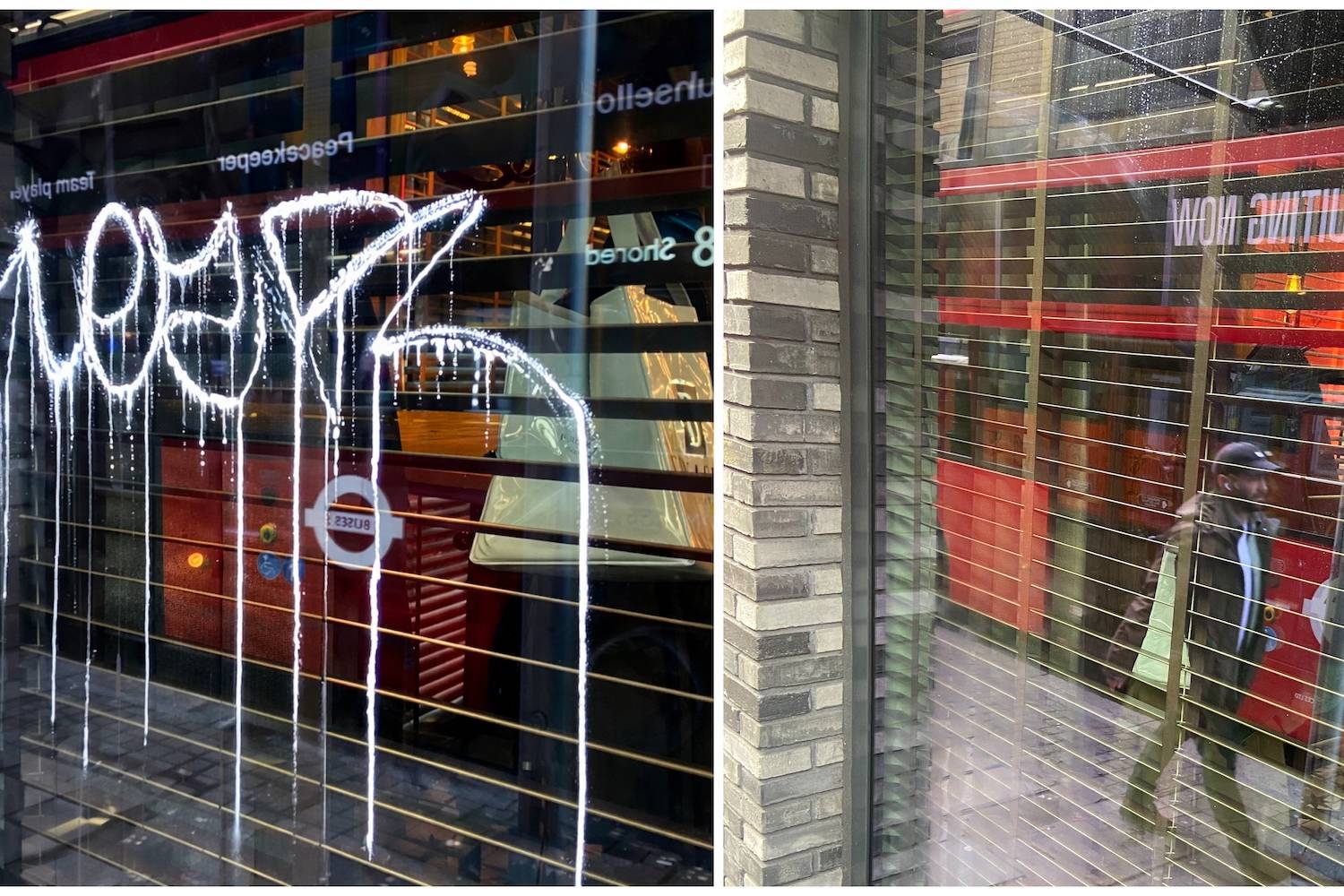
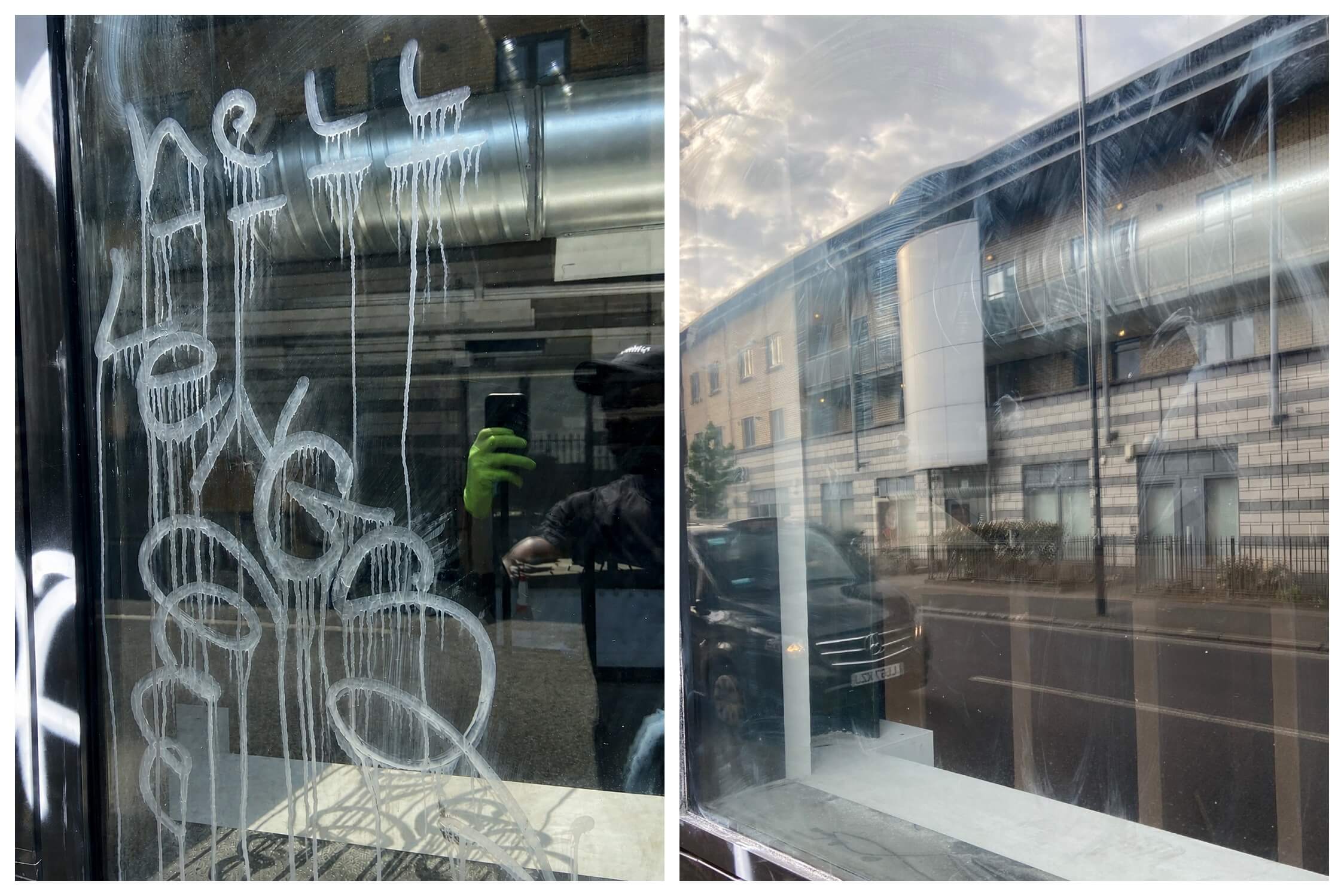
At 6.47am on a Tuesday, the manager of a flagship Bond Street boutique unlocks her shutters and finds a milky, frost-white tag burned into the centre of the front display window. There is no spray paint to wipe off, no marker pen to scrub away, the glass itself has been etched, its surface chemically dissolved where the vandal's acid paste touched it. Replacement quotes will start at £4,200 once specialist scaffolding, labour and a bespoke laminated pane are accounted for. The shopfront will be boarded for the better part of a fortnight. Footfall, dwell time and the brand's own image take the rest of the hit.
Table of Contents
- What Acid-Etched Vandalism Actually Is, And Why You Cannot Wash It Off
- The True Cost: Replacing Vandalised Glass vs. Installing Sacrificial Film
- How DUA London's Anti-Graffiti Film Works
- London Industries We Protect
- High Street Retail and Hospitality
- Corporate and Commercial Real Estate
- Public Transport and Local Government
- The DUA London Installation Process
- Vandalism Trends, and What to Do If You Have Already Been Hit
- Why London Facility Managers Choose DUA London
- Stop Paying for Vandals' Damage. Protect Your London Glass Today.
- Frequently Asked Questions
Do you need acid etched graffiti removed from your property? Get a fast, hassle-free quote today! Click here to get a professional graffiti removal quote or call us today on: 020 8050 5997
DUA London's Anti-Acid Etched Graffiti Protection service is engineered to make that scenario impossible. We install optically clear, sacrificial anti-graffiti window film across commercial storefronts, corporate façades, hospitality venues and public transport glass throughout Greater London. When acid pastes, etching creams or glass-scratching tools meet a protected pane, the film takes the damage. We strip and replace the film in hours, at a fraction of the cost of a new glazing unit, and with no boarded windows or lost trading days. All day. Every day. Within three hours.
What Acid-Etched Vandalism Actually Is, And Why You Cannot Wash It Off
Acid-etched graffiti is a fundamentally different category of vandalism from spray paint, marker pen or sticker tags. Hydrofluoric acid pastes, sometimes repurposed from industrial stone-frosting products, react chemically with the silica in soda-lime float glass, dissolving microscopic layers of the substrate and leaving behind a milky, semi-transparent frosted patch. The effect is permanent. No solvent, cleaner or commercial degreaser will reverse it, because there is no foreign material left on the surface to extract. The damage is the absence of glass.
If you have arrived at your premises to find a frost-white tag you cannot remove, our breakdown of the visual symptoms of acid-etching vandalism will help confirm what you are dealing with. A close cousin of acid etching is mechanical scratching, perpetrators using spark plug ceramic, key tips, tungsten scribers or carbide-tipped tools to gouge tags directly into the glass. Visually the two damage types can be hard to distinguish from a distance, and our guide to telling glass scratching apart from acid etching sets out the field-level diagnostic cues.
The harsh truth most facility managers discover too late is that traditional graffiti remediation cannot help in this scenario. We ourselves are restoration specialists who routinely extract pigment via chemical neutralisation and low-pressure steam, but acid etching is not pigment. It is substrate damage. As we explain in the practical reality of cleaning acid-etched glass, once etching has occurred the realistic options narrow to professional glass polishing (slow, partial, and depth-dependent) or full pane replacement.
The True Cost: Replacing Vandalised Glass vs. Installing Sacrificial Film
Replacing a single large commercial glazing unit in central London is rarely a straightforward line item. A bespoke 3m × 2m laminated or toughened pane will typically cost £1,500 to £3,500 in materials alone, depending on specification. Add specialist installation labour, often two technicians working with suction lifters, and the figure rises sharply. For first-floor and above units, scaffolding or a mechanical access platform pushes the cost higher again, and pavement licences or short-term road closure permits in boroughs such as Westminster or the City of London are themselves a meaningful expense.
The most painful line on the invoice is rarely on the invoice. It is the downtime, the boarded shopfront, the empty display window, the diverted trading. For a Bond Street, Knightsbridge or Covent Garden flagship, two weeks of plywood frontage during a replacement lead time has measurable consequences for footfall, brand perception and conversion. Bespoke commercial panes are not held in stock; fabrication frequently runs 7–14 working days. Our detailed comparison of the true cost of glass replacement against proactive window protection walks through every line item.
By contrast, installing optically clear sacrificial film is a single-visit, low-disruption job. If the protected pane is later targeted, our team returns within three hours, peels away the damaged layer, and applies a new one. Total cost of ownership over the asset's life cycle is a small fraction of even a single full pane replacement, and unpredictable capex shocks become predictable, planned opex.
How DUA London's Anti-Graffiti Film Works
Anti-graffiti film is a thin, tough, optically clear polyester laminate, applied to the inside or outside face of the glass with a precision-formulated adhesive. Once installed, it bonds tightly to the substrate and forms a transparent sacrificial layer between the world and your glass. When a vandal applies acid paste, hydrofluoric or otherwise, the chemistry attacks the film, not the glass beneath. When a vandal scratches with a key or scriber, the gouges sit in the film, not the substrate. Our deeper technical explainer of how anti-graffiti window film actually works covers the layer chemistry and adhesion specification in full.
The single most common objection from retail and hospitality decision-makers is aesthetic: will the film be visible, will it dull the display, will it affect natural light? On modern premium-grade hard-coat films, the answer is essentially no. Optical clarity is engineered to be invisible to the unaided eye, and light transmission losses typically sit in the low single digits. We address this concern at length in our piece on whether anti-graffiti film blurs shop windows.
Durability matters as much as clarity. London conditions, UV exposure, particulate pollution, freeze-thaw cycles, repeated cleaning regimes, all stress film over time. High-quality hard-coat films installed by trained technicians typically last several years before scheduled replacement, even in heavily trafficked retail environments. Our breakdown of how long anti-acid etched graffiti film actually lasts sets out the realistic film life cycle.
For a single comprehensive resource that walks through every protection-related question end to end, our ultimate guide to glass graffiti protection for businesses is the document our enterprise clients work through before commissioning a survey.
London Industries We Protect
Acid-etch vandalism is not evenly distributed across London. It clusters around night-time economy zones, transport interchange hubs, prominent retail corridors and high-prestige corporate frontages, exactly the assets least able to absorb either the financial cost or the reputational damage of a boarded shopfront. Our overview of window graffiti protection across London sets out the wider sector picture.
High Street Retail and Hospitality
Storefronts in Soho, Mayfair, Bond Street, Oxford Street, Covent Garden, Shoreditch and Knightsbridge see the highest concentration of foot traffic and, by extension, the widest population of opportunistic vandals. Premium retail brands and listed restaurants depend on the integrity of the front pane to do half the marketing work. Our piece on protecting high street retail displays from glass vandalism is written specifically for retail and hospitality decision-makers.
Corporate and Commercial Real Estate
Curtain wall systems, structural glazing and ground-floor commercial atria in Canary Wharf, the City of London, Paddington Square and King's Cross are high-value targets. Replacing IGUs at height is among the most expensive maintenance line items in the commercial property book. We work with facility managers and asset managers to specify protection on first-floor and accessible units, see our analysis of securing corporate office fronts and glass architecture.
Public Transport and Local Government
Bus shelters, Overground and rail station glazing, council-owned street furniture and signage cabinets are among the most consistently targeted glass surfaces in the capital. Replacement at fleet scale is uneconomic, and sacrificial film is now the standard mitigation across most procurement frameworks. Read our briefing on anti-graffiti glass protection for London public transport.
If your premises has already been targeted, our Rapid Response Team can be on site within three hours, request an instant quote here.
The DUA London Installation Process
Our installation process is engineered to fit around the operational realities of a working London business. We do not close your shop, we do not occupy your trading floor, and we do not leave half-finished panels.
Step 1, Site assessment. A senior technician attends your premises, surveys all relevant glazing, measures each pane individually, and confirms the specification, film grade and application surface (typically inside, sometimes outside depending on access and environment). Where existing damage is present, we discuss restoration options before film application.
Step 2, Precision installation. Trained technicians clean the substrate to clinical standard, apply the film using precision squeegee technique, and finish all edges to a tight, near-invisible bond. No curling, no air entrapment, no peel risk, no "lazy contractor" finish.
Step 3, Ongoing protection and rapid response. If a protected pane is later vandalised, our team is dispatched within three hours, all day, every day. The damaged film is stripped, the substrate inspected, and a fresh layer applied, usually within a single visit.
For commercial premises in Mayfair, Canary Wharf, the City of London or any London borough, call our team directly on 020 8050 5997 for a same-day assessment. Full process detail is set out in our walkthrough of DUA London's anti-acid etched graffiti protection installation process.
Vandalism Trends, and What to Do If You Have Already Been Hit
Acid-etch and deep-scratch attacks have become increasingly common across central London commercial corridors over recent years, with reported clusters in night-time economy areas and transport interchange zones. We track the picture in detail in our analysis of the rise of acid-etch vandalism across London.
If your premises has just been targeted and you have arrived to find acid etching for the first time, the instinct to attempt aggressive cleaning is understandable, and counterproductive. Solvents will not extract substrate damage, and may streak or distort surrounding finishes. Our step-by-step emergency guide for facility managers whose shop window has been vandalised sets out the correct sequence: documentation for police and insurance, neutralisation of any residual chemical, professional assessment, and forward protection.
Why London Facility Managers Choose DUA London
Three things, consistently:
- Speed. Three hours, all day, every day. Our dispatch model is built for the operational reality of London commercial premises, not for office-hours convenience. A vandalism event on a Saturday night can be on its way to remediation by Sunday morning.
- Specialism. Our technicians work exclusively in commercial surface restoration. We understand the chemistry of substrates and the physics of damage, and we recognise the difference between extracting pigment from heritage stone with low-pressure steam systems such as DOFF and TORC and protecting a glazing unit with sacrificial film. The two jobs require entirely different skill sets, and we do not use a one-size-fits-all approach.
- Eco-conscious method. Biodegradable agents where chemistry is required, low-impact application techniques, and a clean uplift and re-install cycle that produces minimal waste over the film's life.
We are fully insured, our technicians are certified, and our work programme covers every London borough, from premium retail corridors in the West End to corporate estates in Canary Wharf and council-managed signage and shelter glass across Stratford, Lewisham and beyond.
Stop Paying for Vandals' Damage. Protect Your London Glass Today.
Acid etching does not need to be your problem. It can be a film's problem instead. The economics are unambiguous: a planned, predictable installation cost replaces an unpredictable, escalating replacement cost, and your shopfront keeps trading. To request a no-obligation site survey for any commercial premises in Greater London, request an instant quote or call our Rapid Response Team directly on 020 8050 5997. We are dispatching jobs across London, all day, every day, within three hours.
Frequently Asked Questions
What exactly is acid-etched vandalism, and how does it damage commercial glass?
Acid-etched vandalism uses hydrofluoric acid pastes, etching creams or similar reactive chemistries to chemically dissolve the surface of soda-lime glass, leaving a permanent frosted, semi-transparent tag. The damage is to the substrate itself, not a coating on top of it, which is why it cannot be cleaned off with conventional chemicals.
How does sacrificial anti-graffiti film actually protect the glass beneath it?
The film acts as a transparent expendable layer bonded to the substrate. When acid or scratching tools meet the surface, the film absorbs the damage. The underlying glass is preserved, and our technicians simply replace the film at a fraction of the cost of a new pane.
Does the film stop both acid etching and key or scribe damage?
Yes. Premium-grade hard-coat films defend against both chemical attack (acid pastes and etching creams) and mechanical attack (keys, scribers, spark plug ceramic). The defence type differs but the outcome is the same, the substrate is preserved.
What is anti-graffiti film actually made of?
It is typically a multi-layer optically clear polyester laminate with a hard surface coating and a precision-engineered adhesive. Thickness, coating chemistry and adhesion specification vary by application and are confirmed at site assessment.
How does the cost of installation compare to replacing a vandalised commercial pane?
In most cases, the installed film cost across an entire shopfront is a fraction of replacing a single damaged pane. When the protected film is later targeted, replacement is again a fraction of the cost of a new glazing unit, with no fabrication lead time and no boarded shopfront.
Will the film distort my window display or affect natural light?
No. Premium-grade films are engineered for high optical clarity, with light transmission losses typically in the low single digits. Properly installed, the film is effectively invisible to customers and does not distort visual merchandising.
Will customers be able to tell the film has been installed?
In normal viewing conditions, no. The film is colourless, optically clear, and finished to the edges of each pane with a precision installation technique that leaves no visible margin or air entrapment.
Can the film be applied to tinted, frosted, branded or vinyl-graphic glass?
Yes, in most cases. The application surface and any existing graphics are reviewed at site assessment to confirm compatibility and to determine whether internal or external application is appropriate.
How long does installation typically take?
Installation time varies with the size and number of panes. A typical retail shopfront is completed within a single working day, often outside trading hours so the business is not interrupted.
Do I need to close my business during installation?
Almost never. We schedule around your trading hours where possible and complete installation with minimal disruption to staff and customers. For larger corporate buildings we frequently work overnight or at weekends.
Do you work outside business hours and at weekends?
Yes. Our service operates all day, every day, with rapid response within three hours across Greater London. Out-of-hours and weekend installation is part of our standard offer for retail and hospitality clients.
How long does the film typically last in London conditions?
Premium hard-coat films installed by trained technicians typically last several years before scheduled replacement, depending on UV exposure, cleaning regime and pollution load at the location.
What happens if a protected window is vandalised, how quickly can the film be replaced?
Our Rapid Response Team is dispatched within three hours, all day, every day. The damaged film is stripped, the substrate inspected, and a fresh layer applied, usually within a single visit, with no need for boarding or pane replacement.
Is anti-graffiti film protection an allowable business expense?
In most commercial cases yes, though the precise tax treatment depends on your circumstances. We recommend confirming with your accountant. Our clients typically expense it as part of routine asset protection or facilities maintenance.
How do I arrange a survey for my London premises?
You can request an instant quote through our online form, or call our Rapid Response Team on 020 8050 5997. We attend across all London boroughs and provide a no-obligation site assessment.
Toby Doherty
Toby Doherty is a seasoned graffiti removal expert with over 20 years of experience in the industry. Throughout his career, Toby has helped countless businesses and property owners in London maintain clean, graffiti-free spaces. His extensive knowledge of graffiti removal techniques, from eco-friendly solutions to advanced technologies like laser cleaning, makes him a trusted authority in the field. Passionate about restoring urban environments, Toby combines his hands-on expertise with a commitment to staying up-to-date on the latest industry trends and innovations. When he’s not out in the field, Toby shares his insights through detailed articles, offering practical advice on everything from graffiti prevention to legal considerations.