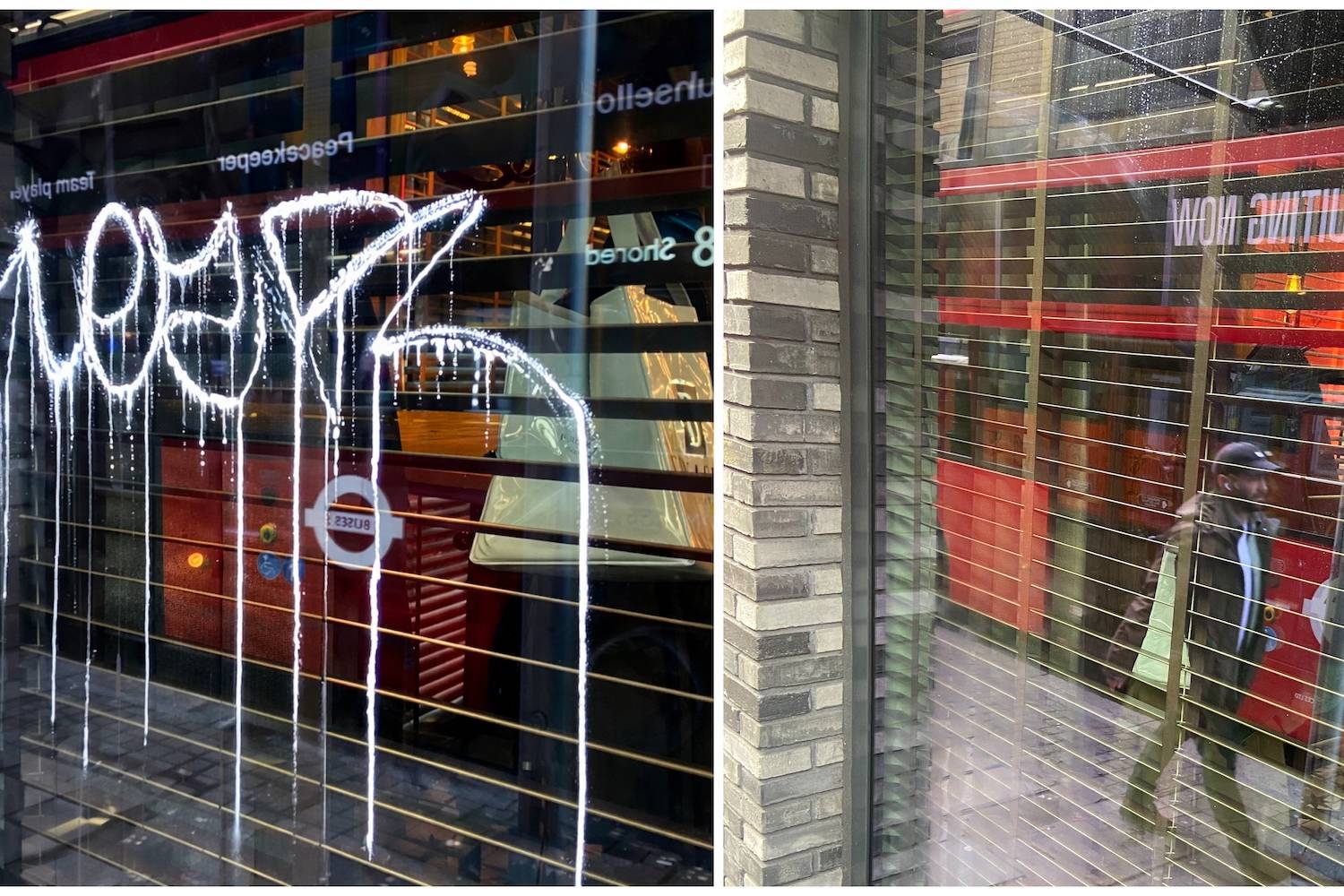
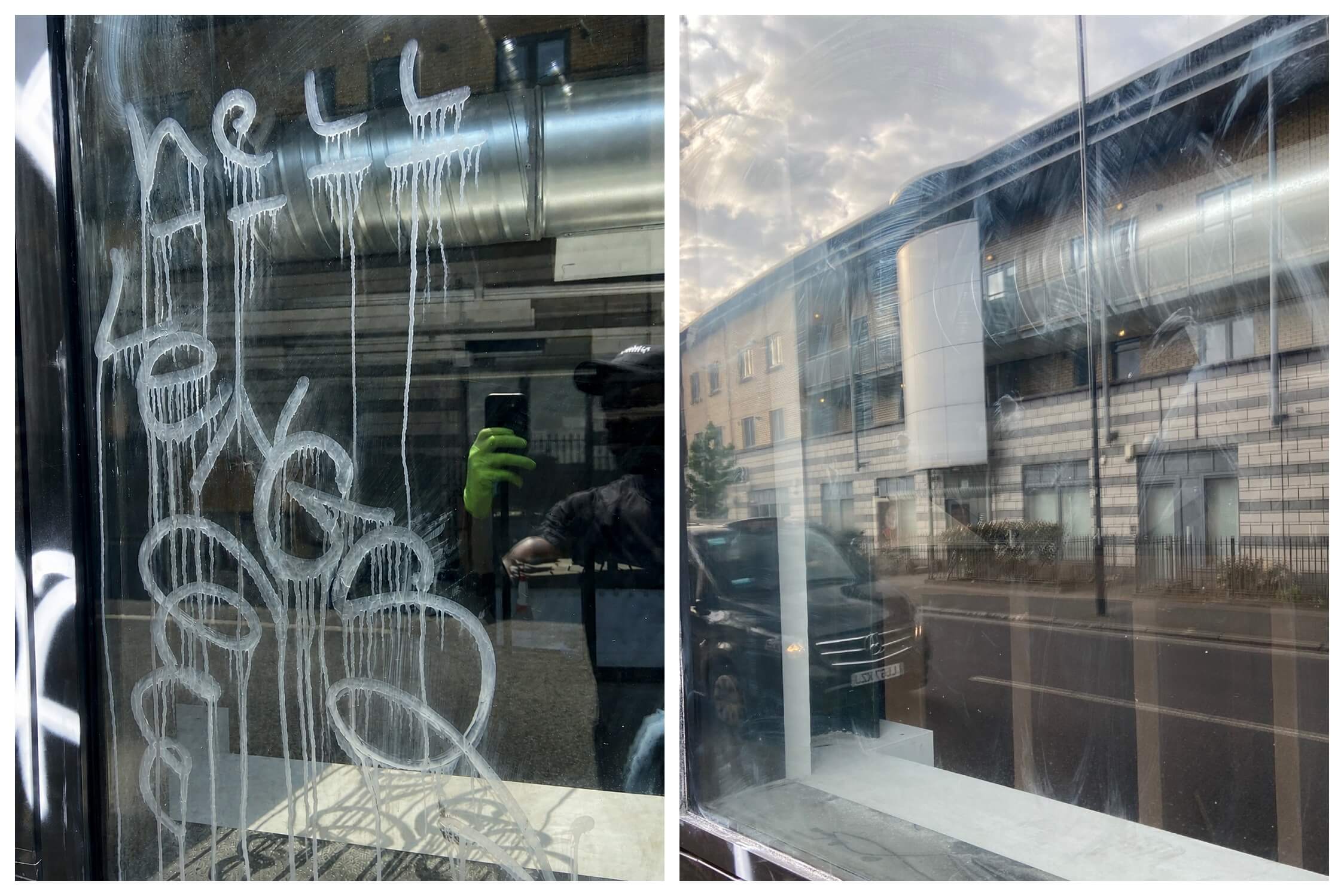
There is one question our team receives more often than any other from London facility managers in the hours after acid-etched vandalism is discovered. It is the same question, phrased a hundred different ways: can this actually be cleaned off, or is the glass finished? Behind that question sits a kitchen full of half-tested products, glass cleaner, white vinegar, isopropyl alcohol, acetone, branded "graffiti remover" sprays from Amazon, kitchen-grade scouring sponges, and the slowly dawning realisation that none of them have moved the damage by a single millimetre. So let us answer it directly, with no caveats and no marketing fog.
Table of Contents
- The Short Answer
- Why Conventional Cleaning Cannot Work, Ever
- Specialist Glass Polishing: The Sometimes Solution
- When Polishing Tends to Work
- When Polishing Will Not Work
- Full Pane Replacement: The Always-Available Solution
- The Decision Framework: Polish, Replace, or Accept-and-Protect
- Why Prevention Defeats Both Restoration Options
- What To Do Right Now If You Are Looking at Etched Glass
- The Honest Conclusion
- Frequently Asked Questions
Do you need acid etched graffiti removed from your property? Get a fast, hassle-free quote today! Click here to get a professional graffiti removal quote or call us today on: 020 8050 5997
This guide sets out exactly what does and does not work on acid-etched glass, what the realistic remediation pathways are, and why the long-term economics point overwhelmingly toward prevention rather than cure. For the wider context across all forms of glass-targeted vandalism, our pillar resource on anti-acid etched graffiti protection in London sets out the full landscape.
The Short Answer
No, acid-etched graffiti cannot be cleaned off glass in the conventional sense. No solvent, cleaner, abrasive pad or aftermarket product will remove it, because there is nothing on the surface to remove. The damage is microscopic erosion of the substrate itself. There are exactly two viable remediation routes, plus one preventative option, and only one of them costs less than four figures on a typical London commercial pane:
- Specialist glass polishing, sometimes effective for shallow, recent damage on suitable glass types.
- Full pane replacement, always available, always expensive, always disruptive.
- Sacrificial film prevention, eliminates the problem at the source for a fraction of either remediation cost over a five-year horizon.
The rest of this guide explains each option in detail, what determines which one applies to your specific pane, and how the maths works out across a typical London commercial property.
Why Conventional Cleaning Cannot Work, Ever
To understand why standard cleaning fails on acid etching, you only need to understand one principle: cleaners are designed to lift foreign material from a surface. Acid etching is not foreign material. It is missing material.
When a vandal applies hydrofluoric acid paste or an etching cream to commercial glass, the fluoride ions react with the silica in the substrate, dissolving microscopic layers of the glass itself. The acid is then rinsed or wiped away. What remains is a roughened, light-scattering surface where smooth glass used to be. There is no pigment to extract. There is no resin to soften. There is no coating to peel. The vandalism has not added something, it has removed something. We cover the chemistry in detail in our guide to identifying white frosty acid-etched graffiti.
This is why every commonly attempted product fails:
- Glass cleaner and white vinegar. Engineered to dissolve grease, mineral deposits and atmospheric film. They have no mechanism to restore eroded glass.
- Isopropyl alcohol and acetone. Effective on adhesive residue, marker pen and certain paint chemistries. Useless on substrate damage.
- Aftermarket graffiti removers. Designed to dissolve paint binders. They will not regrow glass.
- Scouring pads, abrasive sponges, steel wool. These add new damage on top of existing damage. They scratch the surrounding undamaged glass and leave a worse-looking pane than before.
- Toothpaste and household abrasives. A common online suggestion. The abrasive content is far too fine to address etching depth and produces no measurable result.
- Razor blades and scrapers. Useful for paint and stickers. They have no effect on etched glass and risk further surface damage.
If you have already attempted any of these methods, you have not damaged anything irreversibly, most cleaners simply have no interaction with etched glass at all. But you have also achieved nothing. It is time to move to a strategy that addresses the actual problem.
Specialist Glass Polishing: The Sometimes Solution
Specialist glass polishing is the only restoration method that can address acid etching directly, and it works by mechanically reducing the surrounding glass surface to match the depth of the etched area. The process uses cerium oxide compound, a specialist polishing tool, and considerable technician skill to produce an even, optically acceptable finish.
Polishing succeeds in some cases and fails in others. The variables that matter are depth of etching, area covered, glass specification, and time elapsed since the damage occurred.
When Polishing Tends to Work
- Shallow etching, typically caused by milder etching creams rather than concentrated hydrofluoric paste, with damage measured in microns.
- Small areas, single tags or limited zones rather than whole-pane coverage, so the polished area can be blended into the surrounding glass without distortion.
- Untreated, single-pane glass, annealed or float glass without coatings, films or laminations.
- Recent damage, addressed within days rather than months, before secondary contamination or environmental wear has built up around the damaged area.
When Polishing Will Not Work
- Deep etching, caused by extended dwell time of strong acid pastes, where the depth exceeds what can be matched by polishing the surrounding glass.
- Large areas, full-pane or majority-pane coverage, where polishing cannot produce a uniformly clear result without unacceptable distortion.
- Tempered (toughened) glass, polishing can introduce localised heating and stress that risks shattering the pane.
- Laminated glass, the interlayer constrains the polishing depth and complicates the process.
- Coated glass, solar control, low-emissivity, anti-reflective and other functional coatings are removed by polishing, requiring a different remediation conversation.
Polishing is technically demanding work and is best left to specialists. Online cerium oxide kits marketed for DIY use exist and will, in unskilled hands, produce a worse outcome than untouched etched glass, typically a hazy, distorted patch surrounded by visible polishing marks. We do not recommend the DIY route under any circumstance for commercial glass.
Full Pane Replacement: The Always-Available Solution
When polishing is not viable, replacement is the fallback. The pane is removed, a new pane fabricated to specification, and the new unit installed. The technical process is straightforward; the cost picture is not.
Replacing a single bespoke commercial glazing unit in central London routinely costs four figures before associated costs are added. Materials alone run from £1,500 to £3,500 for a typical 3m × 2m laminated or toughened pane, and the full delivered cost, including specialist labour, suction-lift access equipment, scaffolding for first-floor and above units, pavement licences, and trading downtime, frequently doubles that figure. For high-specification curtain walling, structural glazing or premium retail frontages, the total can exceed £8,000 per pane. Our companion piece on the true cost of glass replacement against proactive window protection walks through every line item.
Replacement also takes time. Bespoke commercial panes are not held in stock; fabrication frequently runs 7–14 working days. During that period the property typically requires either a boarded-up frontage or temporary frosted vinyl, neither of which projects the brand impression that any London retailer, hospitality venue or corporate frontage wishes to maintain.
The Decision Framework: Polish, Replace, or Accept-and-Protect
For any London facility manager standing in front of acid-etched glass, the decision tree is straightforward:
| Damage profile | Recommended pathway | Indicative cost order |
|---|---|---|
| Shallow, small area, recent, suitable glass | Specialist polishing, then film protection forward | Low–medium |
| Deep or large area, but suitable glass | Replacement, then film protection forward | High |
| Tempered, laminated or coated glass | Replacement (polishing not viable), then film protection forward | High |
| Damage is mild and not customer-facing | Accept the pane; install film to prevent further attack | Low |
| Premises has not yet been hit | Install film proactively before the first attack | Lowest |
In every column, sacrificial film appears as the forward step. This is not a sales line, it is a structural feature of the economics. Whether you have just been hit, are repairing past damage, or have never been targeted, installing film is the only step that prevents the next four-figure invoice. Our explainer of how anti-graffiti window film actually works covers the technical detail.
Why Prevention Defeats Both Restoration Options
The argument for prevention is not philosophical. It is arithmetic. A single replacement event on a single pane in central London routinely runs into four figures. A polishing event, where viable, is significantly cheaper but still represents real cost and real disruption. Sacrificial film installation, by contrast, is a single predictable cost amortised across several years of protection, and when the protected pane is later attacked, replacement of the damaged film is fast, low-cost, and uninterruptive to trading.
Across a typical five-year horizon for a central London commercial property in a higher-risk borough, the total-cost-of-ownership comparison is rarely close. Two unprotected pane replacements over five years exceeds the cost of comprehensive film protection across the entire shopfront, with replacements of the film as required. One unprotected replacement plus repeated remediation cycles often exceeds it as well. The economics improve further once trading downtime, brand impact and operational disruption are weighted properly.
What To Do Right Now If You Are Looking at Etched Glass
If you have arrived at this guide with a freshly etched pane on your premises, the right sequence is brief and clear:
Stop attempting to clean. No further cleaning method will produce a different outcome. The variables that matter, etching depth, glass type, area, are physical, and no chemistry will change them.
Document the damage. Photograph in good light with a fixed reference for scale. Note the time of discovery and any nearby CCTV.
Call for an assessment. Our Rapid Response Team is dispatched within three hours, all day, every day. Same-day assessment is the standard. We will tell you, on site, whether polishing is viable for your specific pane or whether replacement is required, and we will scope sacrificial film protection across the rest of your vulnerable glazing as a forward measure. Call 020 8050 5997 or request an instant quote through our online form.
The Honest Conclusion
Acid-etched graffiti cannot be cleaned off commercial glass. It can sometimes be polished out. It can always be replaced. Both options cost real money and produce real disruption. The only specification that defeats the underlying problem, that prevents the next attack from reaching the substrate at all, is sacrificial anti-graffiti film, professionally installed and rapidly replaced when damaged. For any commercial premises in Greater London, the conversation worth having is not which cleaner to try next. It is when to specify film protection and on which panes. Request a no-obligation site assessment, or call 020 8050 5997 to speak to our team directly.
Frequently Asked Questions
Will any commercial graffiti remover work on acid etching?
No. Commercial graffiti removers are formulated to dissolve paint binders, marker inks, and adhesive residues. None of those mechanisms apply to substrate erosion. The product will sit on the glass without effect, regardless of price point or branding.
What about acid etching cream sold as a "remover", does that work in reverse?
No. Etching creams are themselves the cause of the damage in many cases, not a solution to it. Applying more fluoride chemistry to already-etched glass deepens the damage. This is one of the more common misconceptions and one of the more expensive ones.
Is there a specialist solvent that the trade uses to remove acid etching?
No solvent in commercial use will remove substrate erosion, because there is no solvent that regrows glass. The trade uses mechanical polishing with cerium oxide compound where damage is shallow enough, and replacement where it is not.
How shallow does acid etching need to be for polishing to succeed?
Shallow enough that the surrounding glass can be polished down to match without producing visible distortion. There is no exact universal threshold, it depends on pane size, glass type and the optical tolerance acceptable for the specific application. A site assessment is the only reliable way to confirm.
Can I attempt cerium oxide polishing myself with an online kit?
Strongly inadvisable for commercial glass. Polishing requires controlled pressure, even motion, careful heat management and skilled blending into the surrounding glass. Unskilled application produces hazy, distorted patches that look worse than the original etching and frequently necessitate full replacement.
How long does professional polishing take?
Variable with damage severity and pane size. A small, shallow tag on a single pane can typically be addressed within a few hours on site. Larger or more complex damage may require longer. We confirm timing at site assessment.
Will polished glass look exactly the same as it did originally?
In well-executed cases on suitable glass, yes, the polished area is visually indistinguishable from the surrounding pane to a customer or passer-by. In more challenging cases, slight optical distortion may remain visible at certain angles. We will set realistic expectations based on the specific damage.
What does it cost to replace a typical commercial pane in central London?
Materials alone for a 3m by 2m laminated or toughened pane typically run £1,500–£3,500. Once specialist labour, scaffolding for above-ground access, pavement permits and trading downtime are added, total delivered cost frequently lands between £4,000 and £8,000 per pane.
How long does pane replacement actually take in practice?
Fabrication of bespoke commercial panes typically runs 7–14 working days, with installation taking a single day on site once the pane is ready. During the fabrication period, the property usually requires temporary boarding or vinyl coverage.
Is there any way to reduce the visual impact while waiting for replacement?
Temporary frosted vinyl or branded window decals can cover the damaged area during trading hours. We can arrange this as a stopgap measure on the same visit as the assessment, so trading impact is minimised while you await fabrication or polishing scheduling.
Does protective film go on after restoration is complete?
Yes. The substrate must be smooth for the adhesive to bond reliably, so we restore (polish or replace) first and then install film. The two stages are coordinated to minimise total site visits and disruption.
What is the realistic cost difference between protection and replacement?
Protective film installation across a typical commercial shopfront costs a fraction of a single pane replacement. Over a five-year horizon, total-cost-of-ownership comparisons consistently favour film protection, often by a wide margin, once the expected frequency of vandalism events is factored in.
Can I claim acid-etching damage on my commercial property insurance?
Most commercial property policies cover malicious damage, including acid etching. Excess levels and exclusions vary considerably between policies, however, and many clients find that the cumulative excess across multiple incidents over time exceeds the cost of installing film protection in the first place.
What happens if a film-protected window is later attacked?
The film absorbs the damage. We are dispatched within three hours, strip the damaged film, inspect the substrate, and apply a new layer. Total cost is a fraction of glass replacement, the underlying pane is preserved, and the trading window is uninterrupted.
How do I get a definitive answer for my specific pane?
You can request an instant quote through our online form, or call our team on 020 8050 5997. We will attend the site, assess the damage, and confirm whether polishing is viable or replacement is required. The assessment is no obligation.

Toby Doherty
Toby Doherty is a seasoned graffiti removal expert with over 20 years of experience in the industry. Throughout his career, Toby has helped countless businesses and property owners in London maintain clean, graffiti-free spaces. His extensive knowledge of graffiti removal techniques, from eco-friendly solutions to advanced technologies like laser cleaning, makes him a trusted authority in the field. Passionate about restoring urban environments, Toby combines his hands-on expertise with a commitment to staying up-to-date on the latest industry trends and innovations. When he’s not out in the field, Toby shares his insights through detailed articles, offering practical advice on everything from graffiti prevention to legal considerations.