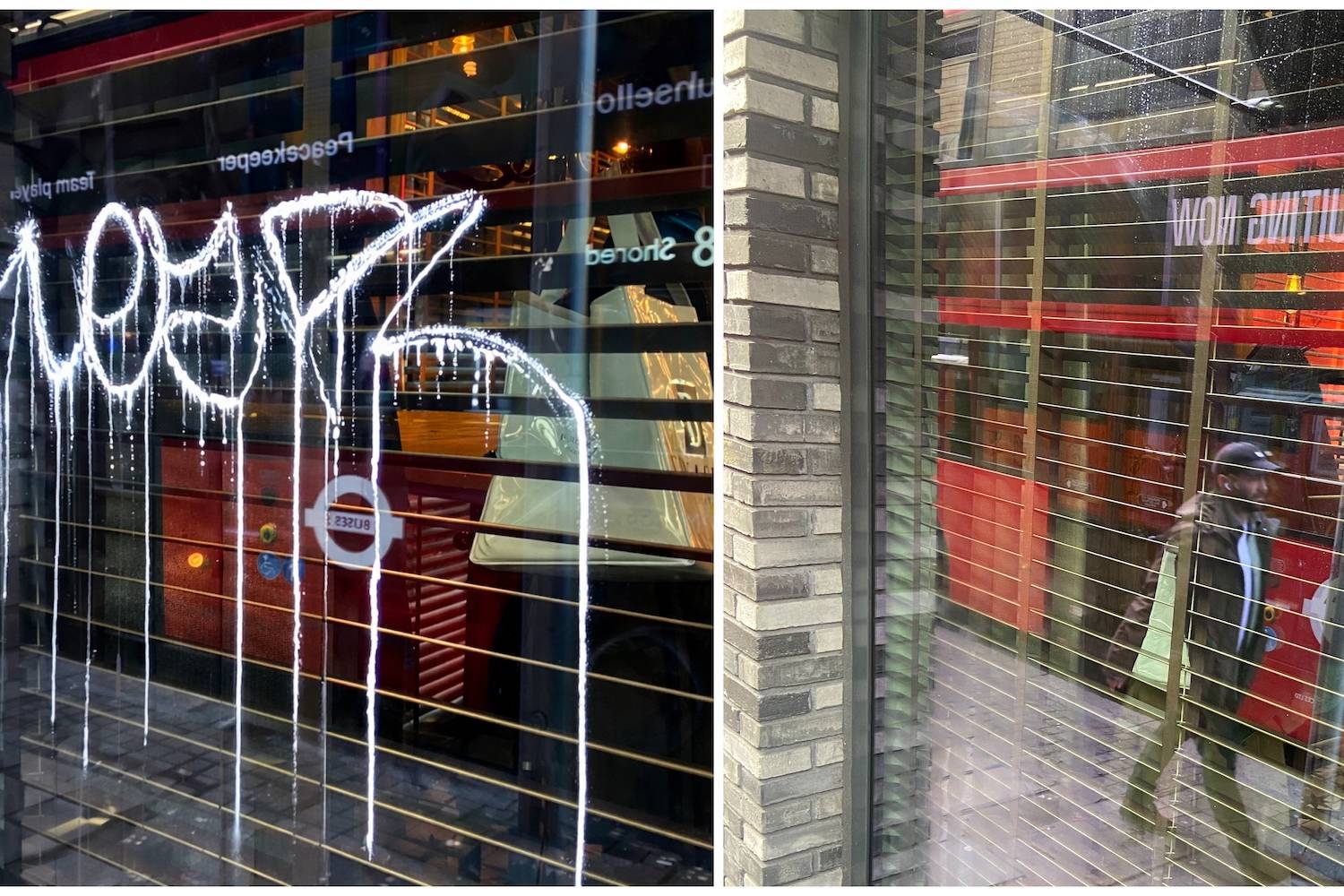
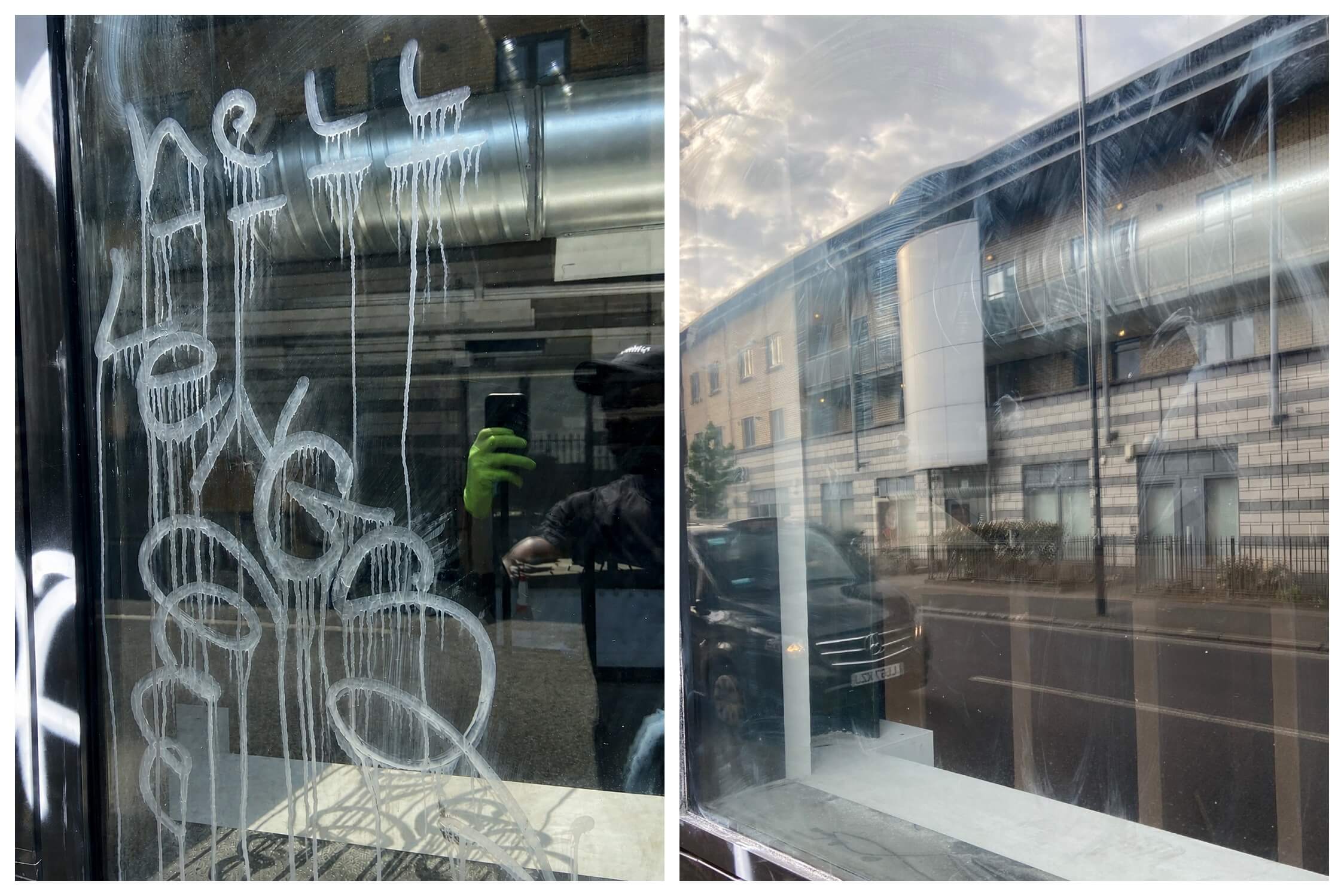
It is 7.15am on a Saturday morning. The shutters go up at the front of a Soho menswear boutique. The manager steps outside, coffee in hand, and stops. Across the centre of the £3,800 main display window, the one with the new spring collection lit perfectly behind it, there is a milky, semi-transparent, frosty white scrawl. Letters, tags, something approximating handwriting. He grabs the cleaning kit. Glass cleaner. Microfibre. Nothing. He tries the degreaser stocked behind the till. Tries warm soapy water with a non-scratch sponge. None of it works. The marks do not move. The marks are the glass.
Table of Contents
- How to Identify Acid Etching: The Visual Symptoms
- Why It Will Not Wash Off: The Chemistry in Plain English
- How Acid Etching Differs From Paint, Marker, and Sticker Vandalism
- Spray Paint and Marker Pens
- Sticker Tags and Adhesive Vinyl
- Acid Etching
- What Acid Etching Costs Your Business, Even If You Do Nothing
- The Proactive Solution: Sacrificial Anti-Graffiti Film
- What to Do Right Now If You Have Just Found This on Your Window
- Why London Premises Are Disproportionately Targeted
- Stop Frosty Window Graffiti Before It Starts
- Frequently Asked Questions
Do you need acid etched graffiti removed from your property? Get a fast, hassle-free quote today! Click here to get a professional graffiti removal quote or call us today on: 020 8050 5997
If you have arrived at your London premises and found this exact scenario unfolding, you are looking at acid-etched graffiti, and the reason no amount of conventional cleaning will remove it is that there is nothing on the surface to remove. The damage has already happened, microscopically, to the glass itself. This guide explains exactly what you are looking at, why it has happened, what it will and will not respond to, and what your next move should be. For the wider context across all forms of glass vandalism in the capital, our pillar resource on anti-acid etched graffiti protection in London sets out the full picture.
How to Identify Acid Etching: The Visual Symptoms
Acid-etched graffiti has a distinct visual fingerprint that, once you have seen one example, becomes immediately recognisable. The damage is consistently:
- Milky and frosted, never opaque, light still passes through it, but diffusely, as though the affected area has been replaced with bathroom-window glass.
- Semi-transparent with a soft white or pale grey tone, sometimes with a faint yellow or beige tint depending on the chemistry used.
- Permanent on first contact with cleaning agents, it does not smudge, smear, lift, or transfer to a cloth.
- Tag-shaped or hand-drawn, frequently with letters, initials, crew names, or simple symbols. Vandals draw with the acid paste much as they would with a marker.
- Often accompanied by drip marks, where the paste ran vertically down the pane before reacting, leaving feathered trails below the main tag.
- Concentrated at eye level, typically across the central third of the pane where it is most visible to passers-by.
If the damage on your window matches three or more of these descriptions, you are almost certainly dealing with acid etching rather than mechanical scratching, paint, or sticker residue. For the closest visual cousin to acid etching, and how to tell them apart in the field, see our companion piece on glass scratching vs. acid etching identification.
Why It Will Not Wash Off: The Chemistry in Plain English
Standard commercial glass, the soda-lime float glass used in almost every shopfront, office façade and bus shelter in London, is essentially a thin, hard layer of fused silica with a smooth, non-porous surface. When that surface meets a strong acid such as hydrofluoric acid (or one of the etching cream products that contain milder fluoride compounds), a chemical reaction occurs. The fluoride ions break apart the silica bonds at the molecular level. Microscopic layers of glass are dissolved away. What remains is a roughened, light-scattering surface where smooth glass used to be.
This is the critical point: there is no foreign material left on the window. There is no pigment, no resin, no coating to extract. The graffiti is not on your glass, it has replaced part of your glass. This is why solvents, degreasers, alcohol-based cleaners and even commercial graffiti-removal products fail. They are designed to strip foreign material from a surface. There is no foreign material here. There is only damaged substrate. Our deeper analysis of whether acid-etched graffiti can be cleaned off glass walks through every cleaning method that has been attempted and why each one fails.
How Acid Etching Differs From Paint, Marker, and Sticker Vandalism
Distinguishing acid etching from other glass-targeted vandalism is straightforward once you know what to look for. The diagnostic test is, in most cases, a single light wipe with a damp cloth.
Spray Paint and Marker Pens
Aerosol paint and permanent marker sit on top of the glass. They have visible thickness, often slight texture, and a saturated colour. A solvent, fingernail edge or razor blade will lift them given the right product and a few minutes. They respond to remediation. We extract pigment from glass surfaces routinely as part of our standard graffiti removal service, using chemical neutralisation and low-pressure steam.
Sticker Tags and Adhesive Vinyl
Stickers and slap-tags leave a clear physical edge, can usually be peeled by hand or with a plastic scraper, and reveal clean glass beneath any adhesive residue. Heat, citrus solvent and patience will fully remove them. The glass is not damaged.
Acid Etching
Acid etching has no edge to lift, no thickness, no surface deposit. Run a fingernail across it and the surface feels almost imperceptibly rougher than the surrounding glass, but there is nothing to scrape away. Run a damp cloth across it and the cloth comes back clean. The graffiti remains. That irreversibility, on first contact with cleaning, is the single clearest diagnostic.
What Acid Etching Costs Your Business, Even If You Do Nothing
The instinct, faced with frosted scrawl on a shopfront, is sometimes to leave it. To trade through it. To deal with it next quarter. We would gently advise against that approach for three reasons.
First, the damage signals. Customers, clients and passers-by read the condition of your frontage as a proxy for the state of your business. Frosted vandalism on a window is read as neglect, abandonment, or a lack of resources to maintain the premises, none of which is the impression a Soho restaurant, Mayfair gallery or Knightsbridge boutique wishes to project.
Second, the damage compounds. Once a property has been successfully etched once and the tag has remained visible for a sustained period, that property tends to be revisited. The original tag stands as proof of impunity. We see this pattern repeatedly across central London commercial corridors.
Third, the financial maths only worsens with time. Glass polishing, the only realistic non-replacement remediation, has a depth limit, and is most successful immediately after the damage has occurred. Replacement of a single bespoke commercial pane in central London typically runs into four figures before any associated costs (scaffolding, permits, downtime) are added. Our breakdown of the true cost of glass replacement against proactive window protection sets out the full numbers.
The Proactive Solution: Sacrificial Anti-Graffiti Film
The single most cost-effective response to acid-etched graffiti is to make it impossible. That sounds bold, but the technology exists, has been deployed across thousands of London commercial premises, and is mature, durable, and aesthetically invisible.
Anti-graffiti window film is a thin, optically clear polyester laminate, applied to the inside or outside face of your glass with a precision-formulated adhesive. Once installed, it sits between the world and your substrate. When a vandal applies acid paste to a protected pane, the chemistry attacks the film, not the glass. When the vandal scratches with a key or scribing tool, the gouges sit in the film, not the substrate. The film is sacrificial: it absorbs the damage, and we replace it. Your glass is preserved. Our technical explainer of how anti-graffiti window film actually works covers the layer chemistry and adhesion specification in detail.
Critically for retail and hospitality clients, the film does not affect visual merchandising. Premium-grade hard-coat films are engineered for high optical clarity, with light transmission losses typically in the low single digits. Customers will not be able to tell the film has been installed. Your displays look exactly as they did before, until something tries to damage them.
What to Do Right Now If You Have Just Found This on Your Window
If you have just identified acid etching on your London premises, the immediate priorities are documentation, preservation, and protection. In that order.
Document. Photograph the damage clearly, in good light, with a fixed reference point in the frame (a known dimension helps assessors and insurers). Note the time you discovered it and any nearby CCTV that may have captured the perpetrator.
Do not attempt aggressive cleaning. Solvents, abrasive pads and aftermarket "miracle" products will not extract the etching, and may streak or distort the surrounding glass and frame finishes. The damaged area is best left untouched until a professional has assessed it.
Get a professional assessment quickly. The remediation options narrow as time passes, both because polishing depth limits are most generous immediately after the event, and because secondary attacks become more likely once the original tag has been seen. Call our team on 020 8050 5997 for a same-day assessment, or request an instant quote through our online form.
Protect every other vulnerable pane. A successful acid attack on one window is the strongest possible signal that the rest of your glazing is at risk. Sacrificial film should be specified across all accessible panes as a forward measure, not just the one that has already been hit.
Why London Premises Are Disproportionately Targeted
Acid-etch vandalism has clustered around specific London geographies for over a decade. Night-time economy zones such as Soho, Shoreditch and parts of Camden see a high baseline rate. Transport interchange hubs, Stratford, King's Cross, London Bridge, Waterloo, produce sustained pressure on adjacent commercial glass. High-prestige retail corridors in the West End, particularly Bond Street, Oxford Street and Mayfair, are targeted both for visibility and for the brand-impact of the resulting damage. If your premises sits in any of these zones, proactive protection is no longer a luxury specification, it is a baseline asset-protection measure that prudent facility managers are now defaulting to as standard.
Stop Frosty Window Graffiti Before It Starts
Identifying acid etching after the fact is helpful. Preventing it in the first place is transformative. If you have just found this damage on your London premises, or, ideally, before you ever do, our Rapid Response Team can attend within three hours, all day, every day. We will assess the damage, recommend the appropriate remediation pathway, and specify sacrificial film across your vulnerable glazing so that the next attempt cannot succeed. Request an instant quote or call us directly on 020 8050 5997.
Frequently Asked Questions
What chemical causes the white frosty appearance on my window?
Most commonly hydrofluoric acid in paste form, or one of several commercial etching creams that contain milder fluoride compounds. Both react with the silica in soda-lime glass to dissolve microscopic layers of the substrate, creating the milky, light-scattering finish you can see.
Is acid etching the same as frosted glass?
Visually similar, but produced very differently and on a different scale. Factory-frosted glass is etched uniformly under controlled conditions to a precise depth. Vandalism etching is uneven, hand-applied, often with drip marks, and typically deeper in some areas than others, which is why the result looks scrawled rather than smooth.
Will the etching get worse over time on its own?
The chemical reaction is essentially complete once the acid has been neutralised by the surrounding environment, so the etching does not deepen further. However, the surrounding glass can pick up dirt and grime that emphasises the damage visually, and a successfully attacked property is statistically more likely to be revisited.
Can I scrape acid etching off the glass?
No. There is no foreign material on the surface to scrape. The damage is microscopic erosion of the glass itself. Scraping at it will, at best, achieve nothing and, at worst, scratch the surrounding undamaged glass and worsen the appearance.
Will glass cleaner, vinegar, or solvents remove acid etching?
None of these will work. Glass cleaners, white vinegar, isopropyl alcohol, acetone, and aftermarket "graffiti remover" products are all designed to lift foreign material from a surface. With acid etching, there is no foreign material, only damaged glass. The methods cannot succeed.
Can the glass be polished to remove the etching?
In some cases, yes. Specialist glass polishing using cerium oxide and controlled abrasion can reduce shallow etching, particularly when addressed quickly. Deeper damage, large areas, and tempered or laminated panes have specific limitations. A site assessment will confirm whether polishing is viable for your particular pane.
How much does it cost to replace a vandalised commercial window in London?
Costs vary widely with size, specification and access. A bespoke 3m × 2m laminated or toughened pane will typically run from £1,500 to £3,500 in materials alone, with installation labour, scaffolding and permits adding meaningfully on top. For first-floor and above units, the figure climbs further.
Does business insurance usually cover this kind of vandalism?
Many commercial property policies cover malicious damage, but excess levels and exclusions vary considerably. Most clients find that the excess on a single pane replacement claim, plus the associated downtime and disruption, makes proactive film protection significantly more economical over a 3–5 year horizon.
Should I cover the etched window while I wait for assessment?
You can apply temporary frosted vinyl or removable signage to obscure the damage during trading hours if it is affecting customer perception. Avoid permanent solutions until a technician has confirmed whether polishing is viable, as some products can interfere with assessment.
How quickly can DUA London attend a site after acid-etched vandalism?
Our Rapid Response Team is dispatched within three hours, all day, every day, across Greater London. Same-day assessment is the standard, not the exception, and we frequently attend within ninety minutes of a call.
Will sacrificial film prevent the same kind of attack happening again?
Yes. With protective film installed, the next acid attack damages the film instead of the glass. We replace the film at a fraction of the cost of a new pane, and your trading window is uninterrupted. This is the entire point of the sacrificial layer.
Does the protective film alter the appearance of my windows?
No. Premium-grade hard-coat films are optically clear with light transmission losses typically in the low single digits. Properly installed, the film is effectively invisible to customers and does not distort visual merchandising or natural light.
How long does anti-graffiti film last once installed?
High-quality hard-coat films installed by trained technicians typically last several years before scheduled replacement, depending on UV exposure, cleaning regime and pollution load at the location. The film is replaced individually if it is ever damaged by vandalism in the meantime.
Can DUA London handle both the existing damage and the forward protection?
Yes. Where polishing is viable, we will restore the existing pane first; where it is not, we will coordinate replacement. In both cases, we then install sacrificial film across all vulnerable glazing so future attacks cannot reach the substrate.
How do I get a survey of my premises?
You can request an instant quote through our online form, or call our Rapid Response Team on 020 8050 5997. We attend across all London boroughs and provide a no-obligation site assessment.

Toby Doherty
Toby Doherty is a seasoned graffiti removal expert with over 20 years of experience in the industry. Throughout his career, Toby has helped countless businesses and property owners in London maintain clean, graffiti-free spaces. His extensive knowledge of graffiti removal techniques, from eco-friendly solutions to advanced technologies like laser cleaning, makes him a trusted authority in the field. Passionate about restoring urban environments, Toby combines his hands-on expertise with a commitment to staying up-to-date on the latest industry trends and innovations. When he’s not out in the field, Toby shares his insights through detailed articles, offering practical advice on everything from graffiti prevention to legal considerations.