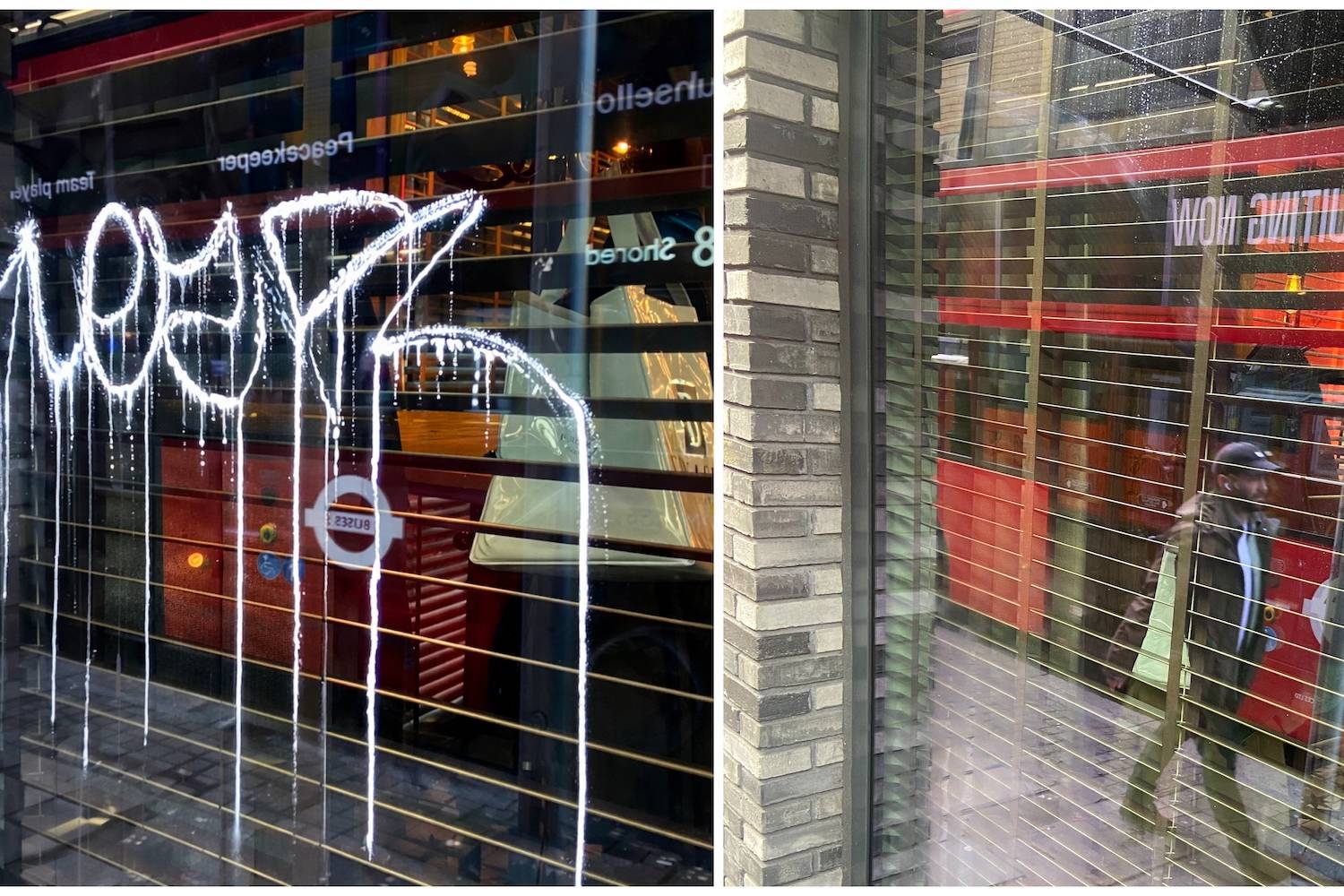
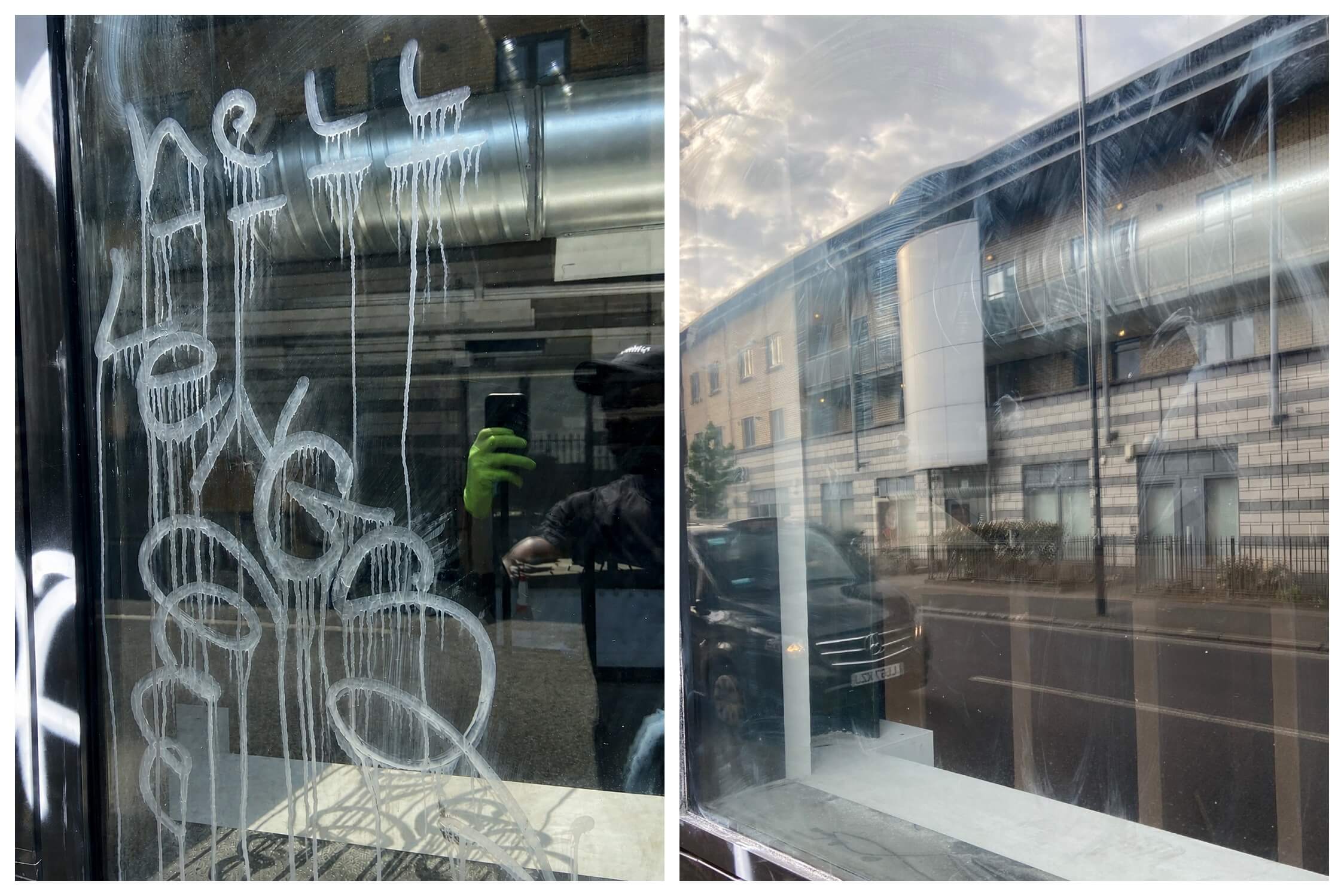
A facility manager responsible for three commercial buildings across the City of London receives two phone calls within ninety minutes. Both report "vandalism on the front windows." Both photographs, sent through on WhatsApp, show pale, irregular damage across the centre of the glass. From the thumbnails, they look like the same problem. They are not. One pane has been chemically etched with acid paste; the other has been physically scratched with a tungsten scribing tool. The two attacks require different diagnostic thinking, have different remediation pathways, and produce different cost outcomes, but, critically, share the same proactive protection. Knowing the difference is the first step in responding correctly to either.
Table of Contents
- At a Glance: The Quick Diagnostic Reference
- Acid Etching: The Chemical Attack
- Mechanical Scratching: The Physical Attack
- Five Diagnostic Cues That Will Tell You Which Is Which
- 1. The Edge Test
- 2. The Light Test
- 3. The Fingernail Test
- 4. The Drip Test
- 5. The Tag Geometry Test
- Why Both Damage Types Are Solved by the Same Protection
- The Cost Picture: Polishing, Replacement, or Prevention
- What To Do When You Cannot Confidently Diagnose the Damage
- One Solution, Both Threats, Across Every London Borough
- Frequently Asked Questions
Do you need acid etched graffiti removed from your property? Get a fast, hassle-free quote today! Click here to get a professional graffiti removal quote or call us today on: 020 8050 5997
This guide sets out exactly how to distinguish acid etching from mechanical scratching in the field, what each form of damage costs to remediate, and why both are eliminated by a single class of preventative solution. For wider context across all forms of glass-targeted vandalism in the capital, our pillar resource on anti-acid etched graffiti protection in London sets out the full landscape.
At a Glance: The Quick Diagnostic Reference
If you are standing in front of a damaged pane and need a fast read, this comparison covers the key visual and tactile differences:
| Characteristic | Acid Etching | Mechanical Scratching |
|---|---|---|
| Surface finish | Milky, frosted, semi-transparent | Sharp linear gouges, often clear-edged |
| Light interaction | Diffuses light through the damage | Catches light along the scratch edge |
| Edge definition | Soft, feathered, with possible drip trails | Hard-edged, repeatable, often parallel |
| Tactile feel | Subtly rougher than surrounding glass | Distinctly grooved, a fingernail catches |
| Tool used by perpetrator | Acid paste, etching cream | Key, scriber, spark plug ceramic, carbide tip |
| Damage depth | Microscopic surface erosion | Linear gouge of variable depth |
| Realistic remediation | Polishing if shallow; otherwise replacement | Polishing if shallow; otherwise replacement |
If you are still not certain after reviewing this table, our companion piece on identifying white frosty graffiti as acid etching walks through the symptoms of acid attacks specifically, with deeper visual cues.
Acid Etching: The Chemical Attack
Acid etching uses chemistry, not force. Vandals apply a paste, typically hydrofluoric acid in gel form, or a commercial etching cream containing milder fluoride compounds, directly to the glass with a brush, sponge applicator, or even a finger. The fluoride ions in the compound react with the silica in the glass, dissolving microscopic layers of the substrate over the next few minutes. The acid is then rinsed or wiped away, leaving behind a milky, light-scattering finish where smooth glass used to be.
The visual signature is unmistakable once you have seen it. The damage is soft-edged, semi-transparent, and frosted. There is often visible drip evidence below the main tag, where the paste ran down the pane before reacting fully. The damage tends to be hand-drawn, letters, initials, crew tags, rather than mechanical or geometric. Light passes through it but is diffused; you can still see shapes through the etching, but not detail.
Critically, there is no foreign material left on the glass. The graffiti is not on the surface, it has replaced part of the surface. This is why no solvent, cleaner, or aftermarket "graffiti remover" will lift it. We explore the reasons in detail in our analysis of whether acid-etched graffiti can be cleaned off glass.
Mechanical Scratching: The Physical Attack
Mechanical scratching uses force. The vandal physically gouges the glass surface with a tool harder than glass itself, creating a permanent linear groove. The most common tools are:
- Key tips and metal pen clips, opportunistic, low-force, and producing relatively shallow scratches that may still be polishable.
- Spark plug ceramic shards, alarmingly effective, very hard, and able to gouge significantly into glass with little effort. A single shard fits in a pocket.
- Tungsten carbide scribers and tile cutters, workshop tools repurposed for vandalism, producing deep, repeatable, surgical-looking gouges.
- Glass cutters, purpose-built for scoring glass, used for the deepest and most damaging tag work.
Visually, scratch damage is the opposite of acid etching. The lines are sharp-edged, geometric, often parallel or repeated. The damage catches light along its edges rather than diffusing light through it. Scratched tags frequently include angular geometry, boxes, pentagrams, sharp lettering, because the tool naturally produces straight strokes. Run a fingernail across the damage and it catches in the groove. There is no chemistry involved; there is only physical removal of material.
Five Diagnostic Cues That Will Tell You Which Is Which
If the table at the top of this article has not resolved your specific case, these five field-level cues almost always will.
1. The Edge Test
Acid etching has soft, slightly feathered edges. Mechanical scratching has hard, decisive edges. Look closely at where the damage stops and undamaged glass begins. A clean, surgical line indicates a scribing tool. A diffuse, slightly hazy boundary indicates acid.
2. The Light Test
Stand inside the building and look out through the damaged area, then walk to the outside and look in. Acid-etched areas appear milky from both sides. Scratch damage tends to "catch" light at specific angles, you may see it brilliantly from one viewpoint and barely at all from another, because the gouge edges reflect light directionally.
3. The Fingernail Test
Run a fingernail very lightly across the damaged area. Acid etching feels almost identical to surrounding glass, a barely perceptible roughness. Scratch damage produces a noticeable catch or click as the nail crosses each gouge.
4. The Drip Test
Look for drip trails extending downward from the main tag. Acid pastes commonly leave visible feathered drip evidence below the main damage. Scratching does not produce drips, gravity does not influence a hand-held scriber.
5. The Tag Geometry Test
Acid-applied tags tend to be loose, hand-drawn, and curved, vandals draw with paste much as they would with a marker. Scratch tags tend to be angular, geometric, and architectural, sharp lines, boxes, and lettering with hard corners, because the tool forces straight strokes.
Why Both Damage Types Are Solved by the Same Protection
Here is the key practical insight for facility managers: both forms of damage have the same proactive solution. Optically clear sacrificial anti-graffiti film, applied to the glass, eliminates both threats simultaneously.
When a vandal applies acid paste to a protected pane, the chemistry attacks the film, not the glass. The fluoride ions cannot reach the silica beneath, because there is a polyester laminate in the way. When a vandal scratches with a key, scriber or ceramic shard, the gouges sit in the film, not the substrate. The film is sacrificial, designed to absorb both chemical and mechanical attack, and we replace it at a fraction of the cost of a new pane. Our explainer of how anti-graffiti window film works covers the layer chemistry, adhesion specification and damage-absorption performance in full.
For commercial premises in any London borough, whether your prevailing threat is opportunistic key-scratching outside a Soho hospitality venue, or targeted acid attacks on a high-end Mayfair retailer, the protection specification is the same. Premium-grade hard-coat film, professionally installed, with rapid replacement when damaged.
The Cost Picture: Polishing, Replacement, or Prevention
Both damage types share remediation pathways, but with different success profiles.
Polishing uses cerium oxide and controlled abrasion to reduce surface damage. For shallow acid etching, polishing can be highly effective. For shallow scratch damage, polishing can also work, but deep gouges have a depth limit beyond which the optical quality of the polished area becomes unacceptable. Polishing is also limited on tempered, laminated and coated glass, which represents an increasing share of modern commercial glazing.
Replacement is the fallback when polishing is not viable. For commercial London glazing, this is rarely a small invoice. Bespoke 3m × 2m laminated or toughened panes start in four-figure territory for materials alone, with installation labour, scaffolding, pavement permits and trading downtime adding meaningfully on top. For first-floor and above units, costs escalate further. Our detailed comparison of the true cost of glass replacement against proactive window protection sets out every line item.
Prevention short-circuits both. Sacrificial film is a single, predictable installation cost. When attacks occur, replacement of the damaged film is fast, low-cost and uninterruptive. Total cost of ownership over a five-year horizon is consistently lower than the expected value of one or two unprotected vandalism events.
What To Do When You Cannot Confidently Diagnose the Damage
If you have arrived at your premises, found unfamiliar damage, and run through the diagnostic tests above without reaching a confident conclusion, the correct next step is not to keep guessing. It is to get a professional eye on the damage quickly. Polishing windows narrow with time, and the longer damage sits visible, the higher the chance of secondary attack on the same property.
Photograph the damage in good light with a fixed reference for scale, note the time of discovery and any nearby CCTV, and call our team on 020 8050 5997 for a same-day assessment. Alternatively, request an instant quote through our online form. We attend across all London boroughs and will give you a clear remediation pathway, polish, replacement or protection, within a single site visit.
One Solution, Both Threats, Across Every London Borough
The takeaway for any London facility manager is simple. Whether the threat to your glazing is acid etching, key scratching, or both, sacrificial anti-graffiti film is the single specification that eliminates the consequences of either. The damage stops being a four-figure replacement event and becomes a routine, scheduled film swap at a fraction of the cost. To arrange a survey for any commercial premises in Greater London, request an instant quote or call our Rapid Response Team directly on 020 8050 5997. All day. Every day. Within three hours.
Frequently Asked Questions
What is the single fastest way to tell acid etching from glass scratching?
The fingernail test. Lightly run a fingernail across the damage. Acid etching feels almost identical to undamaged glass, a barely perceptible roughness. Mechanical scratching produces a clear catch or click as the nail crosses each gouge. The tactile difference is decisive in most cases.
Can both types of damage occur on the same window?
Yes, and we see it regularly. Some vandals carry both acid pastes and scribing tools and use whichever is convenient. A pane can show frosted etching across one section and angular scratch damage across another, requiring assessment of both forms of damage in the same survey.
Which type of damage is more common in London?
Both are present across central London commercial corridors, with broad regional and seasonal variation. Mechanical scratching is more opportunistic and tends to follow night-time economy patterns. Acid etching is more deliberate and tends to cluster around prominent retail and corporate frontages where visibility is highest.
Is one type of damage cheaper to repair than the other?
Not consistently. Both have the same remediation pathway: polish if shallow enough, replace if not. The depth and area of the damage matter more to the cost than the cause of it. Shallow scratch damage and shallow acid etching can both be polished; deep damage from either source typically requires replacement.
Will sacrificial film stop both acid attacks and scratching?
Yes. Premium-grade hard-coat film is engineered to absorb both chemical and mechanical attack. Acid pastes react with the film instead of the glass; scribing tools gouge the film instead of the substrate. The protection specification is the same for both threats.
Can I tell from a photograph alone, or do I need to be on site?
A clear, well-lit photograph with the damage in sharp focus is often sufficient for an experienced technician to make a confident initial diagnosis. However, the fingernail and edge tests do require physical inspection. We will always confirm at site assessment.
Does insurance treat the two types of damage differently?
Most commercial property policies treat both as malicious damage and apply the same excess and exclusions. Specific policy wording varies, however, so it is worth checking with your insurer. Most clients find that the excess on a single pane replacement claim plus downtime makes proactive protection more economical than reactive claims.
Are some types of glass more resistant to scratching than to acid?
Tempered glass has marginally improved resistance to mechanical scratching but is not significantly more resistant to acid etching, since the chemistry attacks the silica regardless of how the glass was processed. Laminated glass offers no meaningful protection against either threat. Sacrificial film is the only specification that defeats both.
Can the protective film itself be scratched or etched?
Yes, that is precisely the point. The film is sacrificial. When it is damaged, we strip and replace it within a single visit, at a fraction of the cost of a new glazing unit. The underlying substrate is preserved, and the trading window is uninterrupted.
How quickly does scratching damage develop versus acid etching?
Mechanical scratching is instantaneous, the damage occurs as the tool moves across the glass. Acid etching takes a few minutes to develop fully as the chemistry reacts with the substrate. From the property owner's perspective, both are discovered after the fact, and both are equally permanent once the act has been committed.
Does DUA London handle both damage types in a single visit?
Yes. Our technicians assess all forms of glass damage during the site survey, recommend the appropriate remediation for each pane (polish, replace, or accept and protect), and install sacrificial film across vulnerable glazing as a forward measure. The work is coordinated to minimise disruption to your trading.
Will scratched film be visually obvious before we replace it?
Damaged film is visible at close range but typically far less prominent than damage to bare glass. Crucially, the underlying glazing is preserved, so the visual impact while you await film replacement is significantly lower than the impact of a damaged or boarded substrate.
How long does it take to replace damaged film after an attack?
Our Rapid Response Team is dispatched within three hours, all day, every day. Stripping the damaged film, inspecting the substrate, and applying a new layer is typically completed within a single visit, often within ninety minutes once on site.
Can the film be applied over an existing scratched or etched window?
Not directly. The substrate must be smooth for the adhesive to bond reliably. Where existing damage is present, we will assess for polish or replacement first, then apply film once the surface is restored. This sequencing is confirmed at site assessment.
How do I get an assessment for my London premises?
You can request an instant quote through our online form, or call our team directly on 020 8050 5997. We attend across all London boroughs and provide a no-obligation site assessment with a clear, costed remediation pathway.

Toby Doherty
Toby Doherty is a seasoned graffiti removal expert with over 20 years of experience in the industry. Throughout his career, Toby has helped countless businesses and property owners in London maintain clean, graffiti-free spaces. His extensive knowledge of graffiti removal techniques, from eco-friendly solutions to advanced technologies like laser cleaning, makes him a trusted authority in the field. Passionate about restoring urban environments, Toby combines his hands-on expertise with a commitment to staying up-to-date on the latest industry trends and innovations. When he’s not out in the field, Toby shares his insights through detailed articles, offering practical advice on everything from graffiti prevention to legal considerations.