





Tagging has appeared on your building and you need it gone, properly, without leaving a pale patch where it used to be.
The removable part is usually straightforward. What decides the outcome is the surface underneath, because the method that lifts paint cleanly off glazed tile will bleach and blow the face of soft Victorian brick.
We identify the substrate first, test before we commit, and remove what is there without harming what is beneath it. Most jobs are done the same day, seven days a week.
Do you need graffiti removed from your property? Get a fast, hassle-free quote today! Click here to get a professional graffiti removal quote or call us today on: 020 8050 5997
Before Anything Is Removed, Establish What It Is
Shoreditch is the one district where removing graffiti can cost more than leaving it, because not all of it is vandalism. Commissioned murals, permitted walls and pieces the freeholder agreed to years ago sit within a few streets of straightforward illegal tagging. Some is contractually protected, some has real value, and some is why a tenant took the unit.
A contractor arriving with a pressure washer and no questions removes all of it equally, and that is a mistake nobody can undo. So the first thing we do here is not technical. The line between the two is argued over endlessly, and graffiti vs street art covers that debate.
We Confirm What Is Authorised Before We Quote
If commissioned work sits on the elevation, we need to know where it starts and stops. Managing agents frequently do not hold that information. Occupiers usually do, and a caretaker or long-standing tenant often knows more than the file does.
Tagging Over A Mural Is Its Own Job
This is common here and it is the most skilled removal we do in the area. Taking a tag off a mural without lifting the artwork underneath means working to the tag alone, with a method gentle enough to leave the original paint film intact. It cannot be done by anybody moving at speed across a whole wall.
Sometimes The Artwork Cannot Be Saved
Where a tag has been applied in a solvent that has bitten into the original paint, selective removal takes both. We say so at the assessment rather than discovering it halfway through, and we photograph the position before starting so there is a record of what was already lost.
Where There Is Doubt, We Stop
An hour confirming who authorised what is cheaper than removing a commissioned piece and explaining it afterwards. If you manage buildings here, the most useful record you can hold is a note of which elevations carry authorised work. Most portfolios have none, and it is the difference between a routine instruction and a difficult phone call.
Recent London Graffiti Removal Projects
Before & After Photo of Graffiti Removal Project in Shoreditch
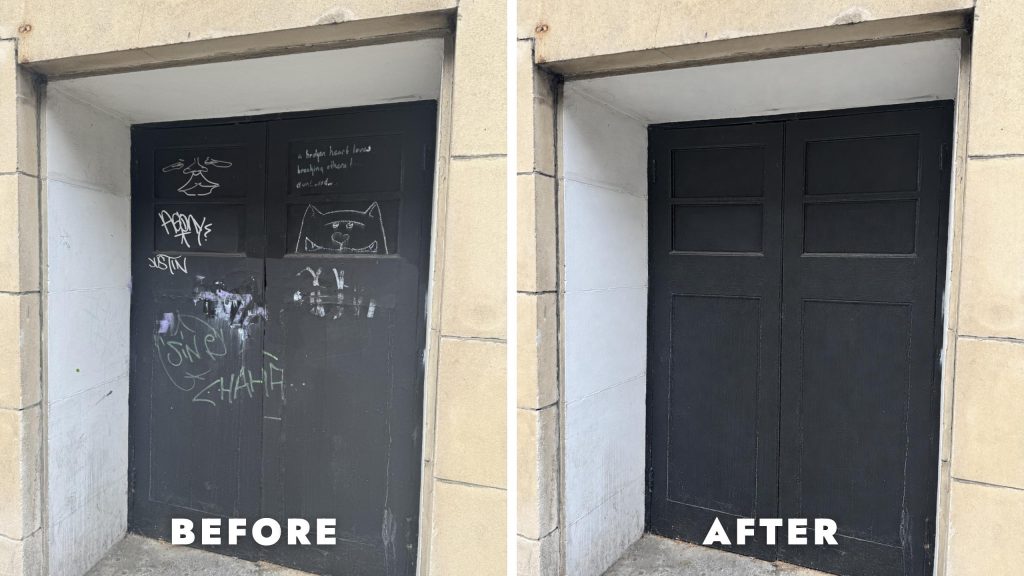
Soft Victorian Brick Is Unforgiving
This is overwhelmingly nineteenth-century warehouse stock in soft red brick with lime mortar, and brick of that age is where bad removal does permanent harm. Three failure modes, all common, all avoidable.
Ghosting
The paint comes off and a pale shadow of the tag stays, because removal cleaned the brick face more aggressively than the weathered surface around it. From across the street you have replaced a tag with the outline of a tag.
Spalling And A Blown Face
Too much pressure, or a harsh chemical left too long, takes the fired outer skin off the brick. Once it is gone the brick is porous, weathers faster, and the next tag soaks in far deeper. That is a permanent downgrade to the building.
Open Mortar Joints
Lime mortar is softer than the brick. A method safe on the face can wash the joints out, and repointing a Victorian elevation costs far more than the removal did.
Which Method, And Why It Matters
The answer is not a single product, it is the right method for that surface. These are the four that do most of the work here.
Low Pressure Superheated Steam
The DOFF system is the safest general method on soft masonry. It works at a pressure low enough to leave the fired face intact and uses heat rather than force, which is why it suits lime mortar and listed fabric.
Dry Ice Blasting
Non-abrasive, and it leaves no secondary waste because the pellets sublimate on impact. It suits delicate brick, stone and metal, and it is useful where run-off would be a problem, such as over a basement lightwell or a food business doorway.
Soda Blasting
Gentler than grit, with a place on sound masonry and metalwork, though it needs full containment.
Poultice Treatment
Draws pigment back out of porous stone and brick rather than driving it in. It is the only approach that works where paint has soaked deep into the substrate.
Which one is right is decided by the test patch, not by what is on the van. On protected fabric it also means accepting a very slightly imperfect result rather than a perfect one on damaged brick. The limits of the obvious alternative are covered in high-pressure washing for graffiti removal.
The Surface Decides The Method
Every quotation starts with what the surface actually is, because the wrong method on the wrong material is how a small job becomes a repair bill.
- Unpainted red brick dominates here and tolerates least. Softened removal, low pressure, tested first, accepting a faint trace over a blown face.
- Painted brick is a different problem, because the tag and the wall coating are both paint. Anything removing one attacks the other.
- Glazed brick is the easiest surface in the district. Nothing soaks into the glaze, so removal is quick and complete.
- Mortar joints absorb where the brick does not, and frequently need different treatment from the face either side.
- Render and stucco is porous and easily damaged, and aggressive removal leaves a patch smoother and paler than its surroundings.
- Painted metal on shutters, doors and railings takes tagging constantly, with the risk of stripping the finish along with the paint.
- Galvanised steel and powder coated metal carry a surface layer that is part of the product rather than a finish over it. Lose it and you get corrosion later.
- Painted timber on shopfronts and doors, where solvent lifts the paint as readily as the tag.
- Glass and glazing, where paint comes off cleanly but acid etching does not and needs a different service entirely.
Anybody quoting one flat rate across a mixed elevation has not looked at it properly. The factors that affect the cost of graffiti removal are set out separately.
What Professional Removal Actually Includes
The word gets used by everybody, so here is what it means when we use it, and why each item matters to you rather than to us.
| What you get | Why it matters |
|---|---|
| A substrate assessment before a price | The surface, what is already on it, how weathered, and a test patch out of sight. Not a glance from the van. |
| Method statement and risk assessment, in advance | Agents need them on file. Independents are rarely offered them, and they are what protects you if something goes wrong. |
| Current public liability insurance | Ask any contractor for the certificate rather than the claim. |
| Containment and wastewater handling | Run-off is contaminated and should reach no gully, lightwell or neighbouring doorway. On a street of food businesses that matters. |
| Correct waste disposal | Chemical residues are not general waste. A contractor who cannot say where theirs goes is a problem waiting to attach itself to your building. |
| Dated before and after photography | Issued as standard, for agent records and recharge or for an independent's insurer and landlord. |
| Seven days a week, self-contained | We carry our own water and power, so we draw on neither your supply nor your staff, and on most jobs nobody needs to attend. |
The wider case is made in DIY vs hiring professionals and in safety precautions during graffiti removal. None of it is exotic. It is the difference between a trade van and a contractor, and it is most of what you are paying for.
Response Times, Honestly
Most of this district we attend same day, seven days a week, and for accessible tagging at ground level that is the normal answer. Three things genuinely change it.
Height
Anything beyond safe reach from the ground needs access equipment, so it is scheduled rather than attended on spec.
Doubt Over Authorisation
Any possibility the work is commissioned and we confirm first. That may add a day, and it is the right day to spend.
Protected Fabric
On listed buildings, of which there are many here, the method may need agreeing before anybody starts.
For portfolios we will propose a scheduled cycle rather than reacting each time, which on a high-incidence street is cheaper and more consistent than emergency call-outs.
Removing It Or Painting Over It
| Painting over | Professional removal | |
|---|---|---|
| Immediate appearance | Hidden, if the colour matches | Surface returned to original |
| On exposed brick | Permanently changes the building | Brick left as brick |
| Within a year | Patch weathers differently and shows | Nothing to weather differently |
| Next incident | Another patch, then another | Same process, same result |
| Listed or protected fabric | May require consent | Nothing altered |
| Long term cost | Recurring, and compounds visually | One-off per incident |
Painting over is the commonest response in this district and the one that costs most over five years. A patched elevation reads as neglected in a way that tagging does not, and once a wall has been patched three times the only fix left is painting the whole thing. The longer-term arithmetic is in the hidden costs of not removing graffiti promptly.
Do you need graffiti removed from your property? Get a fast, hassle-free quote today! Click here to get a professional graffiti removal quote or call us today on: 020 8050 5997
What To Do In The First Hour
- Photograph it before anybody touches it, dated, wide enough to show the whole elevation and close enough to show the surface. Where there is commissioned work, photograph that too so the boundary is on record.
- Stop anybody scrubbing it. A cleaner attacking fresh paint with a wire brush drives it into porous brick and turns a surface problem into a deep one.
- Keep proprietary removers off brick and stone. Most are formulated for hard, non-porous surfaces, and there is an honest assessment in chemical solutions for graffiti removal.
- Do not pressure wash it. Pressure that seems modest will blow the face off Victorian brick and wash out lime mortar.
- Establish whether anything on that elevation is authorised before instructing anybody, and say so when you report it.
- Report it as criminal damage if it is on your own fabric, following reporting vandalism in London. The reference matters for an insurer, and for a portfolio it matters for the pattern across a street.
How The Work Is Carried Out
- Identify the substrate, whatever coating is already on it, how weathered it is, and whether authorised work sits anywhere on the elevation.
- Test in a concealed area. Always on masonry, without exception, because the test tells us the gentlest method that will work and that is the one we then use.
- Set up containment, with sheeting, run-off collection and protection of the doorways, lightwells and neighbouring frontages below.
- Begin at the lowest effective intervention and increase only where needed, rather than starting hard and hoping the surface survives.
- Where artwork is present, confine the work to the tag itself so the original paint film is left intact.
- Blend the treated area outward into the surrounding surface so it does not read as a clean rectangle on a weathered wall. Skipping this is what produces ghosting.
- Rinse, collect the run-off rather than letting it find a drain, and take the residues away.
- Photograph the finished elevation and issue dated before and after images with a written description of what was done and what was used.
Where a surface cannot be fully recovered we say so before starting. Deep penetration into porous brick, tagging over damaged render, and solvent that has bitten into an underlying coating each mean an honest expectation rather than a promise, in writing.
Where We Work Around Shoreditch
| Location | What we are usually called to |
|---|---|
| Shoreditch High Street and the station approaches | Heavy commercial frontage, and the most consistently tagged stretch in the area |
| Curtain Road and Rivington Street | Bars, restaurants and workspace in converted warehouse stock, much of it exposed brick |
| Redchurch Street and north | Independent retail and galleries, dense with both commissioned and uncommissioned work |
| Hoxton Square and the office conversions | Mixed period and modern frontage, entrance screens, render and painted joinery |
| The arches and viaduct elevations | Brick openings and infill units, unobserved for long stretches at night |
| Service yards and rear elevations | Back-of-house brickwork and shutters, where tagging accumulates because nobody walks round |
Work Completed In East London
- Acid etched graffiti removal from glass in Shoreditch
- Acid etched graffiti removal on Brick Lane
- Acid etched graffiti removal in Hackney
- Emergency acid etched graffiti removal in Dalston
Who We Work For In Shoreditch
| Client | What the work looks like |
|---|---|
| Managing agents and asset managers | Portfolios across the district on scheduled cycles rather than reactive call-outs, with documentation supporting recharge |
| Facilities teams in converted office stock | Entrance elevations, service yards and rear brickwork, with method statements ahead of attendance |
| Independent bars, restaurants and shops | Single frontages worked around trading, at a price that makes acting on it realistic |
| Galleries and creative workspace | Buildings carrying both commissioned and uncommissioned work, where knowing the difference is the whole job |
| Landlords of arch and workshop units | Brick openings and shutters, quoted as a run where several are hit |
What Drives The Price
Nobody in this trade publishes a rate card, and any figure quoted before somebody has seen the surface is a guess. Here is what the figure is built from, so you can read any quotation you receive. General London pricing is discussed in how much does graffiti removal cost in London.
The Surface, More Than Anything Else
Glazed brick and painted metal are quick. Soft unpainted brick and porous render are slow, because the method has to be gentle and gentle takes longer.
The Area Covered, Not The Size Of The Tag
On masonry the treated zone is blended into the surrounding surface, so a small tag mid-wall costs more than the same tag in a corner.
Height And Access
Ground level from the pavement is one price. Anything requiring access equipment, a road closure or working over a trading frontage is another.
Whether Artwork Is Present
Selective removal around commissioned work is slower and more skilled than clearing a blank wall.
Whether It Is A Repeat
A surface tagged repeatedly holds residue from previous incidents, and each removal is harder than the last. This is the strongest argument for protective coating.
Scheduled Versus Reactive
A portfolio on a planned cycle costs materially less per incident than one calling out each time.
Who Carries The Cost
If You Are A Commercial Occupier
The repairing covenant decides. Your own frontage normally sits inside the demise. The main elevation above it, the flank wall, the service yard and the communal entrance generally do not, and those belong to the landlord and are recovered through the service charge. On converted warehouse stock that boundary is rarely obvious, so read the demise plan rather than assuming.
If You Are An Independent Trader
Do not pay for the flank wall of a building you rent one unit in. Report it, ask us for a written itemised figure, and hand that to the landlord or the agent. A defined number produces a decision far faster than a description of the problem.
If You Manage The Building
The useful question is whether to recharge at all. One small removal is often cheaper to absorb than to administer, while a recurring pattern on an elevation is worth tracking and raising with the occupier or the local authority. Responsibility is set out in who is responsible for graffiti removal.
Whether To Claim
Weigh the figure against the excess before notifying a broker, and see does insurance cover graffiti removal. A single removal will frequently cost less than the excess, so the claim returns nothing and still registers at renewal. A whole elevation, or repeated incidents forming a pattern, is a different calculation.
Stopping It Coming Back
Removal deals with what has happened. On the most-tagged commercial streets in London it will happen again.
Anti-graffiti coating is a barrier applied to the surface so the next tag sits on the coating rather than soaking into the substrate. On porous masonry it is the most effective thing available, converting an absorbent surface into a washable one and removing the risk of cumulative damage from repeat removals. How the products work is explained in anti-graffiti coatings, with options in the best coating products for London properties.
It Changes The Appearance Slightly
On exposed brick a coating usually deepens the colour a little. Most clients accept that, some do not, and it is better raised beforehand than discovered afterwards.
It Is Not Worth It Everywhere
For an independent hit once, clear the wall and see. Coating earns its keep where tagging repeats, and on soft masonry where each removal does a little more harm than the last. On a blank flank wall it pays for itself quickly; on a frontage tagged once in five years it does not. On listed and protected fabric the specification needs raising with the local authority first, and graffiti on historic buildings in London covers that ground.
Areas We Cover Next To Shoreditch
Glass damage is a separate service, covered on the main acid etched graffiti removal page.
Shoreditch Graffiti Removal: Frequently Asked Questions
How do you know what is commissioned and what is vandalism?
By asking before we quote, not after. Managing agents frequently do not hold that information and occupiers usually do, so we establish it with whoever knows the building. Where there is any doubt we confirm before removing rather than after.
Someone has tagged over our mural. Can the mural be saved?
Usually, and it is the most skilled removal we do here. The work is confined to the tag itself, using a method gentle enough to leave the original paint film intact. Where the tag was applied in something that has bitten into the artwork, we will tell you at the assessment.
Can you pressure wash our brickwork?
No, and nobody should. Pressure that seems modest will take the fired face off Victorian brick and wash out lime mortar joints. Once that face is gone the wall is porous, weathers faster and holds the next tag far more deeply.
What is DOFF and why do you use it?
Low pressure superheated steam. It cleans using heat rather than force, at a pressure low enough to leave the fired brick face intact, which is why it suits soft masonry, lime mortar and listed fabric better than anything pressure-based.
Is dry ice better than steam?
Neither is better in general, they suit different jobs. Dry ice is non-abrasive and leaves no secondary waste, which makes it the right answer where run-off would be a problem. Steam is usually the better general method on soft brick. The test patch decides.
The last contractor left a pale patch. What is that?
Ghosting. The removal cleaned the brick more aggressively than the weathered surface around it, so you are left with an outline where the tag was. It is caused by not blending the treated area into the surrounding wall, and it is avoidable.
Can ghosting be corrected?
Often yes, by carefully working the surrounding area so the whole elevation reads evenly. It depends how much of the brick face was lost in the original removal, so it is assessed rather than promised.
Should we just paint over it?
On exposed brick, no. A painted patch weathers differently within a year and shows, then the next incident produces another patch. After three the only remaining fix is painting the entire elevation, which permanently changes the building.
Is one flat rate for the whole elevation reasonable?
Not on a mixed surface. Glazed brick, soft unpainted brick, render and painted metal all take different methods and different amounts of time, and a contractor quoting one rate for all of them has not assessed the surface.
What documentation do you provide?
All of it as standard: method statement and risk assessment in advance, current public liability insurance on request, and dated before and after photographs with a written description of works.
Do we need to be there while you work?
No. We carry our own water and power and arrive self-contained, so on most jobs nobody from your side needs to attend. For an agent managing several buildings that is the difference between one instruction and five site visits.
Can you attend the same day?
Usually, seven days a week, for accessible tagging at ground level. Height, protected fabric and any question over authorisation are the three things that genuinely mean scheduling instead.
As a tenant, am I liable for the whole wall?
Very probably not. Your own frontage is usually inside your demise; the main elevation, the flank wall and the service yard generally are not. Report it and pass on our written figure rather than funding something that belongs to the landlord.
Our building is listed.
Removal is the right route, though the method may need agreeing before work starts. Nothing is being altered, which is the argument against painting over, and we will raise the specification with you before attending.
We get tagged constantly. Is there anything better than removing it each time?
Yes. On repeatedly tagged masonry a protective coating changes the economics entirely, because the next tag sits on the coating rather than soaking into the brick, and it removes the cumulative damage that repeat removals cause.
Does coating change how the wall looks?
Yes, slightly. On exposed brick it usually deepens the colour a little. Most clients accept that, some do not, and it is better raised now than discovered afterwards.
We manage several buildings here. What is the most cost-effective arrangement?
Move to a scheduled cycle instead of reactive call-outs. On a high-incidence street the cost per incident falls materially, the appearance stays consistent, and the documentation arrives in a form that supports recharge.
What is on the glass is not paint. It will not come off.
That is likely acid etching, which is a different service and a different method entirely. It is covered fully on the acid etched graffiti removal page.
How do we get a price?
Send photographs showing the whole elevation and a close view of the surface, and tell us whether any authorised artwork is present. Those two things are usually enough to price the work and propose a method before anybody visits.
Do you need graffiti removed from your property? Get a fast, hassle-free quote today! Click here to get a professional graffiti removal quote or call us today on: 020 8050 5997