





Tagging or fly-posting has appeared on your frontage and you want it dealt with properly, without a bleached patch or a smear of glue where it used to be.
Most of it comes off. What decides whether the surface survives is what that surface is, because the method that strips a poster cleanly from powder coated shutters will lift the paint off timber joinery and burnish a polished stone stall riser.
We identify the substrate first, test before committing, and take off what is there without harming what is underneath. Same day in most of the district, seven days a week.
Do you need graffiti removed from your property? Get a fast, hassle-free quote today! Click here to get a professional graffiti removal quote or call us today on: 020 8050 5997
What The Council Will Do, And What It Will Not
Camden runs one of the more active municipal graffiti services in London, and a lot of businesses here do not realise where its boundary sits. Knowing that before you pick up the phone saves money in one direction and days of trading in the other.
On Council Property It Is Free
The council cleans graffiti and removes posters from Camden streets, council-owned street furniture and housing estates at no charge. If what has been tagged is a lamp column, a bin, an estate wall or the street itself, that is the right call to make and it costs you nothing.
On Your Shopfront It Is Not Automatic
To remove graffiti from a shopfront the council requires a signed disclaimer from the property owner before anybody touches it. If you lease your unit, that means tracking down the freeholder or the managing agent and getting a signature before the work is even scheduled. On a multi-let building with an off-site owner, that is frequently the longest part of the whole process.
The Timescales Are Not Commercial Timescales
Camden aims to remove racist or offensive graffiti within twenty-four hours of notification, and everything else within five working days of receiving agreement to remove. For street furniture that is a reasonable service. For a High Street frontage in August it is a week of trading with a tagged window, in a district where a large share of your customers are seeing you for the first and only time.
Some Of It Is Nobody's Job But The Owner's
Graffiti on privately owned street furniture, railway structures and the canal and waterway assets is reported to whoever owns it, not to the council. In Camden, with a canal running through the middle and railway land on several sides, that accounts for a good deal of what people assume is council responsibility.
The sensible position is not one or the other. Report street and estate damage to the council, because it is free and they will do it. Use us for your own frontage, where the disclaimer requirement and the five-day window make the municipal route the wrong tool.
Recent London Graffiti Removal Projects
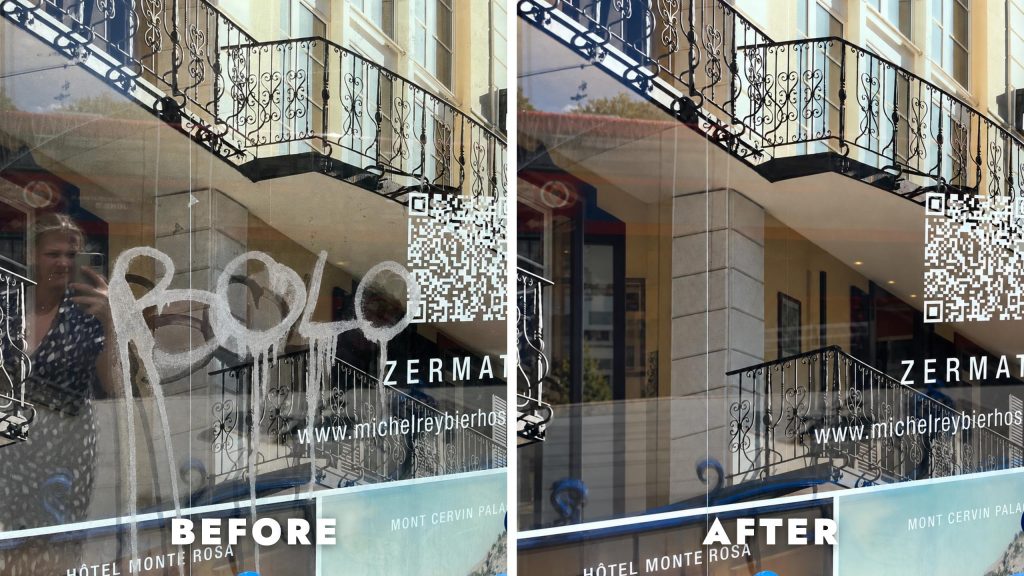
Before & After Photo of Graffiti Removal Project in Camden Town
Fly-Posting Is A Different Job From Tagging
Camden carries more fly-posting than anywhere else we work, and it is worth separating from spray paint because the removal problem is not the same.
A poster is paper, ink and adhesive. Pulling it off is easy and almost always the wrong move, because what you leave behind is the part that causes the damage.
The Adhesive Is The Real Problem
Wheat paste and contact adhesives bond into porous surfaces. Once the paper is stripped, a hard residue stays, it darkens as it collects grime, and it holds the outline of every poster that was ever there. On render or unpainted brick that shadow is more conspicuous than the poster was.
Paper Pulp Drives Into The Surface
Layered posters soften in the rain and the pulp works into open texture. Scraping compacts it further. It has to be softened and lifted rather than picked at, which is slow and is why the cheap option looks like a cheap option.
Stripping Posters Takes Finishes With It
On painted timber, on vinyl signage and on older powder coated shutters, poster adhesive frequently bonds better than the finish beneath does. Pull hard and the paint, the vinyl or the coating comes away with the paper, which turns a cleaning job into a repainting job.
Layered Posting Hides What Is Underneath
Where a surface has been posted repeatedly for months, we frequently find tagging, previous adhesive and sometimes damage beneath the top layer. That is why a poster job is quoted after the top layer is lifted, not before, and we say so rather than discovering it on site and asking for more.
Choosing The Method
No single product covers a district like this. Four approaches carry most of the work, and which applies is a decision rather than a default.
Low Pressure Superheated Steam
The DOFF system cleans with heat rather than force, at a pressure low enough to leave a masonry face intact. It is the strongest general option on Camden's older brick and stucco, and it is particularly good on poster adhesive because heat softens the bond rather than tearing at it.
Dry Ice Blasting
Non-abrasive, with no secondary waste because the pellets sublimate on impact. It suits delicate brick, stone and decorative metalwork, and it is the answer where run-off would be a problem, such as above a basement lightwell or beside a food stall.
Soda Blasting
Gentler than grit, useful on sound masonry and on ironwork, though it needs full containment.
Poultice Treatment
Draws pigment and adhesive residue back out of porous stone and brick rather than driving it in. It is the only method that works where something has soaked well into the substrate.
The test patch settles which one, rather than whatever happens to be loaded in the van that morning. Why the obvious shortcut is usually wrong is explained in high-pressure washing for graffiti removal.
Reading The Surface First
A price begins with identifying the material, since the surface decides the method and the wrong one turns a cleaning job into a making-good job.
- Unpainted brick across the older stock, which tolerates least and needs softened removal tested first.
- Painted stucco and render on the High Street terraces, porous and easily left paler where treatment was too strong.
- Painted timber on shopfronts, doors and stall risers, where solvent lifts the finish as readily as the tag.
- Powder coated metal on shutters and railings, where the coating is the product rather than a finish over it.
- Painted metal on shutter housings, gates and street furniture in the market areas.
- Cast iron on canal railings, bollards and bridge structures.
- Polished granite stall risers and thresholds, which burnish visibly if worked unevenly.
- Hoarding board around the constant redevelopment, the single most posted surface in the district.
- Glass and glazing, where paint comes off cleanly but acid etching does not and needs a different service.
A single rate covering brick, render, timber and shutters is a sign nobody assessed the elevation. There is more in what affects the cost of graffiti removal.
What You Are Actually Buying
Every contractor calls itself professional, so here is the specific content of the word, set out against what each item does for you.
| Included | What it does for you |
|---|---|
| Surface assessed before any figure is given | Material, existing coating, degree of weathering, and a trial in a spot nobody sees. Not a look from the kerb. |
| Method statement and risk assessment up front | Portfolio managers file them. Smaller operators are seldom offered them at all, and they are your cover if the work goes wrong. |
| Live public liability cover | Request the certificate itself from anyone quoting, not an assurance that cover exists. |
| Containment and wastewater handling | Run-off is contaminated and should reach no gully, lightwell or canal. Beside the water that is a legal matter, not a courtesy. |
| Correct waste disposal | Poster pulp, adhesive residue and chemical waste are not general refuse, and a contractor who cannot say where theirs goes is a risk to you. |
| Dated images before and after | Supplied every time, whether they are going into a management file or to your own insurer. |
| Seven days a week, fully self-contained | Our own water and power come with us, so neither your supply nor your people are called on, and attendance by you is rarely needed. |
Both DIY vs hiring professionals and safety precautions during graffiti removal go further into it.
Response Times, Honestly
Most of Camden we attend same day, seven days a week, and for accessible work at ground level that is the normal answer. Three things genuinely change it.
The Market Crowds
Between late morning and early evening the pedestrian density around the market and the Lock makes a working area impractical. Early morning and evening are the reliable windows, and we plan to them rather than arriving and hoping.
Height And Canal Access
Anything beyond safe reach from the ground, or reached only from the towpath, needs equipment and planning rather than an unscheduled visit.
Protected Fabric
Much of the High Street and the streets behind sit in conservation areas with listed frontages. The method may need agreeing before anybody starts.
For portfolios we will propose a scheduled cycle rather than reacting each time, which in a district with this much fly-posting is both cheaper per incident and more consistent than call-outs.
Removing It Or Covering It Up
| Painting over or re-posting | Professional removal | |
|---|---|---|
| Immediate appearance | Hidden, if the colour matches | Surface returned to original |
| On stucco and render | Patch reads pale, then darkens unevenly | Original finish retained |
| On posted hoarding | Invites the next layer within days | Clean board is posted less often |
| Within a year | Patchwork elevation, visibly maintained badly | Nothing to weather differently |
| Listed or conservation frontage | May require consent | Nothing altered |
| Long term cost | Recurring, and compounds visually | One-off per incident |
The longer-term arithmetic is in the hidden costs of not removing graffiti promptly.
Do you need graffiti removed from your property? Get a fast, hassle-free quote today! Click here to get a professional graffiti removal quote or call us today on: 020 8050 5997
What To Do In The First Hour
- Photograph it before anybody touches it, dated, wide enough to show the elevation and close enough to show the surface texture.
- Leave posters alone rather than pulling them off. The paper is the easy part and stripping it dry is what leaves adhesive shadow and takes finishes with it.
- Stop anybody scrubbing spray paint. A wire brush drives pigment into porous brick and stucco and turns a surface problem into a deep one.
- Keep proprietary removers off masonry. Most are made for hard non-porous surfaces, and there is an honest assessment in chemical solutions for graffiti removal.
- Do not pressure wash it. Pressure that seems modest blows the face off soft brick and opens lime mortar joints.
- Work out whose surface it is. Street furniture, estate walls and the highway go to the council for free; your own frontage does not.
- Report it as criminal damage where it is on your own fabric, following reporting vandalism in London.
How The Work Is Carried Out
- Identify the substrate, any existing coating, how weathered it is, and whether posters are concealing anything beneath them.
- Test in a concealed area. Always on masonry, without exception, because the test establishes the gentlest method that works and that is the one we use.
- Set up containment, with sheeting, run-off collection and protection of doorways, lightwells, stalls and the waterway where we are working near it.
- Soften rather than strip where posters are involved, lifting paper and adhesive together instead of pulling the paper and leaving the bond behind.
- Start with the mildest approach that shifts anything and step up only if it stalls, instead of opening hard and trusting the surface to cope.
- Carry the treated zone outward and fade it, so a weathered wall is not left with a conspicuously clean rectangle in the middle of it.
- Rinse, collect the run-off rather than letting it find a drain or the canal, and take the residues away.
- Record the finished elevation and hand over dated images from both stages alongside a written note of the method and materials used.
Sometimes full recovery is not always possible, and we will say so before a tool comes out rather than afterwards. Adhesive cured into open render, pigment driven deep by somebody else's scrubbing, and a coating already failing beneath the posters each mean a realistic expectation in writing instead of a promise we cannot keep.
Where We Work Around Camden Town
| Location | What we are usually called to |
|---|---|
| Camden High Street | Painted stucco frontages, shutters and decorative signage, with the heaviest footfall and the heaviest posting |
| Camden Lock and the market approaches | Brick, ironwork and hoarding, with access dictated by the crowds |
| Chalk Farm Road | Shopfronts, shutter housings and gable elevations, quieter at night and marked accordingly |
| The canal and towpath elevations | Rear walls, railings and bridge structures reached on foot, with containment kept clear of the water |
| Kentish Town Road and Camden Road | Mixed parades with flats above, where the residential door and stair glazing are hit alongside the shop |
| Hoardings and redevelopment sites | Board elevations that attract layered posting faster than any other surface in the district |
Work Completed In North London
- Acid etched graffiti removal in Hackney
- Emergency acid etched graffiti removal in Dalston
- Acid etched graffiti removal in Farringdon
- Acid etched graffiti removal on Bond Street
Who We Work For In Camden Town
| Client | What the work looks like |
|---|---|
| Managing agents and asset managers | Parade and market-adjacent portfolios on scheduled cycles, with documentation supporting recharge |
| Market and estate operators | Shared frontages, ironwork and hoarding, quoted as a run rather than unit by unit |
| Independent shops, bars and venues | Single frontages worked before opening or after close, at a price that makes acting on it realistic |
| Licensed venues and late premises | Shutters and entrances dealt with in the afternoon window rather than around a night that has not ended |
| Developers and hoarding owners | Board elevations cleared on a cycle, because a clean hoarding is posted less often than a layered one |
What Drives The Price
There is no published rate card in this trade, and a number given before anyone has seen the wall is guesswork. These are the variables that build it, so you can read any quotation you are handed. Wider figures are discussed in how much does graffiti removal cost in London.
The Surface, More Than Anything Else
Powder coated shutters and glazed surfaces are quick. Porous render, soft brick and open-textured stone are slow, because the method has to be gentle and gentle takes longer.
Paint Or Posters
Spray paint is a single removal. Layered posting is a sequence of them, and the adhesive underneath usually takes longer than the paper on top.
The Area Covered, Not The Size Of The Mark
On masonry the treated zone is blended outward into the surrounding surface, so a small tag mid-wall costs more than the same tag in a corner.
Access And Timing
Ground level at a quiet hour is one price. Working around market crowds, from the towpath, or at height with equipment is another.
Whether It Is A Repeat
A surface hit repeatedly holds residue from previous incidents, and each removal is harder than the last. This is the strongest argument for protective coating.
Planned Cycle Or Emergency Call
Per incident, a portfolio cleaned on a rota comes in well below the same portfolio phoning each time something appears.
Who Carries The Cost
Commercial Occupiers
Your lease settles it. Your own frontage normally sits inside the demise. The elevation above it, the flank wall, the service yard and the communal entrance generally do not, and those belong to the landlord and go through the service charge.
If You Are An Independent Trader
Never fund the side wall of a building where you hold a single unit, and do not spend a week chasing a disclaimer for fabric that belongs to somebody else. Raise it, get an itemised figure from us in writing, and put that in front of the freeholder or their agent.
If You Manage The Building
Yours is the signature the council wants on a shopfront disclaimer, so a tenant pressing you for it is not being awkward. Settling in advance whether you sign them or simply instruct the work yourself removes a week from every incident. There is more in who is responsible for graffiti removal.
Is A Claim Worth Making
Run the figure against your excess before a broker hears anything, and read does insurance cover graffiti removal. One removal usually falls under the excess, which means claiming gains nothing and still marks the policy. An entire elevation, or an established pattern, changes that sum.
Reducing The Next Incident
Clearing a surface settles the current problem only. Somewhere posted and tagged as heavily as this, there will be another.
Anti-graffiti coating is a barrier applied to the surface so the next mark sits on the coating rather than soaking into the substrate. Across porous render and brick nothing else performs as well, and against fly-posting it is unusually valuable, since adhesive unable to key into the surface lifts away with the paper rather than remaining as a stain. There is a technical explanation in anti-graffiti coatings and a product comparison in the best coating products for London properties.
Expect A Slight Change In Appearance
Coating tends to darken exposed brick marginally. That suits most owners and not all of them, which is a conversation to have first rather than after it is on.
Not Every Surface Justifies It
Hit once as a small operator, clean the frontage and wait. Coating pays where posting or tagging recurs, and on soft masonry where every removal costs the surface a little. Listed and conservation frontages need the specification put to the local authority beforehand, a subject taken up in graffiti on historic buildings in London.
Areas We Cover Next To Camden Town
- Chalk Farm
- Kentish Town
- Primrose Hill
- Belsize Park
- Gospel Oak
- Tufnell Park
- Holloway
- Islington
- Angel
- Kings Cross
Glass damage is a separate service, covered on the main acid etched graffiti removal page.
Camden Town Graffiti Removal: Frequently Asked Questions
Will the council remove it for free?
On council property, yes. Camden cleans graffiti and removes posters from streets, council-owned street furniture and housing estates at no charge, so if it is a lamp column, a bin or an estate wall, that is the right call to make.
Will they do our shopfront?
Not without paperwork. A signed disclaimer from the property owner is required before the council will remove graffiti from a shopfront, which on a leased unit means tracking down the freeholder or agent for a signature first.
How long does the council route take?
Racist or offensive graffiti is targeted within twenty-four hours of notification, and everything else within five working days of agreement to remove. For street furniture that is reasonable. For a High Street frontage it is a week of trading looking like that.
Our building backs onto the canal. Who deals with that?
The asset owner, not the council. Graffiti on canal and waterway structures, railway land and privately owned street furniture is reported to whoever owns it, which in Camden accounts for a surprising share of what people assume is council responsibility.
Can we just pull the posters off?
No, and it is the commonest mistake here. The paper is the easy part. Stripping it dry leaves the adhesive bonded into the surface, which darkens with grime and holds the outline of every poster that was ever there.
What is left behind after posters are removed badly?
Adhesive shadow, compacted paper pulp in the surface texture, and frequently missing paint or vinyl where the glue bonded better than the finish did. All three are avoidable by softening rather than pulling.
Why can you not quote a poster job from a photograph alone?
Because layered posting hides what is underneath. We regularly find tagging, old adhesive or existing damage below the top layer, so the honest approach is to price after the first layer is lifted rather than guess and come back for more.
What is DOFF and why do you use it?
Low pressure superheated steam. It cleans with heat rather than force, which leaves a masonry face intact and is especially effective on poster adhesive, because heat softens the bond instead of tearing at it.
Is dry ice better than steam?
Neither wins outright; they answer different problems. Dry ice leaves no secondary waste and touches the surface lightly, which makes it the choice near the water where run-off matters. For soft brick and render across a whole elevation, steam usually does better.
Can you pressure wash our render?
No. Pressure that seems modest opens the surface of stucco and render, leaving a patch that is paler and smoother than everything around it, and it will blow the face off soft brick entirely.
When can you work around the market?
Early morning or evening. Between late morning and early evening the pedestrian density around the Lock makes a safe working area impractical, so we plan to the quiet windows rather than turning up and hoping.
Our frontage is listed or in a conservation area.
Cleaning rather than covering is the correct approach, with the method agreed in advance where the listing requires it. Since nothing is altered, no consent question arises, which is exactly the argument against painting over it.
Do we need to be there while you work?
No. Water and power travel with us, so the great majority of jobs need nobody from your side present at all. Across a portfolio that turns five separate site attendances into a single instruction.
As a tenant, am I liable for the whole elevation?
Very probably not. The demise normally stops at your own frontage, leaving the upper elevation, the side wall and the yard with the freeholder. Raise it and forward our written figure to them.
Our hoarding gets posted constantly. Is there any point clearing it?
Yes, and the effect is bigger than people expect. A clean board attracts far less posting than a layered one, so a hoarding on a scheduled clear cycle stays markedly cleaner than one left until it looks bad.
Does coating help against posters as well as paint?
Yes, and it is one of the strongest arguments for it here. Adhesive that cannot bond into the surface lifts away with the paper rather than staying behind as a shadow.
What is on the glass is not paint. It will not come off.
Almost certainly acid etching, which is a separate service needing an entirely different technique. There is a full explanation on our acid etched graffiti removal page.
How do we get a price?
Photograph the full elevation plus one close shot of the material, and tell us whether it is paint, posters or a mixture. From that we can normally price it and set out a method without needing to visit first.
Do you need graffiti removed from your property? Get a fast, hassle-free quote today! Click here to get a professional graffiti removal quote or call us today on: 020 8050 5997