





Your frontage has been marked and you want it cleared properly, without a ghost of the lettering, a bleached patch, or a wall that takes the next one deeper than this one went.
Most of it comes away. What decides the outcome is the material beneath it, because the method that clears paint from glazed tile will open the face of soft brick, strip a painted shutter and leave a permanent pale square on render.
We work out what the wall is, test the approach where it will not show, then lift the mark and leave the finish alone. Across most of Dalston that happens the day you call, seven days a week.
Do you need graffiti removed from your property? Get a fast, hassle-free quote today! Click here to get a professional graffiti removal quote or call us today on: 020 8050 5997
Somebody Else Can Report Your Wall
This is the part of the local position that surprises owners here more than anything else, and it is worth understanding before it applies to you rather than afterwards.
The Request Does Not Have To Come From You
In this borough a request for graffiti to be removed can be made by anyone, including people with no interest in the property. A passer-by, a neighbour or a resident who dislikes what is on your wall can set the process in motion, and the first you may hear of it is a notice.
Notices Go To The Address On The Register
Where an owner does not respond, the authority can act by default and arrange removal itself. The practical weak point is the contact details: statutory notices are sent to the address held for the registered owner, and if that record is out of date the letters go somewhere you will never see them. There is a well-documented local case in which exactly that happened and a valuable mural was removed from a private building whose owner had received no warning at all.
Check Your Registered Details, Today
Confirming that the registered correspondence address is current takes five minutes and it is the only reliable early warning you have. Agents and freeholders holding several buildings should check each one, because the records are held per title rather than per owner.
Which Cuts Both Ways
Something you want gone can be pushed for by more than just you. Something you want kept needs saying so before another party asks for its removal.
Recent London Graffiti Removal Projects
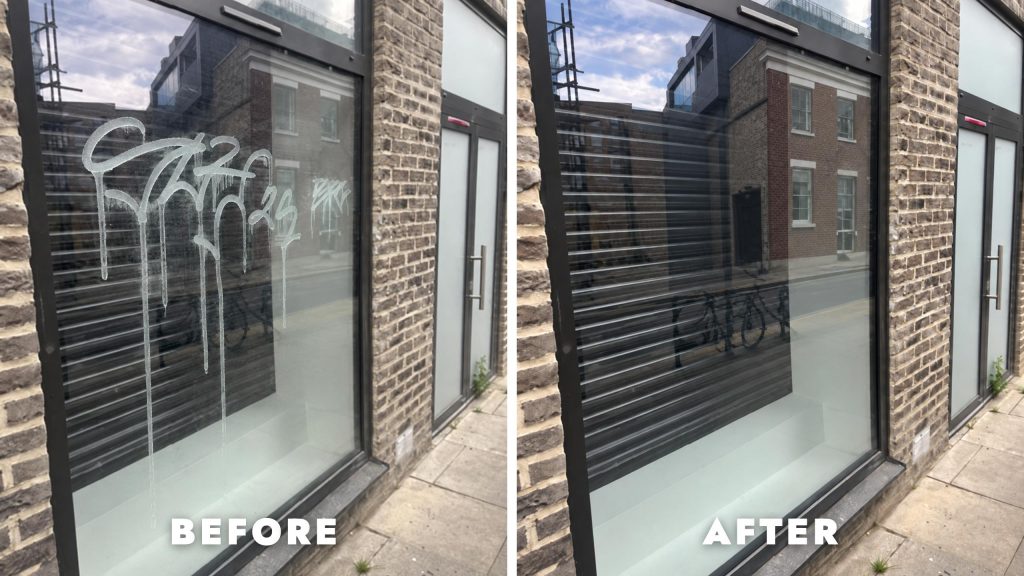
Before & After Photo of Graffiti Removal Project in Dalston
Street Art Is Now A Judgement, Not A Blanket Rule
The borough's position has moved, and the change matters commercially for a district where a wall piece can be an asset.
The Distinction Is Recognised
Current policy acknowledges the difference between graffiti and street art rather than treating everything identically, with decisions guided by the location, the content and the impact of the work. That is a meaningful shift from a blanket approach and it creates room to argue a case.
Make The Case Before You Need To
Record it now where a piece on your building draws customers, was commissioned, or is simply something you want to keep. Dated photographs, whatever commissioning correspondence exists, and a note to your agent or freeholder cost nothing and are what you would otherwise be assembling under time pressure.
We Do Not Remove Anything Without Asking
Where a frontage carries work that may be wanted, we establish what is authorised before quoting, and we will not clear a piece on the assumption that anything unexplained is vandalism. Where tagging has been applied over work you want kept, selective removal confined to the tag is a job we do regularly.
And Where It Genuinely Is Vandalism
Most of what we clear here is straightforward tagging on shutters, render and brick, and there is no ambiguity about it at all. The point is not to complicate a simple job, it is to ask one question first.
Selecting A Method
No single product suits a district holding Victorian brick, painted render, roller shutters and newer coated frontages within one street. Four approaches carry most of the work.
Low Pressure Superheated Steam
DOFF relies on temperature instead of impact, run at a pressure that leaves both the brick skin and the soft mortar untouched. On Victorian stock it is the first thing we consider.
Dry Ice Blasting
Non-abrasive, and it leaves no water or residue because the pellets sublimate on impact. Useful on ironwork, on damp rear elevations and anywhere a wash would carry material into a neighbouring unit.
Soda Blasting
Gentler than grit and suited to sound masonry and railings, with full containment, which on a busy parade means bounding an area people walk past continuously.
Poultice Treatment
Draws pigment back out of porous brick, render and stone instead of driving it deeper, and it is the only approach that works once paint has soaked into an open surface.
Which of the four applies is settled by testing, never by convenience. High-pressure washing for graffiti removal sets out the damage the quick answer does, and chemical solutions for graffiti removal weighs the alternatives.
Start With What It Is Made Of
We quote nothing until the material is established, because the surface decides the method and picking wrongly costs more than the tag did. Brick mishandled gives ghosting and a spalled face; painted timber mishandled loses its finish altogether. Brick, render, stone, timber, metal and painted surfaces behave nothing like one another.
- Unpainted stock brick through the older terraces and flank walls, soft and the surface pressure ruins fastest.
- Painted brick on the gable ends, where the tag and the wall coating are both paint and one cannot be lifted without risking the other.
- Painted render on the parade frontages, where an unmatched repaint shows for years.
- Painted metal on roller shutters, gates and shutter housings, the single most frequently marked surface here.
- Powder coated metal on newer shopfronts and railings, cured on and impossible to patch locally.
- Painted timber on older shopfronts, doors and stall risers.
- Cast iron on railings, bollards and shopfront columns.
- Glazed brick on pub and older commercial frontages, non-porous and the easiest surface in the area.
- Laminated glazing in doors and display windows, where spray paint lifts cleanly and etching does not lift at all.
One rate quoted across brick, render, shutters and glazing tells you the frontage was never assessed. See what affects the cost of graffiti removal.
The Standard You Should Be Buying
The word professional is not protected, so here is what ours is built on, item by item, with the purpose of each.
| What is included | Why it matters |
|---|---|
| The wall assessed before pricing | Its material, whatever is already on it, its condition, and a test somewhere hidden. On painted brick that assessment decides whether the job can be done. |
| Authorisation checked, not assumed | We establish what on the elevation is wanted before clearing anything, rather than treating everything unexplained as vandalism. |
| Method statement and risk assessment up front | Written for your frontage rather than pulled from a folder, which is what an agent or freeholder actually reads. |
| Public liability insurance you can verify | Ask for the certificate itself before anyone starts, since a promise on a call is no protection at all. |
| Containment that protects neighbours | Nothing reaching the units either side, the drainage or the pavement people are using a metre away. |
| Disposal properly recorded | Everything produced leaves with us under a transfer note, so nothing remains attached to your building. |
| Dated images and a written works record | Issued every time, and the evidence you would otherwise be assembling under pressure. |
| Available every day, independent of site | We arrive self-contained with our own water and power, so nothing is drawn from your supply and you rarely need to be there. |
DIY vs hiring professionals makes the case at greater length, and safety precautions during graffiti removal covers how a job is controlled.
Getting To You
If it can be reached from the footway, it is generally dealt with that same day, any day. Three things lengthen it.
Questions Of Authorisation
Where a frontage carries work that may be wanted, we confirm before clearing. That occasionally adds a day and it is the right day to spend.
Anything Above Reach
Gable ends and upper elevations need access equipment, and on these pavements that also means a pedestrian plan agreed beforehand.
Trading Hours On The Parades
A great deal of this area trades late, so the workable window is mid morning rather than early or after close, and with residents above an early start is not an option.
For portfolios and traders' associations we propose a scheduled cycle rather than reacting each time, which on a parade with this much shutter frontage is cheaper per incident and keeps the run consistent.
Removing It Or Covering It Up
| Painting over | Professional removal | |
|---|---|---|
| On painted brick | Another layer, and the next one after that | The wall coating kept and the tag taken off it |
| On a roller shutter | Adds weight and peels at the slats within a season | Original finish retained and running freely |
| If a notice is involved | May not satisfy what was asked for | Documented removal with dated evidence |
| Within a year | The patch weathers differently and shows | Nothing to weather differently |
| Next incident | Another patch, then another | Same process, same result |
| Long term cost | Recurring, and ends in repainting the elevation | One-off per incident |
The longer-term arithmetic is in the hidden costs of not removing graffiti promptly.
Do you need graffiti removed from your property? Get a fast, hassle-free quote today! Click here to get a professional graffiti removal quote or call us today on: 020 8050 5997
What To Do Before Anyone Touches It
- Photograph it dated, wide enough to show the elevation and close enough to show the surface texture.
- Decide whether anything on that wall is wanted, and say so when you instruct, because a contractor clearing the whole elevation cannot undo it afterwards.
- Check that the registered correspondence address for the property is current, since that is where any notice would be sent.
- No brushing, by anyone. Wire bristles drive the pigment into soft brick and render and convert a shallow problem into a lasting one.
- Shop-bought removers belong nowhere near masonry or a painted shutter, having been formulated for hard, sealed surfaces.
- Never pressure wash brick or render, which loses its face, gives up the mortar in its joints and ends up conspicuously paler than the wall beside it.
- Assuming the wall is yours, record it with the police as criminal damage, as described in reporting vandalism in London.
The Process On Site
- Establish what on the elevation is authorised and who holds authority to instruct the work.
- Work out the material, whatever coating sits on it already, and how open or weathered it has become.
- Prove the approach on the same material somewhere hidden, checking it takes the paint off without opening the surface or lifting the coating beneath.
- Sheet and contain the working area, protecting the units either side, the glazing and the drainage.
- Open at the mildest setting that does anything, moving up only when it stops working, and never starting at the strong end.
- Where work is being kept, confine the treatment to the tag itself so the original paint film is left intact.
- Blend the edges away into the surrounding brickwork, so no bright panel is left sitting in a weathered wall.
- Capture everything that comes off instead of allowing it into a drain or next door, and take it away under the transfer note.
- Record the finished elevation and issue the dated set with a written summary of products and technique.
Full recovery is not always possible on every surface, and you hear that at assessment rather than halfway through the job. Where a previous pressure wash has driven pigment in, where open render has absorbed the paint, or where the wall coating beneath was already failing, we set out in writing what can realistically be achieved instead of overpromising.
Where We Work Around Dalston
| Location | What we are usually called to |
|---|---|
| Kingsland High Street and the main road | Painted render frontages, shutters and signage on the busiest and most frequently marked run |
| Ridley Road and the market streets | Shutters, stallboards and service frontages, worked before the pitches are set out |
| Dalston Lane and Balls Pond Road | Mixed parades with flats above, where the residential door is hit alongside the shop |
| Gable ends and flank walls | Large painted and unpainted brick elevations, frequently carrying work somebody wants kept |
| The station approaches | Concentrated flow at either end of the day and very little between times |
| Rear elevations and yards | Back-of-house brickwork and shutters where marking accumulates because nobody walks round |
Work Completed In East London
- Emergency acid etched graffiti removal in Dalston
- Acid etched graffiti removal in Hackney
- Acid etched graffiti removal from glass in Shoreditch
- Acid etched graffiti removal on Brick Lane
Who We Work For In Dalston
| Client | What the work looks like |
|---|---|
| Independent shops, bars and venues | Single frontages and shutters, a written figure, and a straight answer on whose surface it is |
| Managing agents and freeholders | Parade portfolios on scheduled cycles, with registered details and authorisation checked before instruction |
| Owners of gable and flank walls | Large elevations where what is kept and what is cleared has to be settled first |
| Market and yard operators | Shutters, stallboards and service frontages, worked around trading rather than through it |
| Housing providers and estate teams | Communal entrances, bin stores and stair cores on a rota rather than a ticket at a time |
What Drives The Price
Published prices do not exist here, and any figure arrived at without seeing the wall is a guess. What follows are the things that genuinely change a quotation, so one can be read properly rather than compared on its total alone. There is a broader picture in how much does graffiti removal cost in London.
What It Is And What Condition It Is In
Sound shutters and glazed brick are fast work. Painted brick, open render and anything previously blasted with pressure runs much longer, because the method needs proving first and then applying slowly.
Whether Anything Is Being Kept
Clearing a blank wall is straightforward. Working around a piece that is staying is slower and more skilled, and it is priced accordingly.
Height And Access
Ground level is one price. Gable ends and upper elevations need equipment and a pedestrian plan.
How Long It Has Been There
Paint sitting on render or brick for weeks is materially harder to lift than the same tag treated in the first few days.
We Price The Blend, Not The Letters
Masonry needs the treated area graded out into the wall around it, so a modest tag in open brickwork costs more than a larger one tucked into a corner.
On A Rota Or On Demand
Incident for incident, buildings kept to a maintenance schedule cost noticeably less than those dealt with by emergency call.
Who Carries The Cost
If You Lease A Unit
Your lease settles it. The shopfront and its shutter sit inside almost every demise, while the elevation over it, the side wall and the communal door usually do not, and those come back through the service charge.
Independent Operators
Never fund a gable end on a building where you hold one unit. Report it, get an itemised figure in writing, and put that in front of the freeholder or their agent.
Freeholders And Managing Agents
Yours is the address on the register, yours is the signature any council permission needs, and yours is the decision on whether to instruct directly. Keeping the registered details current is the cheapest risk control available to you. More on this at who is responsible for graffiti removal.
Whether To Involve Insurers
Measure the cost against your excess before telling anyone, and read does insurance cover graffiti removal. A single clean almost always falls short of the excess so there is nothing to recover, whereas a properly recorded run of incidents is another matter.
Making The Next One Less Likely
A clean resolves the current mark and leaves everything else unchanged. With this quantity of shutter and gable wall along one street, further marking is certain.
Put a disposable layer between the wall and the world and the next tag lands on that instead. The argument is strongest on shutters and painted brick, and on painted brick especially, since a coated wall can be cleaned with no risk to the paint underneath, which is otherwise the most difficult removal in our range. See anti-graffiti coatings for how they work and the best coating products for London properties for the options.
Expect A Small Change In Appearance
Bare brick reads slightly darker once treated and a shutter picks up a light sheen. That troubles almost nobody, though it troubles some, so it is worth agreeing before application.
Where We Will Tell You Not To Bother
Anything above reach, anything marked once in several years, and any wall carrying work you intend to keep, since a coating goes over everything indiscriminately. On protected fabric the specification needs raising with the local authority first, and there is separate guidance at graffiti on historic buildings in London.
Areas We Cover Next To Dalston
- Hackney
- Hackney Central
- Haggerston
- Hoxton
- Shoreditch
- De Beauvoir Town
- Canonbury
- Highbury
- Stoke Newington
- Homerton
Glass damage is a separate service, covered on the main acid etched graffiti removal page.
Dalston Graffiti Removal: Frequently Asked Questions
Can somebody else report graffiti on our building?
Yes. In this borough a request for removal can come from anyone, including people with no interest in the property, so a neighbour or a passer-by can start the process without your involvement.
What happens if we do not respond?
The authority can act by default and arrange removal itself. That is precisely why the correspondence details held for the registered owner matter so much.
Why do our Land Registry details matter?
Because statutory notices go to the address held on the register. If that record is out of date the letters arrive somewhere you will never see them, and there is a well-documented local case where a valuable mural was removed from a private building whose owner had received no warning at all.
How do we protect against that?
Confirm that the registered correspondence address is current. It takes minutes, it is the only reliable early warning you have, and agents holding several buildings should check each one because records are held per title.
We have a piece on our wall that we want to keep.
Then record it now rather than later. Dated photographs, any commissioning correspondence and a note to your agent or freeholder cost nothing, and they are what you would otherwise be assembling under time pressure.
Does the council distinguish street art from graffiti?
Current policy does recognise the distinction rather than treating everything the same, with decisions guided by location, content and impact. That is a change from a blanket approach and it creates room to make a case.
Will you clear everything on the elevation?
Only what you tell us to. We establish what is authorised before quoting and will not treat anything unexplained as vandalism by default. Where tagging sits over work you are keeping, we confine the removal to the tag.
Our gable end is painted. Can the tag come off without taking the paint?
Sometimes, and it is the hardest removal we do, because the tag and the wall coating are both paint. We test first and give you a realistic expectation in writing rather than promising a result we cannot guarantee.
Can you pressure wash our brickwork?
No. Pressure lifts the fired face, strips lime mortar from the joints and leaves a patch noticeably lighter than the wall around it, and none of that can be reversed.
What is DOFF?
Superheated steam at low pressure. It cleans by heat rather than impact, which is why it copes with soft, lime-mortared masonry where pressure methods do damage.
Why dry ice on a rear elevation?
Because it adds no water. Rear walls here are frequently damp already, and the pellets turn to gas on impact so there is no run-off to manage in a yard where everything drains to one point.
Our shutter has been tagged. Should we repaint it?
We would advise against it. Each repaint thickens the coating until it flakes at the slats within months, and the colour rarely matches. Removing the tag preserves the original finish and the shutter keeps running smoothly.
When can you attend a parade with flats above?
Mid morning. Much of this area trades late, so an early start is not an option with residents overhead, and after close is usually too late to be useful.
As a tenant, is the wall above our shop ours?
Usually not. A demise typically stops at the shopfront and shutter, leaving the wall above and the flank to the freeholder. Pass it to them along with our written quotation.
Several units along the parade have been hit.
Treat the parade as a single instruction. Units are priced one by one, but one visit and one mobilisation charge covers them all, which is often the only way several small budgets are released at once.
Is protective coating worth it?
On repeatedly marked shutters and painted brick, yes. Above reach, marked once in years, or on a wall carrying work you want kept, we will tell you not to bother, since a coating goes over everything indiscriminately.
What is on the glass is not paint and will not come off.
You are looking at acid etching. The process needed is entirely different and it is dealt with separately, as described on the acid etched graffiti removal page.
How do we get a price?
Send photographs of the elevation and a close view of the surface, and tell us whether anything on that wall is to be kept. Those two things let us price the work and propose a method without visiting first.
Do you need graffiti removed from your property? Get a fast, hassle-free quote today! Click here to get a professional graffiti removal quote or call us today on: 020 8050 5997