





Something has been sprayed on a Mayfair elevation and you want it taken off properly, leaving the stucco, the stonework and the painted metalwork exactly as they were.
Nearly all of it lifts. What is different here is that a great deal of Mayfair sits under an estate scheme with written rules about how the outside of your building may look, and those rules make the obvious shortcut the wrong move. The surface decides the method; the estate decides what the finished elevation is allowed to be.
We identify the material, prove the treatment out of sight, then lift the mark and leave the finish untouched. Across W1J and W1K that is usually the same day, any day of the week.
Do you need graffiti removed from your property? Get a fast, hassle-free quote today! Click here to get a professional graffiti removal quote or call us today on: 020 8050 5997
Here The Colour Is Not Yours To Choose
Most owners dealing with a tag assume the decision is theirs: clean it or cover it. Across much of Mayfair that assumption is wrong, and the document that makes it wrong is not a planning policy.
A Scheme Made Under The 1967 Act
The Grosvenor Mayfair Estate Management Scheme was made under section 19 of the Leasehold Reform Act 1967 and amended by later housing legislation. It applies to the lands and buildings within the estate boundary, and it is a legal framework rather than a set of preferences.
It Binds You Even If You Own The Freehold
This is the part that surprises people. The scheme applies to all the enfranchised properties comprised in the estate, so buying your freehold does not release you from it. Grosvenor remains the manager whether or not the freehold has been acquired, and no alteration to the external construction or appearance may be made without the previous written consent of the Surveyor, such consent not to be unreasonably withheld.
Painting And Cleaning Are Both Obligations
The scheme is specific in a way that bears directly on graffiti. Exterior woodwork and metalwork are to be painted every third year, with at least two coats of good quality paint approved in writing by the Surveyor. Cement and stucco are to be finished in a light cream colour of a tint previously approved. Owners are also required to clean the exterior stonework and repoint external brickwork as the Surveyor considers necessary.
What Follows When A Tag Appears
Two things, both pointing the same way. Covering the mark with whatever tin is to hand is not neutral, because the colour and quality of external paint are specified and approved cream is not something anybody keeps in a cupboard. And keeping the elevation clean is not goodwill, it is an obligation you already owe. Removal discharges it and alters nothing. Over-painting risks a breach on colour while doing nothing for the stone beneath.
Recent London Graffiti Removal Projects
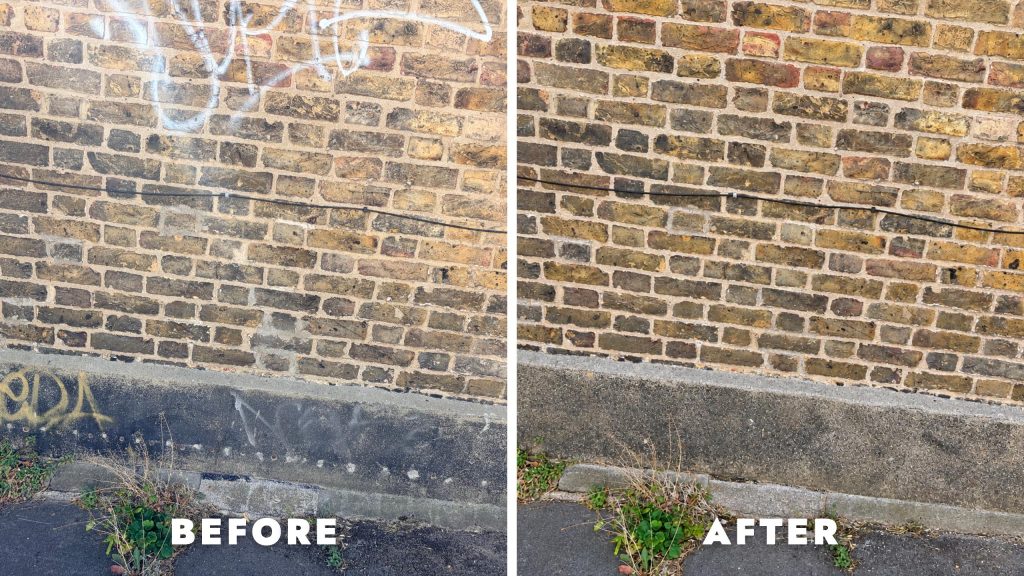
Before & After Photo of Graffiti Removal Project in Mayfair
It Happens In The Mews
The second thing worth knowing is that the trophy frontages are rarely the problem. Mayfair's marking lands where nobody is watching.
Where It Actually Goes
Mews and service lanes take the great majority of it. They are narrow, unlit for stretches, dead at night, and lined with exactly the flat reachable surfaces a tag wants: painted render, garage and coach house doors, stucco flanks, bin stores and the blank returns of the houses facing the square.
The Mews Is Somebody's Home
Most Mayfair mews are now residential rather than stabling, which inverts the usual scheduling. On a commercial frontage you work before opening. In a mews the constraint is people asleep above and either side, so the early start that suits Grosvenor Street does not suit Adams Row. Better to propose mid morning honestly than book dawn and wake a street.
Painted Metalwork Runs On A Cycle
With exterior woodwork and metalwork on a three yearly painting cycle, where a tag falls in that cycle changes the sensible answer. Marking shortly before a scheduled redecoration can often be treated lightly, since the surface is about to be recoated. The same mark two months after redecoration needs proper removal, because nobody brings a full cycle forward by thirty four months.
Approved Cream Does Not Patch
Stucco finished in an approved light cream tint is unusually unforgiving of spot repair. Any patch is a different age, weathers at a different rate, and reads as a rectangle within a season even when the colour matched on the day. The only stucco finish that stays invisible is the one never interrupted, which argues for removing the mark rather than painting across it.
Two Identical Tags, Two Different Bills
The same aerosol, the same size, the same afternoon, on two Mayfair walls a hundred metres apart. The surface decides everything that follows.
| On painted render to a mews flank | On ashlar stone to a principal elevation |
|---|---|
| The paint sits largely on a modern coating, so the pigment has not travelled far. | The stone is porous and the pigment has moved into the surface rather than sitting on it. |
| A correctly chosen gel and a single pass usually does it. | A poultice held for hours, sometimes across two applications on separate days. |
| Masking is light, because the neighbouring surfaces are robust. | Masking is extensive, protecting adjoining dressings, joinery and metalwork. |
| Finished within a morning, with no need to return. | A staged job with a return visit built into the quotation. |
| Little consequence if the approach needs adjusting. | No margin at all, since a wrong product etches or bleaches the face permanently. |
That is also where the honest limits sit. Where an earlier attempt has already opened the face of the stone, or a mark has been left long enough to carbonate into old stucco, a clean will not bring it back and we will say so at the quotation rather than after the work.
Porous, Non-Porous, Coated
Rather than sort Mayfair's fabric by age, it is more useful to sort it by whether the surface can absorb anything, because that single property decides the method.
Porous
- Portland and other limestone to principal elevations and dressings, dissolved rather than cleaned by anything acidic.
- Soft London stock brick to returns, flanks and mews, which spalls under pressure and then holds the next mark far more deeply.
- Lime mortar joints, which abrasives empty out before they touch the paint.
- Unpainted render and older stucco, absorbent and easily bleached by a strong solvent.
Non-Porous
- Glazing, glazed tile and polished stone, where the pigment never went anywhere and a gel lifts it in minutes.
- Bronze, brass and patinated metal, safe from absorption but ruined by abrasion and by alkalis.
- Powder coated and anodised metal on later frontages, which burnishes under heat and never recovers.
Coated
- Painted stucco in approved cream, where the risk is not the substrate but the finish.
- Painted timber joinery, doors and mews garage doors, where anything strong enough for the tag takes the top coats too.
- Painted railings and area metalwork, on the three yearly cycle described above.
Substrate detail is on the relevant pages, including limestone, unpainted brick, mortar joints, smooth stucco, painted timber, railings and cast iron, powder coated metal and polished stone.
Superheated Steam Against The Machine People Picture
| The pressure washer most people imagine | Low pressure superheated steam |
|---|---|
| Removes by force, driving water at the surface hard enough to knock material off. | Removes by heat, softening the binder until the film releases on its own. |
| Will take a tag off soft stone and some of the stone with it. | Leaves the face of the stone as it found it, which is why DOFF systems are specified on protected fabric. |
| Uses a great deal of water, most of which ends up on the pavement. | Uses comparatively little, contained at the base of the work. |
| Fast, and that speed is the whole problem. | Slower, because dwell time is doing the work rather than impact. |
Dry Ice And Enclosed Spaces
Dry ice blasting is excellent where water is unwelcome, with one limitation that matters in Mayfair specifically. The pellets become carbon dioxide as they work, and carbon dioxide is heavier than air, so it settles and accumulates at low level anywhere poorly ventilated. Mews garages, undercrofts, lightwells, basement areas and closed courtyards are exactly that. Used there without forced ventilation it is genuinely hazardous rather than merely unwise, which is why we sometimes decline it in a space a customer expected it to suit.
Alkalinity And The Paintwork Beside It
Soda blasting is a useful middle option on robust painted surfaces, and the thing to understand is that its residue is strongly alkaline. It does not stay neatly within the treated area: it drifts, settles on whatever is adjacent, and quietly attacks paint films, lacquers and patinated metal. On a Mayfair elevation those neighbours are freshly painted railings, approved cream stucco and polished door furniture, all damaged by it. Where blasting is right at all it is masked far wider than the work itself, and where it is not, a poultice does the same job slowly and harmlessly. If you want the chemistry behind that, we cover it under chemical solutions for graffiti removal, and the physics of the alternative under pressure washing for graffiti removal.
The Photographic Record Is Part Of What You Buy
On an estate where a surveyor may ask what was done to an elevation, the record is not a courtesy. Every job is photographed at four points: the marking as found, the concealed trial patch with the method noted, the work in progress, and the finished elevation, all dated. That set does three jobs. It evidences to the estate or the managing agent that nothing was altered. It gives a managing agent something to attach to a service charge apportionment. And it builds a history of a surface, so a fourth incident on the same flank is demonstrably a pattern rather than an anecdote.
It is also what makes it unnecessary for anybody to stand there. Nobody needs to be on site: we work self-contained with our own water and power, so nothing is drawn from the property and no access to the interior is needed, and public liability cover is evidenced before we attend rather than produced afterwards. We operate seven days a week, which matters for the reason set out next. How we handle products, run-off and the footway is covered under safety precautions during graffiti removal.
Why The First Forty-Eight Hours Change The Job
Aerosol paint is not finished when it stops being wet. Solvent flashes off in minutes, but the resin keeps cross-linking for days, and two things work against you meanwhile. The film hardens, needing longer dwell and a stronger product to release. And on absorbent surfaces the liquid phase is still migrating into the pores with pigment in it, which is the difference between a mark on stone and a mark that is now part of it.
Clear it within a day or two and it is usually a single application on almost any substrate. Leave it a fortnight on porous stone or old stucco and the same mark becomes a poultice job across more than one visit, at a multiple of the cost. That is the entire argument for weekend cover: a Friday night tag attended on Saturday is a small job, and the same tag attended on Monday has had two warm days to become a large one.
Do you need graffiti removed from your property? Get a fast, hassle-free quote today! Click here to get a professional graffiti removal quote or call us today on: 020 8050 5997
Offensive Content Takes A Different Route
Everything above assumes ordinary tagging. Where the marking is racist, targeted at a person or household, or otherwise abusive, the sequence changes before anybody picks up a tool. Report it to the police first and get a crime reference, because that reference supports any later action and cannot be obtained once the wall is clean. Photograph it as evidence rather than as a quotation aid: the whole elevation, the content legibly, something establishing location. Then screen it if it is in public view and have it removed ahead of everything else. We treat this category as same day without exception, weekends included, and do not ask about budget approval first. Where and how to make that report is covered under reporting vandalism in London, along with what a crime reference is worth afterwards.
From Test Patch To Sign-Off
- Confirm the material by close inspection, and what must not be touched: railings, joinery, door furniture, anything recently decorated.
- Select the mildest approach with a realistic chance of working, rather than the one that will certainly work.
- Run it on a concealed square, typically low on a return, inside a reveal or behind a downpipe.
- Read the result wet, then again dry, since a patch that looks right while damp can dry back lighter than its surroundings.
- Escalate one step only if the trial fell short, and re-trial at the new setting rather than going straight to the marking.
- Work the marked area outward from its edges in passes, so the treated zone blends rather than announcing itself as a rectangle.
- Collect the run-off and residues, which leave with us under waste transfer documentation.
- Photograph the finished elevation, strike the protection, check each surface as it is uncovered, hand back the footway clear.
Removing It Against Painting Over It
| Painting over | Removing |
|---|---|
| Engages a scheme that specifies paint quality and, on stucco, the tint itself. | Restores the approved finish without altering it, so nothing is engaged. |
| A patch weathers at its own rate and reads as a rectangle within a season. | The elevation continues to weather as one surface. |
| Does nothing for stonework, which the scheme expects to be cleaned rather than covered. | Discharges the cleaning obligation directly. |
| Brings a three yearly redecoration forward, or makes the next one look wrong. | Leaves the decoration cycle where it was. |
Where We Are Called Out Around Mayfair
Grosvenor Square and the elevations facing it. Berkeley Square and Bruton Street. Mount Street, South Audley Street and Curzon Street frontages. Park Lane returns and service elevations. Grosvenor Street, Brook Street and Davies Street. Shepherd Market and the lanes around it. Hill Street, Charles Street and Chesterfield Hill. The mews throughout, including Adams Row, Reeves Mews, Three Kings Yard, Lees Place, Balfour Mews and Culross Street, which take the bulk of the marking. Hanover Square and the office frontages on its western side, plus bin stores, garage doors and blank returns across the whole district.
Work Completed Across Mayfair And The West End
We have removed aerosol from ashlar stone without opening the face, cleared repeat marking from mews garage doors and painted render, lifted tags from railings and area metalwork without breaking the paint system, cleaned marking from approved cream stucco with no patch left behind, taken marks off bronze and brass door furniture using nothing alkaline, and attended offensive content the same day at weekends. Heritage fabric generally is covered on graffiti on historic buildings in London, and glass damage nearby on acid etched removal on Bond Street.
Who Instructs Us In Mayfair
| Who they are | What they need from us |
|---|---|
| Estate surveyors and their appointed managing agents | Evidence that nothing was altered, in a form that satisfies a scheme obligation. |
| Freeholders of enfranchised houses and mews properties | Somebody who knows the scheme still applies to them and works accordingly. |
| Facilities teams for offices, clubs and hotels | One contractor covering principal elevations, returns and service areas on a single instruction. |
| Independent galleries, tailors and single-site operators | One frontage cleared quickly, priced before attendance, with no contract to sign. |
| Household and private staff managing a residence | Discreet attendance at a time that suits the household, and honest scheduling on noise. |
Access Is The Biggest Multiplier
Of everything that can move a figure here, height and access move it furthest by a wide margin. Material changes the method and age changes the dwell time, but neither doubles a price. Access routinely does, because it changes what equipment comes, what permissions are needed, and how much of the day goes on setting up rather than removing.
- Ground level with a vehicle able to stop nearby is the cheapest work we do, and most mews marking falls here.
- First floor and above needs a tower or a platform, which has to be arranged, transported and erected before anything starts.
- Anything requiring the footway or carriageway to be occupied needs a licence, with its own lead time and fee.
- Over a lightwell, an area or a basement stair the equipment has to be bridged or the work done from above, which is slower and needs two people.
- Restricted or permit-controlled streets add time at both ends of the visit.
Which is why a photograph showing the whole elevation, not just the mark, builds a price we can stand behind. Owners weighing one quotation against another should read factors that affect the cost of graffiti removal; anyone setting a budget wants how much graffiti removal costs in London; and anyone minded to leave it a fortnight should read the hidden costs of not removing graffiti promptly first.
Shared Frontages And Party Boundaries
Mayfair's terraces and mews share more than their occupiers realise, and a mark that crosses a boundary is two jobs rather than one. The party line frequently runs down the middle of a rendered flank with nothing visible to indicate it, so a continuous tag can belong half to you and half to a neighbour who is a different landlord entirely. On a mews, garage doors and the wall between them may be in separate ownership again. Where a building has been divided, the elevation above a shopfront or entrance is usually the landlord's rather than the occupier's, which means an independent operator or sole trader looking at a tag on their own fascia may not be the party liable for it at all.
The practical route is the same in every version. Photograph it square-on with the neighbouring entrances in shot so the boundary is visible, let us price the whole mark as one job and split it by ownership, and send the written quotation to the managing agent or landlord the same day. That converts a shared problem into two decisions that can each be taken quickly, rather than one that nobody owns. Unsure which side of a boundary you are on? Work through who is responsible for graffiti removal, then whether insurance covers graffiti removal in London before treating it as a claim. A first attempt with the wrong product is covered on DIY versus professional removal.
Sacrificial Against Permanent Coatings
| Sacrificial | Permanent |
|---|---|
| A soft wax or polysaccharide layer that comes away with the graffiti and takes it with it. | A cured film that stays on the surface and is cleaned repeatedly without being consumed. |
| Has to be reapplied after every incident, so somebody must know it is gone. | Lasts for years, with a degradation nobody sees until a removal takes longer than it should. |
| Breathable, so it is the only one worth discussing anywhere near historic masonry. | Frequently impermeable, which rules it out on stucco and soft brick that need to dry outward. |
| Low initial cost, higher running cost on a repeatedly marked surface. | Higher initial cost, better value on shutters and doors marked several times a year. |
Neither belongs on approved stucco, ashlar or freshly decorated metalwork, where the appearance change is exactly the problem. Which product suits which surface is set out in how anti-graffiti coatings work, alongside the best coating products for London properties.
Nearby Areas We Also Attend
We cover the surrounding districts on the same terms, including Bond Street, Oxford Circus, Soho, St James's, Belgravia, Knightsbridge, Marylebone, Fitzrovia, Westminster and Covent Garden.
Mayfair Graffiti Removal: Frequently Asked Questions
We own our freehold. Does the estate scheme still apply to us?
Yes. The scheme applies to enfranchised properties within the estate, and Grosvenor remains the manager whether or not the freehold has been bought.
Can we just paint over the tag on our stucco?
Not sensibly. The scheme specifies a light cream of a previously approved tint, and a patch weathers differently and shows as a rectangle within a season regardless.
Is cleaning the stonework something we have to do?
On the estate, yes. Owners are required to clean exterior stonework and repoint brickwork as the Surveyor considers necessary, so removal discharges an obligation you already hold.
Our railings are due for repainting anyway. Does that change things?
It can. Marking shortly before a scheduled redecoration is often treated lightly, while the same mark just after one needs proper removal rather than a cycle brought forward.
Why is most of our graffiti in the mews?
Because it is unobserved, narrow and dead at night, with flat reachable surfaces. Mews and service lanes take the great majority of Mayfair's marking.
Can you work at dawn in a mews?
We would rather not. Mews are residential now, so mid morning is usually the right answer there even though dawn suits a commercial frontage.
How quickly can you attend W1?
Same day for most morning calls. Ground level marking in a mews is the quickest work we do; anything above first floor usually moves to the next morning.
Does anybody need to be there?
Nobody needs to be on site. We bring our own water and power, and photograph the trial patch, the work and the finished elevation so the record exists without supervision.
Can you use dry ice in our garage or undercroft?
Often not. The gas is heavier than air and settles in poorly ventilated spaces, so without forced ventilation we will propose something slower instead.
The tag is two weeks old. Is it harder now?
Considerably. The resin has continued curing and the pigment has migrated into the surface, which typically turns a single application into a staged poultice job.
The mark crosses onto next door. Who pays?
Both of you, for your own portions. We price the whole mark and split it by ownership so each party has a figure they can approve independently.
Somebody has sprayed something abusive on our door.
Report it to the police and get a reference first, photograph it, then call us. We attend that category same day including weekends, ahead of everything else.
Should we coat the mews doors?
If they are marked repeatedly, yes. Not the stucco, the ashlar or recently decorated metalwork, where the coating changes the appearance you are protecting.
Our window glass has been scratched or etched.
That is damage within the glass rather than anything on it, so no cleaning reaches it. It is dealt with on the acid etched graffiti removal page.
What do you need to price the work?
A photograph of the full elevation showing height and access, one of the mark itself, and one close enough to show the material. Say too whether you are on the estate.
Do you need graffiti removed from your property? Get a fast, hassle-free quote today! Click here to get a professional graffiti removal quote or call us today on: 020 8050 5997