





Something has been sprayed on a Chiswick frontage and you want it off properly, leaving the brickwork, the stucco and the shopfront detail as they were.
Nearly all of it comes off. Two things decide the job before any method is chosen. The dividing line here runs along the highway boundary rather than between public and private ownership, and with pavements this wide that puts much of what you see each morning outside your control. And the detail the appraisal most wants kept, the pilasters and corbels between shop units, is exactly where the marking lands.
We identify the surface, prove the treatment out of sight, then take the mark off and leave the rest alone. Across W4 that is usually the same day, seven days a week.
Do you need graffiti removed from your property? Get a fast, hassle-free quote today! Click here to get a professional graffiti removal quote or call us today on: 020 8050 5997
The Line Runs Along The Highway
Most boroughs draw the boundary between what they own and what you own. Hounslow draws it differently, and knowing where saves a great deal of time.
Who Cleans The Street
Graffiti and fly-posting are removed from the public highway Hounslow Highways maintains on behalf of the London Borough of Hounslow. Offensive material within twenty-four hours, everything else within seven days. Firm published figures, and the service works. The word doing the heavy lifting is highway.
What That Actually Includes
The highway is not just the carriageway. It takes in the footway, kerb, bollards, signposts, bins, guard rails, tree pits and street furniture on it. On Chiswick High Road that is a lot of surface, the pavements being unusually wide and heavily furnished. So a substantial share of what a shopkeeper sees marked is not theirs to clean, and reporting beats paying.
And Where It Stops
At your building line, without exception and with no route back. Fascia, pilasters, stallriser, shutter, forecourt and every inch above sit outside the service. No disclaimer to sign, no small business exemption to qualify for. A tag on the bollard is reported; the same tag on the pilaster a metre behind is bought.
Authorised Work Is Excluded Too
It also leaves alone anything put there legitimately: authorised graffiti walls, approved murals, lawful advertising and hoardings, public notices inside their grace period. Worth knowing before reporting, because a report on an approved piece goes nowhere and costs you the week you waited.
Recent London Graffiti Removal Projects
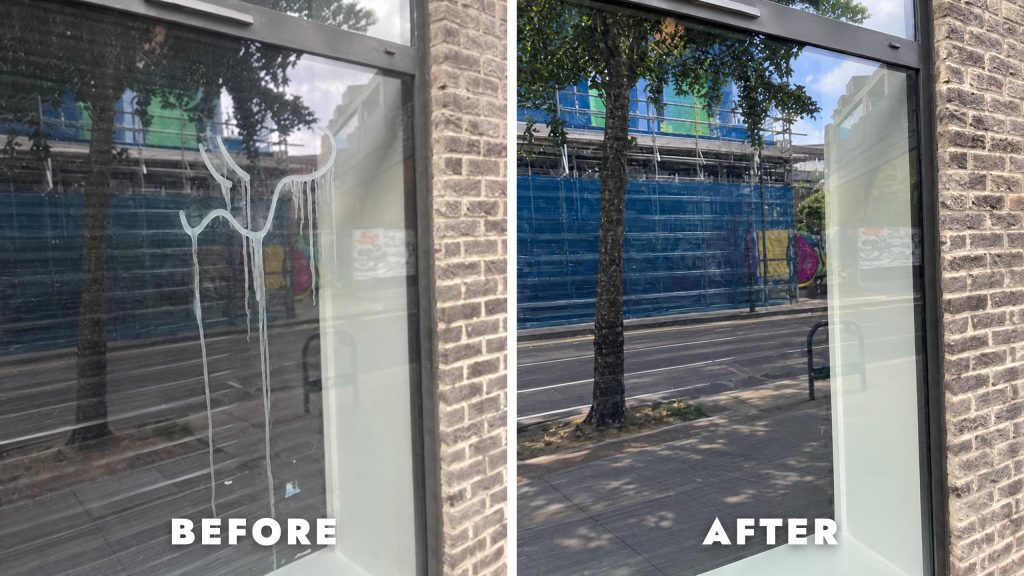
Before & After Photo of Graffiti Removal Project in Chiswick
The Pilasters And Corbels Are The Target
The Chiswick High Road Conservation Area was designated on the third of August 2015, appraisal updated January 2022. The street grew as a shopping parade in the late nineteenth and early twentieth centuries after Turnham Green station opened in 1869: three-storey terraces, retail below and residential above, brick with stucco and stone dressings, a strong parapet line, wide tree-lined pavements.
What The Appraisal Singles Out
Among the original detailing, the appraisal identifies the surviving pilasters and corbels separating one shop unit from the next, and the borough's Shop Front Design Guidelines of 2013 require them preserved when a shopfront is replaced. They are why the parade still reads as a rhythm of individual shops rather than a run of glass.
Why They Are What Gets Marked
A pilaster is the one continuous vertical surface at eye level, standing between two windows nobody can write on usefully. Upright, solid, roughly a person's width, lit from the side. Choose where to put a tag here without thinking and you choose a pilaster, which is what happens.
The Corbel Is The Hard Part
The corbel is the moulded bracket at the head of the pilaster, carrying the fascia across, and it is where removal gets difficult. Mouldings have undercuts, returns and hollows a flat tool cannot reach and a spray reaches unevenly. Pigment collects there and stays after the flat faces are clean, leaving a shadow line that reads from the far pavement. Corbels here are usually moulded stucco or cast cement rather than stone, ruling out abrasive entirely and putting the work on dwell time.
And The Pilaster Is Usually Shared
One more thing follows from the geometry. A pilaster stands on the boundary between two units, so the element most likely to be marked is the one most likely to belong to two parties, or a landlord above two tenants. An ordinary conversation once; an obstacle when nobody has had it in advance.
Three Buildings, Three Trial Patches
The same product on three frontages in one week, three different outcomes: the argument for a concealed trial patch in one paragraph.
On the first, a sound stock brick pier with intact pointing, the gel lifted the aerosol at short dwell and the wall took heat without opening a joint. Half a day, no surprises. On the second, a stucco pilaster painted three times over, the same gel softened the scheme beneath before the tag released, so the method changed on the spot to longer dwell at lower strength and took twice as long. On the third, a corbel someone had attacked with a household solvent the previous winter, the trial patch showed the surface opened and sugary, so we quoted a poultice and warned a faint shadow would probably remain. The surface decides the method; the first attempt decides what stays possible. Where a face has been opened or a mark cured into moulded stucco, full recovery genuinely needs more than cleaning and we will say so at the quotation.
What A Building's Date Does Not Tell You
Knowing the parade is largely 1880s to 1910s narrows the field: expect stock and red brick, stucco and stone dressings, painted timber joinery, moulded cement enrichment, cast iron or early steel framing. What it does not tell you is what has happened since. A nineteenth century pilaster may be bare stucco, may carry a century of paint schemes, or may have been cement-rendered in the 1970s in a way that has cracked and let water behind. The brick above may be original and sound, repointed in hard cement leaving the bricks doing work they were never meant to, or painted. A stone cill may be Portland, reconstituted, or a harder replacement. The period sets expectations; the trial patch settles them.
Detail: unpainted brick, painted brick, smooth render, rough render, cast stone, limestone, painted timber, cast iron and powder coated metal.
What Superheated Steam Will Not Shift
A DOFF or low pressure steam system is the right answer on most masonry here, and its limits are worth knowing. It will not lift anything soaked into the substrate rather than sitting on it, because heat softens a film and a stain is not one. It will not reach an undercut on a corbel any better than a brush, so mouldings need a product that flows and dwells rather than a jet travelling in straight lines. It will not touch scoring, that being damage rather than coating. It will not work through historic paint layers without softening those too, the whole difficulty on a painted pilaster. And it will not help where marking has bonded into a surface already opened. On sound brick, stone and unpainted stucco it stays the best thing available, its failure mode being that the mark stays rather than the wall going.
Dry Ice And Where The Gas Goes
Dry ice blasting is the cleanest method we run, and the constraint nobody anticipates is ventilation. The pellets sublimate on impact, going straight from solid to gas, which leaves no slurry and no grit. That gas is carbon dioxide, heavier than air, collecting in the lowest available space. Outdoors on a wide Chiswick pavement that is a non-issue. In a lightwell, basement area, enclosed rear yard or covered service passage it is a real constraint needing monitoring and forced ventilation, and sometimes the honest answer is a different method rather than engineering around it. A contractor offering dry ice for a basement without mentioning this has not thought about it.
Poultice Or Soda On One Elevation
- Establish which parts are porous and which coated: porous to poultice, coated to soda, nothing crossing over.
- On porous parts, check whether pigment has migrated below the surface, since a poultice earns its cost only where there is something to draw out.
- On coated parts, check the coating is sound, because soda finds anywhere it has already failed and makes that obvious.
- Look at what sits between, usually a moulded corbel, and treat it as its own decision.
- Sequence it so the poultice goes on first and dwells while the soda work proceeds, or one clock idles while the other runs.
- Mask the boundary between the zones properly, since soda travels further than people expect and a poultice carrier stains what it touches.
The reasoning behind each is on chemical solutions for graffiti removal, and the case against the fast option on pressure washing for graffiti removal.
Do you need graffiti removed from your property? Get a fast, hassle-free quote today! Click here to get a professional graffiti removal quote or call us today on: 020 8050 5997
What A Contractor Should Refuse To Do
Refusals tell you more about a contractor than promises. These are the ones worth hearing.
- Refuse a firm figure for a moulded corbel from a photograph alone, because the undercut is what a photograph cannot show.
- Refuse pressure on a painted pilaster however much quicker, and say plainly that it would spall the face.
- Refuse to work without a concealed trial patch, especially when the customer is in a hurry.
- Refuse to attend without public liability cover already sent, not produced when somebody asks.
- Refuse to draw water or power from the premises, arriving self-contained, which is why nobody needs to be there.
- Refuse to advertise seven days a week while meaning weekdays, and roster every day of the week properly.
- Refuse to guarantee total removal before the trial patch, that being the promise most often broken.
Urgent Or Important: Tell Us Which
| Urgent, meaning today | Important, meaning this week |
|---|---|
| Offensive or targeted content anywhere a customer or resident sees it. | A tag on a rear gate, bin store or service door facing nobody. |
| A frontage with a viewing, inspection or opening in the next two days. | Overspray upstairs that needs a tower arranged anyway. |
| Marking on food premises glazing, or anywhere hygiene perception matters. | A shared pilaster where apportionment still needs agreeing. |
| Anything a landlord has formally required removed within a stated period. | A second poultice application, which is scheduled rather than rushed. |
Telling us which you are in changes what we offer rather than the removal price itself. An urgent attendance rearranges a day and prices accordingly; an important one joins a booked run at a lower figure and loses nothing by waiting.
Why The Cheapest Quotation Is A Different Job
What Gets Quietly Dropped
When three figures come back and one is half the others, the temptation is to assume two firms are expensive. Usually the cheap one has quoted a smaller job. What drives the price is a short list, and the cheap quotation has dropped items from it: a second method for what the trial patch reveals, the corbel treated as flat because the photograph made it look so, one visit where the stucco needs two.
And What Never Appears At All
Masking the glazing, signage and neighbouring unit is invisible in a quotation and enormous in a day. Ground level is assumed when part of the mark is above reach. And the record is dropped entirely, so there is no dated photographic set and no invoice describing the elevation, which is what a landlord asks for later. An itemised quotation can be compared; a single number can only be believed. Factors that affect the cost of graffiti removal takes each line in turn, how much graffiti removal costs in London gives the range, and the hidden costs of not removing graffiti promptly covers what waiting adds.
Tenant And Landlord In Practice
| What the lease usually says | What actually happens on this parade |
|---|---|
| The demise stops at the shopfront, so the elevation above is the landlord's. | The tenant clears it anyway, opening at nine while the landlord answers emails on Thursday. |
| The landlord or managing agent recovers exterior costs through the service charge. | Recovery works only where the invoice names elevation and method, so ask up front. |
| A shared pilaster belongs to whichever title it sits on, or to both. | Neither neighbour wants to be the one who paid, so the mark stays up while that settles. |
| An independent operator or sole trader holds only their own unit. | They are still the one the street judges, so they usually pay and argue afterwards. |
| Residents above the shop are separate leaseholders entirely. | They rarely know the frontage is marked and are rarely asked to contribute. |
On a shared element, agree in advance who instructs and how it splits, rather than negotiating while a tag is up. Which title an elevation sits on is worked through under who is responsible for graffiti removal, and the excess arithmetic under whether insurance covers graffiti removal in London.
Lighting And Sightlines Before Chemistry
Before anybody sells you a coating, look at what makes the surface attractive, which here is geometry rather than material. The pilaster that keeps getting marked stands in shadow between two lit windows, where somebody works unseen while the shopfronts either side glow. Lighting that pilaster, rather than only the display behind the glass, changes more than any product will. The same goes for the recessed doorway, the passage entrance and the frontage screened by a mature street tree, and the wide pavements mean the trees screen more than people realise. Sightlines matter too: a frontage overlooked from a window opposite is marked less than one facing a blank flank wall. None of it costs much and all of it works before chemistry does. Coatings come after, and the two pages worth reading then are how anti-graffiti coatings work and the best coating products for London properties.
Photograph It, And Here Is Why
- Because a photograph taken before anybody touches it is the only proof of original condition, which matters if a first attempt fails.
- Because a wide frame from across the road shows the height, deciding whether a tower and licence are involved.
- Because a close frame showing texture rather than colour identifies the substrate, which is what the quotation is built from.
- Because a frame including the pilaster or corbel shows the moulding profile, the most mispriced element here.
- Because it establishes whether the surface is yours or the highway's, so whether you report or buy.
- Because a dated image supports a report to the police or council, which work only with evidence attached.
Where the surface is not yours, routes are under reporting vandalism in London, and the case against a household product on DIY versus professional removal.
Where The Time Actually Goes
| Stage | Share of a typical visit |
|---|---|
| Setting out, sheeting and containment | Longer than anybody expects, more again on a wide pavement in use. |
| Masking glazing, signage and neighbouring units | Often the largest single block of time on a shopfront. |
| Concealed trial patch and recording settings | Short, and the step preventing the expensive mistakes. |
| The removal itself | Usually the shortest part of the day, which surprises people. |
| Mouldings, undercuts and detail work | Disproportionate: a corbel takes longer than the flat metre beside it. |
| Rinsing, collecting run-off, clearing the footway | Modest, never skipped, since the pavement is public. |
| Photographic record and written note | Small, and the only part that survives the visit. |
How a job stays controlled with the public walking past it is set out under safety precautions during graffiti removal.
Where We Attend Around Chiswick
Chiswick High Road along its length. Turnham Green Terrace and the station approaches. Devonshire Road and Chiswick Lane. Acton Lane and Bath Road. Bedford Park. Grove Park and the roads towards the river. Strand on the Green. Plus rear yards, service doors, bin stores, lightwells and the historic passages off the High Road, which take most of the marking the street never sees.
Work Completed Across W4
We have cleared aerosol from moulded stucco corbels without flattening the profile, lifted tagging from painted pilasters with the scheme intact, taken marker off cast iron framing without touching the paint, drawn pigment out of stock brick an earlier attempt had opened, worked around original detailing the appraisal protects, and left condition notes on frontages whose owners had none. Fabric of this age and protection is dealt with under graffiti on historic buildings in London; a window cut into rather than sprayed belongs on acid etched graffiti removal.
Who Instructs Us In Chiswick
| Who calls | What they need from it |
|---|---|
| Independent shops, cafes and sole traders | A frontage cleared before opening, priced first, nobody needing to attend. |
| Managing agents holding upper parts above retail | An invoice naming elevation and method, cover evidenced first, a service charge record. |
| Landlords of conservation area terraces | A method preserving pilasters and corbels rather than flattening them. |
| Restaurants and food premises | Containment tight enough for a public pavement, a visit that misses service. |
| Residents above the shops | Rear elevations, lightwells and passages cleared without disturbing the parade. |
One Job, Decision By Decision
A worked example shows it clearest. Take a tag running up a shared stucco pilaster and across the corbel above.
- The photographs show painted stucco below and a moulded corbel above: one material, two very different geometries.
- The flat pilaster face takes a gel at controlled dwell, releasing the tag before it softens the scheme beneath.
- The corbel cannot take the same treatment, because its undercuts hold pigment a flat application never reaches.
- So the corbel gets a poultice that flows into the moulding and dwells, with a second application priced in.
- The pilaster is shared, so the quotation splits the elevation and both parties see what they pay for.
- Everything sits under three metres and behind the building line, so no tower, and none of it the highway's problem.
- The occupiers open at nine, setting an early start with the shutters still down.
What You Are Given Afterwards
A dated set of photographs: the mark as found, the concealed trial patch with settings noted, the work underway, the finished elevation, and the moulding photographed separately because that is what anybody will scrutinise. An invoice naming the elevation and method rather than a bare total, which lets a landlord or service charge carry it and lets two neighbours split it fairly. Waste transfer documentation for anything taken off site. And a written note of what the work revealed: an open joint, a cracked render patch, a corbel with a hairline fracture behind the paint, an earlier cleaning attempt made before your lease began.
Removing It Against Painting Over It
| Painting over | Removing |
|---|---|
| Fills the undercuts on a moulding, so each repaint blunts the profile the appraisal exists to protect. | Leaves the moulding as sharp as cast. |
| Needs a colour match on stucco weathered unevenly across a whole parade. | Leaves the existing scheme intact, so nothing needs matching. |
| Traps moisture in render that must dry outward, accelerating failure on a cracked patch. | Leaves the wall behaving as built. |
| Marker ghosts through a fresh coat within days, so the patch needs doing again and again. | Draws the pigment out instead of covering it, so nothing comes back. |
What Actually Reduces Repeat Marking
- Speed above all: clear an elevation inside a few days and it attracts a fraction of the repeat marking a neglected one does.
- Light on the pilasters rather than only behind the glass, since the shadow between two lit windows takes the marking.
- Agreeing in advance who instructs on a shared element, so the boundary question adds no fortnight.
- Removing the climbing aid: the bin, stacked crates or cycle stand that turns a reachable wall into a high one.
- Coatings last, on rear gates and service doors, never on moulded detail whose profile they blunt.
Nearby Areas We Also Attend
We cover the streets around W4, and one night's marking often crosses two of them.
Hammersmith, Richmond, Ealing, Acton, Brentford, Kew, Shepherds Bush, West Kensington, Fulham and Putney.
Chiswick Graffiti Removal: Frequently Asked Questions
Do you need to visit before quoting?
No, which is the point of the photographs. Four frames give a firm figure for almost everything, with one exception below.
What is the exception?
A moulded corbel or enriched pilaster head, where the undercut is what a photograph cannot show. There we quote a range and confirm at the trial patch rather than guess high.
Will the council clear our shopfront?
No. The service covers the public highway Hounslow Highways maintains and stops at your building line, with no disclaimer route back.
The tag is on a bollard outside our door.
Report it rather than pay for it. That is highway, so within twenty-four hours if offensive and seven days otherwise.
How soon can you attend W4?
Same day for most morning calls at ground level. Once a tower and a footway licence come into it, we book a slot instead and give you a fixed time.
The pilaster is shared with next door.
Common here, because a pilaster sits on the boundary. Instruct together and the quotation splits the elevation, so each side sees what it pays for.
Our corbel is moulded plaster. Is that a problem?
It changes the method rather than preventing the work. Mouldings need something that flows and dwells in the undercuts, so they take longer than the flat surface beside.
Can you pressure wash the stucco?
No. Pressure strips the paint along with the tag, spalls the render beneath and blunts any moulding it touches, turning a removal into a repaint.
Can you guarantee it all comes off?
Nearly always. Where a mark has cured into moulded stucco, or an earlier attempt opened the surface, a faint shadow may remain and we say so first.
Does anybody need to be there?
No. Everything travels on the vehicle, water and power included, so the premises supply nothing and no door needs unlocking.
Do you work weekends?
Every day of the week, with a vehicle loaded and an operative rostered, not a phone diverted.
There is a mural further along the parade. Would you remove that?
Not without knowing it was unauthorised. Approved murals and authorised walls are excluded from the council service too, so a report goes nowhere.
It is in our lightwell at basement level.
Tell us, because it rules dry ice out or requires ventilation. Carbon dioxide is heavier than air and collects in the lowest space.
Somebody tried to scrub it last winter.
Say so when you call. An opened surface turns a removal into a repair, and the quotation should reflect that rather than discover it.
Our window has been scratched into.
Scoring sits inside the glass where no remover reaches, so it becomes repair or replacement. Acid etched graffiti removal sets out how to tell.
Do you need graffiti removed from your property? Get a fast, hassle-free quote today! Click here to get a professional graffiti removal quote or call us today on: 020 8050 5997