





Your frontage has been tagged and you want it cleared properly, without a shadow of the lettering, a bleached patch, or a surface that takes the next one deeper than this one went.
Most of it lifts. What decides the outcome is the material beneath it, because the method that clears paint from glazed tile will open the face of soft brick, strip a painted shutter and dull a coated panel past repair.
The material is identified first, the technique proved somewhere hidden, and the mark taken off without the finish going with it. Most of the district is same day, any day of the week.
Do you need graffiti removed from your property? Get a fast, hassle-free quote today! Click here to get a professional graffiti removal quote or call us today on: 020 8050 5997
There Is No Quiet Hour Here
Almost every district has a window when the pavement empties and a working area can simply be set out. Waterloo does not, and a contractor who plans on finding one will either work unsafely or not turn up.
The Flow Never Fully Stops
Services begin before five in the morning and the last of the evening movement runs well past midnight, with night buses on the roundabout in between. The South Bank frontages carry weekend and evening leisure traffic when the commuter tide is out. There is no point in the week when the area is genuinely empty.
So The Window Is Built, Not Found
Instead of waiting for quiet we engineer the working area: a bounded, signed and physically separated zone sized for the actual flow, with pedestrian routing agreed rather than assumed, and a crew sized to hold it. That costs a little more in setup and it is the only way this district can be worked properly.
Mid Morning And Mid Afternoon Are The Real Slots
The usable periods here are between the peaks rather than outside them, which is counter-intuitive and is why so much work in this area gets scheduled badly. Early morning, the obvious choice elsewhere, is the worst option at Waterloo.
Some Frontages Only Work At Night
Station approaches, the taxi road and the busiest crossings need a genuinely low-flow period, which means late night with the area lit and bounded. We will say when a frontage falls into that category rather than promising a daytime slot we cannot deliver safely.
Recent London Graffiti Removal Projects
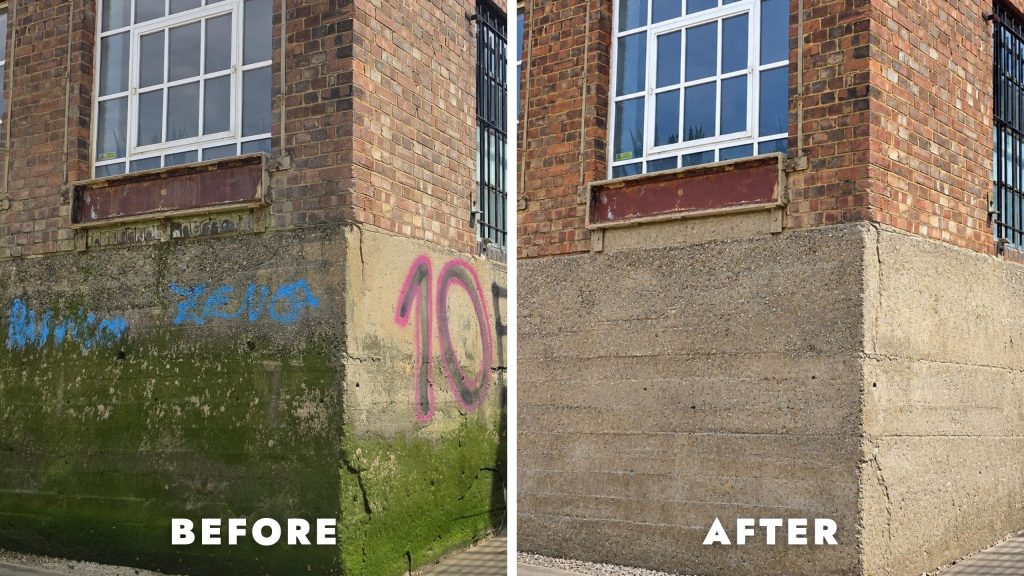
Before & After Photo of Graffiti Removal Project in Waterloo
When The Same Tag Keeps Coming Back
The second thing about a transport hub is that it attracts repeat marking by the same hands, and most businesses throw away the one thing that would help.
Photograph Before Every Removal, Without Exception
A dated image of each incident, showing the tag clearly and the location it was on, is worth more than any single clean. Three or four of those across a few months turn an isolated nuisance into a documented pattern, and a pattern is what police and an insurer can act on. A tag cleaned without a photograph has simply gone.
Record The Same Details Every Time
Date found, approximate date it appeared, surface, height, and whether the mark matches previous ones. Consistency is what makes a log usable months later, and it costs a minute per incident.
Keep The Reference Numbers Together
Each report to the police produces a reference. Held together with the images, they establish frequency and location in a way no single complaint does, and that is what supports a request for attention on a particular frontage.
What We Contribute
Every job leaves you with dated before and after images and a written description of works, issued as standard. Where we attend the same frontage repeatedly we will tell you plainly that it is a pattern rather than bad luck, and that is usually the point at which protecting the surface becomes the cheaper option.
Selecting A Method
No single product suits a district holding Victorian viaduct brick, painted render, coated metal and modern glazed frontages within one street. Four approaches carry most of the work.
Low Pressure Superheated Steam
Heat does the work in the DOFF system rather than force, and the pressure stays low enough that neither the fired face nor the lime mortar is disturbed. Across the older stock and the arches it is what we reach for first.
Dry Ice Blasting
Non-abrasive, and it produces no water or residue because the pellets sublimate on impact. That matters on a busy frontage where a wash would spread across a pavement full of people, and in the undercroft areas where drainage is limited.
Soda Blasting
Gentler than grit and useful on sound masonry and ironwork, with full containment, which on a route this busy means a working area sized for the flow rather than the wall.
Poultice Treatment
Draws pigment back out of porous brick, render and stone instead of driving it deeper, and it is the only approach that works once paint has soaked into an open or previously pressure-washed surface.
The trial dictates the technique; the contents of the van do not. There is a full account of what shortcuts cost a surface in high-pressure washing for graffiti removal, and of the compromises involved in chemical solutions for graffiti removal.
Start With What It Is Made Of
We quote nothing until the material is established, since a mismatched method costs more than the vandalism ever did. The surface decides the method: handle brick badly and ghosting and a spalled face follow; handle painted timber badly and the finish comes away entirely. Brick, render, stone, timber, metal and painted surfaces each respond in their own way.
- Unpainted stock brick through the arches and older frontages, soft and sooted, the surface pressure ruins fastest.
- Glazed brick lining arch openings and older frontages, non-porous and the easiest surface in the district.
- Painted render on the terraces, where an unmatched repaint is visible for years.
- Painted metal on shutters, arch gates and service doors, the most frequently marked surface here.
- Powder coated metal on newer shopfronts, balustrades and street furniture.
- Cast iron on railings, bollards and bridge structures.
- Pre-cast concrete across the post-war stock and the undercroft levels.
- Painted timber on the older shopfronts, doors and stall risers.
- Laminated glazing across entrances and shop windows, from which paint comes away but etched damage does not.
One rate quoted across viaduct brick, render, shutters and coated metal tells you the frontage was never assessed. See what affects the cost of graffiti removal.
What You Should Expect From A Contractor
Nothing stops anyone calling themselves professional, so this is what backs the claim in our case, and why each item is there.
| Included | What it does for you |
|---|---|
| Surface identified before any figure | Material, existing coating, condition and a trial where nobody sees it. On sooted brick this is the whole job. |
| A working area sized for the flow | Bounded, signed and separated for the pedestrian volume actually present, not the volume a quiet street would have. |
| Method statement and risk assessment up front | Written for your frontage rather than pulled from a folder, which is what an agent or estate reviewer actually reads. |
| Public liability cover, on paper | Get sight of the certificate before work begins; reassurance over the phone counts for nothing later. |
| Containment and controlled run-off | Nothing reaching drainage, a crossing or the pavement people are using a metre away. |
| Waste documentation | We take the residues away and the transfer note follows them, keeping the liability off your premises. |
| Dated images and a written works record | Issued every time, and the material that turns repeated incidents into a documented pattern. |
| Seven days a week, self-contained | The crew brings its own water and power, so your supply goes untouched and, in most cases, you need not attend. |
A fuller version of the argument sits in DIY vs hiring professionals, and the site discipline is described in safety precautions during graffiti removal.
When We Can Get There
Work within reach of the pavement is usually done the same day, whatever day that is. Three factors extend it.
Frontages That Need A Low-Flow Period
Station approaches and the busiest crossings need late-night working, which is scheduled rather than attended on spec.
Anything Above Reach
Upper elevations and viaduct faces need access equipment, and on these pavements that also means a pedestrian plan agreed beforehand.
Ownership Questions
Station structures, bridges and railway land belong to the infrastructure owner rather than to the council or to you. We confirm that before quoting so nobody pays for somebody else's asset.
For portfolios we propose a scheduled cycle rather than reacting each time, which on frontages exposed to this much movement is cheaper per incident and stops damage ageing into the surface.
Removing It Or Covering It Up
| Painting over | Professional removal | |
|---|---|---|
| On sooted viaduct brick | Permanently changes a weathered elevation | Brick left as brick |
| On a roller shutter | Adds coating weight and peels at the slats | Original finish retained and running freely |
| Evidence value | The tag is gone with nothing recorded | Dated images build the pattern you may need |
| Within a year | The patch weathers differently and shows | Nothing to weather differently |
| Next incident | Another patch, then another | Same process, same result |
| Long term cost | Recurring, and ends in repainting the elevation | One-off per incident |
The longer-term arithmetic is in the hidden costs of not removing graffiti promptly.
Do you need graffiti removed from your property? Get a fast, hassle-free quote today! Click here to get a professional graffiti removal quote or call us today on: 020 8050 5997
The First Hour After You Find It
- Photograph it dated before anything else, showing the tag clearly and enough of the surrounding surface to place it. If it recurs, this image is the one that matters.
- Note the date it appeared as well as the date you found it, and whether the mark resembles anything you have seen before on the frontage.
- Establish whose surface it is, since station structures, bridges and railway land belong to the infrastructure owner rather than the council.
- Do not let anyone take a brush to it; wire bristles force pigment down into soft brick and render, turning something superficial into something deep.
- Keep proprietary removers off masonry and away from painted shutters, as most are made for hard non-porous surfaces.
- Pressure washing is not an option on brick or render, as it lifts the face, strips lime mortar from the joints and leaves an obviously lighter patch behind.
- If the surface belongs to you, log it with the police as criminal damage, per reporting vandalism in London, and keep the reference with the photograph.
The Process On Site
- Settle ownership of the surface and identify who can authorise the work.
- Agree the working period against the actual pedestrian flow at that frontage, and the extent of the bounded area needed to hold it safely.
- Identify the substrate, any existing coating, and how weathered or sooted the surface is.
- Prove the approach on the same material somewhere hidden, checking it takes the paint off without opening the surface or dulling a finish.
- Set out and sign the working area, protecting the crossing, the drainage and the frontages either side.
- Begin as gently as will achieve anything at all, stepping up only once progress ceases, and never leading with the most aggressive option.
- Feather the treatment out into the wall around it, so that a weathered elevation does not end up with a bright rectangle set into it.
- Collect run-off and residues rather than letting them reach a gully or the pavement, and remove them with the transfer paperwork.
- Photograph the completed frontage and issue the dated set with a written summary of products and technique, for your records as much as ours.
There are surfaces where full recovery is not always possible, and we say so at the assessment rather than partway through. Pigment forced deep by an earlier pressure wash, soot bound into an opened brick face, and a shutter coating already failing each mean a realistic written expectation instead of a promise nobody can honour.
Where We Work Around Waterloo
| Location | What we are usually called to |
|---|---|
| The station approaches and taxi road | Frontages carrying continuous movement, worked in a genuinely low-flow period with the area bounded and lit |
| The viaduct arches and undercroft | Sooted stock brick, arch gates and tenant shopfronts inside somebody else's opening |
| Lower Marsh and the surrounding streets | Independent parades, shutters and painted render, worked between the peaks |
| The riverside and cultural frontages | Long elevations and entrance screens facing open ground, busy at weekends rather than weekdays |
| Waterloo Road and the roundabout | Large elevations seen at distance and at speed, with night bus traffic through the small hours |
| Service yards and rear elevations | Back-of-house brickwork and shutters where marking accumulates because nobody walks round |
Work Completed In South London
- Acid etched graffiti removal in Waterloo
- Acid etched glass graffiti removal in Victoria
- Acid etched graffiti removal in Richmond
- Acid etched graffiti removal in Mortlake
Who We Work For Around Waterloo
| Client | What the work looks like |
|---|---|
| Managing agents and asset managers | Portfolios on scheduled cycles, with the dated records that turn repeat incidents into a documented case |
| Arch and undercroft tenants | Shopfront and gate cleaning, with ownership of the surrounding brick settled before anybody spends money |
| Hotels and hospitality | Entrances and ground floor elevations, timed to the flow at that frontage rather than to a standard slot |
| Independent traders on the parades | Single frontages and shutters, a written figure, and a straight answer on whose surface it is |
| Cultural and institutional estates | Long riverside elevations, worked around programmes and weekend attendance rather than through them |
What Drives The Price
There are no list prices in this trade, and a quote produced without anyone seeing the wall is guesswork. The factors below are what actually shift a figure, so a quotation can be assessed on its contents rather than its bottom line. Broader comparisons are in how much does graffiti removal cost in London.
Material And State Of Repair
Glazed brick and shutters in good order go quickly. Brick that is sooted, damp or has already been pressure washed takes far longer, since the approach must be tested and then worked gently.
The Working Area Required
A frontage on a quiet side street needs little. One on a route carrying continuous movement needs a bounded, signed area and the crew to hold it, and that is a real part of the figure here rather than an afterthought.
Which Period It Has To Happen In
Between the peaks is standard. Late night, where the frontage demands it, costs more and is sometimes the only safe option.
Height And Access
Ground level is one price. Upper elevations and viaduct faces need equipment and a pedestrian plan.
Whether It Is A Repeat
A surface hit repeatedly holds residue from earlier incidents and each removal is harder than the last, which is the clearest argument for protecting it instead.
Programme Or Call-Out
Per incident, a portfolio maintained on a rota works out considerably cheaper than one that phones for help each time.
Who Carries The Cost
Commercial Tenants
Look at the lease. Shopfront and shutter fall within most demises; the wall above, the return elevation and the shared entrance usually do not, and those are recovered through the service charge.
Arch And Undercroft Tenants
Your shopfront is normally yours; the opening, the brick around it and the structure above belong to the infrastructure owner. Report what is not yours rather than funding it.
Landlords And Estate Managers
Most of what gets marked on a frontage like this is yours rather than an occupier's, which is why a scheduled cycle usually costs less across a year than reacting to each report. More on this at who is responsible for graffiti removal.
Insurance
Compare the figure to your excess before notifying anyone, and see does insurance cover graffiti removal. One clean will generally sit under the excess, leaving nothing to claim. A documented series of incidents is an entirely different conversation, which is exactly why the photographs earn their keep.
Cutting Down Repeat Incidents
Cleaning addresses what is there now and nothing else. With this volume of movement past the frontages, more will come.
With a sacrificial layer in place the next tag sits on something disposable rather than on the fabric. Sooted brick, shutters and undercroft walls make the best case for it here, being the surfaces that get hit again and again while every clean takes a little more out of the material. There is an explanation in anti-graffiti coatings and a product guide in the best coating products for London properties.
The Surface Will Look Marginally Different
Coating deepens the colour of bare brick a shade and puts a faint sheen on a shutter. Most owners have no objection, a few do, and it is better raised at the outset.
Where We Will Tell You Not To Bother
Anything above reach, anything marked once in several years, and any surface you do not own. On listed and protected fabric the specification needs raising with the local authority first, and there is separate guidance at graffiti on historic buildings in London.
Areas We Cover Next To Waterloo
- Lambeth
- Southwark
- Bankside
- Blackfriars
- Elephant and Castle
- Kennington
- Vauxhall
- Westminster
- Charing Cross
- Covent Garden
Glass damage is a separate service, covered on the main acid etched graffiti removal page.
Waterloo Graffiti Removal: Frequently Asked Questions
When is the quiet period here?
There isn't one, which is the point. Services start before five and the last movement runs past midnight, with night buses in between and weekend leisure traffic on the riverside. The working area is built rather than waited for.
So when do you actually attend?
Between the peaks, mid morning or mid afternoon, for most frontages. That is counter-intuitive and it is why so much work here gets scheduled badly. Early morning, the obvious choice elsewhere, is the worst option at Waterloo.
Some of our frontage faces the station approach.
That will need a genuinely low-flow period, which means late night with the area lit and bounded. We will say so rather than promise a daytime slot we cannot deliver safely.
It keeps happening. Is there anything we should be doing?
Photograph every incident before it is cleaned, dated, showing the tag and its location. Three or four of those across a few months turn an isolated nuisance into a documented pattern, and a pattern is what the police and an insurer can actually act on.
What exactly should we record?
Date found, approximate date it appeared, the surface, the height, and whether the mark resembles previous ones. Keep the police reference numbers with the images. Consistency is what makes the log usable months later.
Does a photograph really change anything?
For one incident, rarely. For a run of them it changes everything, because frequency and location are what support a claim or a request for attention on a particular frontage. A tag cleaned without a photograph has simply gone.
Do you provide anything for our records?
Dated before and after images and a written description of works, issued as standard on every job. Where we attend the same frontage repeatedly we will tell you plainly that it is a pattern rather than bad luck.
The damage is on the arch above our unit.
That is almost certainly the infrastructure owner's rather than yours. Station structures, bridges and railway land sit outside both council responsibility and your demise, and we confirm that before quoting so nobody pays for somebody else's asset.
Can you clean sooted viaduct brick without damaging it?
Yes, with low pressure superheated steam instead of a pressure method. Heat lifts the paint and the fired face and mortar joints stay as they are, which is exactly what jet washing cannot manage.
What is DOFF?
Steam raised well above boiling and delivered at low pressure. Working by heat rather than impact, it copes with soft, sooted, lime-mortared masonry in a way no pressure system does.
Why dry ice on a busy frontage?
Because it produces no water and no residue. On a pavement carrying continuous movement there is nothing to spread underfoot and nothing to manage where drainage is limited.
Our shutter has been tagged. Should we repaint it?
Better not to. A repaint builds up coating that starts peeling at the slats inside a season and seldom matches the rest. Cleaning leaves the factory finish in place and the shutter operating properly.
Do we need to be there while you work?
No. Water and power travel with us, so most jobs need nobody from your side present beyond whatever access the building requires.
As a tenant, is the elevation above our unit ours?
Generally no. Most demises end at the shopfront and shutter, so the wall above and the return elevation belong to the freeholder. Report it and send them our written price.
Several units along the parade have been hit.
Quote the parade as one job. Each unit is costed separately but there is a single visit and a single mobilisation charge, which is frequently how several modest budgets get approved together.
Is protective coating worth it here?
On repeatedly marked brick, shutters and undercroft elevations, yes. Above reach, marked once in years, or on a surface you do not own, we will tell you not to bother.
What is on the glass is not paint and will not come off.
That will be acid etching. It demands a different process altogether and is handled as a separate service, explained on the acid etched graffiti removal page.
How do we get a price?
Send photographs of the frontage and a close view of the surface, say roughly how high the damage sits, and tell us which street it faces so we can judge the flow. Those three answers let us price it and propose a realistic window.
Do you need graffiti removed from your property? Get a fast, hassle-free quote today! Click here to get a professional graffiti removal quote or call us today on: 020 8050 5997