





A frontage in Soho has been marked overnight and you want it gone before the street wakes up, without a pale patch on the brick or a shopfront that needs repainting afterwards.
Almost all of it comes off. What makes Soho different is that the buildings are small, old and tightly packed, the brickwork is soft, and the council has published a document saying plainly what happens when somebody paints over it instead. The surface decides the method, and here the surface is exactly what the conservation audit exists to protect.
We work out what the wall is, prove the approach where nobody will look, then lift the mark and leave the face of the brick alone. Across W1D and W1F that is normally same day, any day of the week.
Do you need graffiti removed from your property? Get a fast, hassle-free quote today! Click here to get a professional graffiti removal quote or call us today on: 020 8050 5997
The Council Has Written Down What Painting Over Does
Most arguments against covering a tag with masonry paint are aesthetic and easy to wave away. In Soho there is a better one, and it is in Westminster's own adopted guidance.
What The Conservation Audit Says
The Soho and Chinatown conservation area audit lists painted surfaces, with poor repair and repointing, as negative features of the area. It goes further than disapproval, recording that painting is non-reversible and can accelerate decay in the brickwork. That is the planning authority stating in an adopted document that the quick fix causes the damage.
Why That Bites Harder Here Than Elsewhere
Soho's Georgian fabric is brick, red or yellow London stock, some already stuccoed and painted. Stock brick of that age is soft and porous and works by letting moisture move through it and evaporate. A modern masonry paint seals the face. Water still gets in, from the ground and the joints, and now cannot get out, so it freezes behind the film and takes the brick face with it. That is the accelerated decay the audit describes, and why a painted-out tag is worse two winters later than the tag ever was.
Non-Reversible Means What It Says
Once brick is painted, getting back is a stripping project with its own risks rather than a cleaning job. The paint has keyed into the pores, and any method that removes it takes some brick face too. Plenty of Soho elevations are already in that condition because somebody dealt with a tag quickly in 1995, and today's owner has inherited a wall with no good options.
Which Makes Removal The Compliant Route
Taking marking off returns the elevation to its existing appearance, so nothing about the conservation area is engaged. Painting over it adds a negative feature to a conservation area, in a way the council has already said cannot be undone. The thorough job is also the one that raises no questions later.
Recent London Graffiti Removal Projects
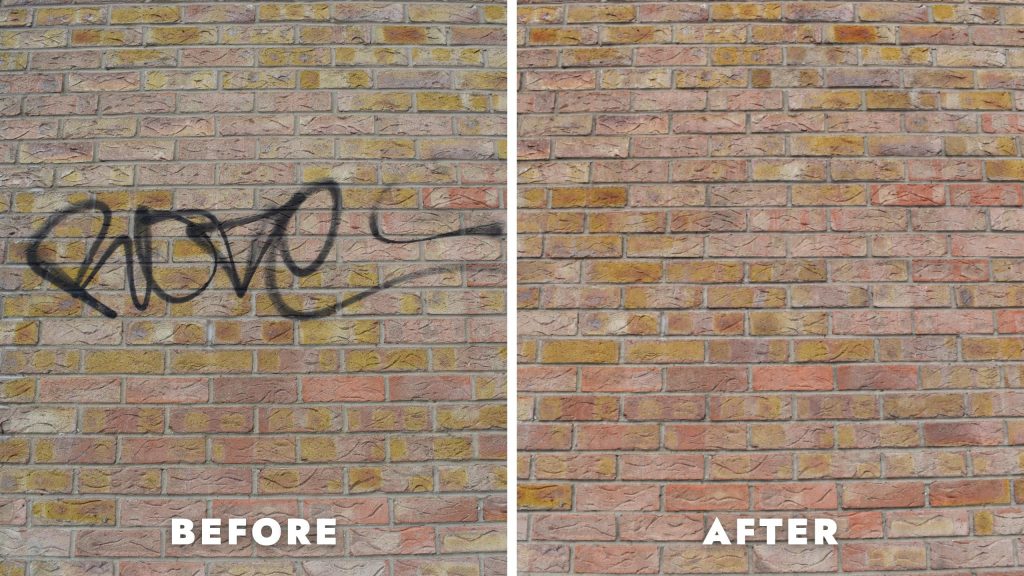
Before & After Photo of Graffiti Removal Project in Soho
One Tag, Three Freeholds
The second Soho problem is geometry. The audit records that narrow seventeenth and early-eighteenth century building plots still predominate, with most buildings no more than four storeys.
A Throw-Up Is Wider Than A Building
Those plot widths mean a tag sprayed at three in the morning routinely spans two or three separate buildings: three freeholds, three leases, three wall build-ups, one continuous mark. Nobody owns the graffiti. Each owner owns a section, and none can have their section cleaned convincingly without the others, because a cleaned third looks worse than the whole of a dirty wall.
The Person Who Sees It Is Rarely The Owner
Soho's vertical mix makes it harder. Small offices occupy the upper floors of many buildings whose ground floors are retail or restaurant, so the business that opens at eight and sees the mark holds the least interest in the fabric. The freeholder may be a fund, an estate, or somebody who has not visited in years.
How A Three-Owner Tag Actually Gets Cleared
We price it as one continuous mark and break the figure into per-building shares, because that is the document that lets three unconnected parties agree in an afternoon. One attendance covers all three, so mobilisation is shared rather than paid three times. In practice the first owner to see the quotation circulates it, and the thing resolves in a morning instead of a fortnight of nobody moving first.
If You Hold One Of The Three
Instruct for your own section and say you are happy to be invoiced separately. That removes the obstacle that stalls these jobs, which is nobody wanting to front the cost for a neighbour who may not pay.
What Happens When The Method Is Wrong
It is easier to choose correctly if you know what the alternatives look like afterwards. On these streets a badly chosen approach does not leave a clean wall with a small problem. It leaves this:
- Spalling. Pressure on soft stock lifts the fired face off, exposing the open body beneath, which then drinks the next tag and holds it four times as hard.
- Ghosting. A strong solvent on painted render bleaches the pigment around the mark, so the halo left behind is larger and more conspicuous than the graffiti.
- An empty joint. Abrasives find the lime mortar before they find the paint, and a raked-out joint on a four-storey Soho elevation is a repointing bill.
- A stripped shopfront. Anything strong enough to lift aerosol from painted joinery takes the top two coats with it, converting a removal into a redecoration.
- A burnished patch. Heat or abrasion on painted or powder coated metal leaves a permanently shiny area that catches every light on the street.
Working back from that list is how the method gets chosen: identify the material, match the approach, prove it somewhere concealed. It also sets the honest boundary. Where a wall is already painted, or an earlier attempt has opened the brick face, a clean will not restore it and we will say so when quoting rather than after. Most of that damage comes from well-meant first attempts, as our DIY versus professional removal page sets out.
Reading The Building By Its Date
Soho gives you three broad eras within a few doors of each other, and the date is a reliable guide to what the wall will tolerate.
| Era | What you are looking at, and what it needs |
|---|---|
| Georgian and early nineteenth century | Soft red brick or yellow London stock, lime mortar, some of it stuccoed and painted, with painted timber joinery at ground floor. Heat and water only. No pressure, no abrasives, nothing acidic. |
| Late Victorian and Edwardian | Harder red brick commercial frontages, terracotta and stone dressings, cast and wrought metalwork. More tolerant, but the stone dressings and any glazed faience still rule out abrasives. |
| Post-war and contemporary infill | Concrete, painted render, powder coated and anodised metal, sealed glazing. The most forgiving chemically, the least forgiving of heat, which burnishes modern metal finishes permanently. |
Substrate detail is on the relevant pages, including unpainted red brick, painted brick, mortar joints, smooth render, painted timber, porous stone, powder coated metal and anodised aluminium.
The Operator Is The Variable, Not The Machine
Two firms can arrive with the same DOFF unit and produce completely different outcomes, because low pressure superheated steam is not a setting you dial in and walk away from. The operator judges three things continuously: standoff distance, dwell in any one spot, and the moment the film has softened enough to release. Too close or too long on soft stock and the heat works on the brick rather than the paint. Rush it and the paint smears into the pores instead of lifting. There is no indicator light for any of that, which is why the same equipment is safe in one pair of hands and a resurfacing tool in another. When a contractor quotes DOFF, ask who will be holding it rather than whether they own one.
Dry Ice: Where The Money Goes
Dry ice blasting has an unusual cost shape worth understanding before comparing quotations. The pellets are consumed as they work and must be bought fresh each job, because they sublimate in storage, so a real part of the price is material rather than time. Against that it is fast, needs no water, leaves nothing on the floor and needs almost no clean-up. On a small Soho elevation that trade lands well, since consumables are modest at that scale and speed matters when the window is short. Over a large area the arithmetic flips and something slower but cheaper to run wins.
Masking Is Most Of The Actual Work
On a narrow frontage with glazing, signage and a neighbour's wall within touching distance, containment takes longer than removal. The sequence is always the same.
- Sheet and tape the glazing, signage and any applied lettering, with the edges sealed rather than simply covered.
- Protect the neighbouring plots either side, since the boundary is frequently mid-elevation and unmarked.
- Bund the base of the working area so nothing crosses the footway.
- Screen anything at pavement level, including bin stores, cellar flaps and ventilation grilles.
- Only then begin, whether that is a poultice held on the brick for hours, a solvent gel on sealed surfaces, or soda blasting on robust painted metal at the rear.
- Strip the protection in reverse order and check each surface as it comes off, rather than at the end.
Further background is on our pages covering chemical solutions for graffiti removal and pressure washing for graffiti removal.
What Seven-Day Cover Costs A Contractor
Every graffiti firm advertises weekend availability and few can deliver it, because the cost sits where a customer never sees it: rota cover rather than overtime, a second set of equipment so a Saturday job is not waiting on Friday's kit, and water and power on the vehicle so a Sunday visit does not depend on a property being open. We work seven days a week on that basis, self-contained, with public liability cover evidenced before attendance rather than promised after.
The reason it is worth paying for is chemistry rather than convenience. Aerosol continues curing after it is applied, and a mark left from Friday night to Monday morning has hardened through two warm days into something that needs a longer dwell, more product and occasionally a second visit. Clearing it on the Saturday is frequently the cheaper job as well as the faster one. None of it requires you to be there: nobody needs to be on site, and the trial patch, the work and the finished elevation are photographed and dated instead. How we handle products, run-off and the public footway is set out under safety precautions during graffiti removal.
When The Marking Actually Happens
Soho's pattern is unusually predictable and it shapes how we schedule. Marking goes on in the gap between the last venues emptying and the first deliveries arriving, a narrow band in the small hours. Shutters are down, the street is briefly empty, and what is available is shutters, shutter boxes, the brick between frontages and every flat panel in a side alley.
Two things follow. A tag on a closed shutter is invisible once the shutter goes up, so it is found at closing rather than opening and reported a day late. And our most useful attendance is early morning rather than overnight: the street has cleared, the marking is fresh, deliveries have not started, and the work finishes before trade begins. Where a shutter is the marked surface we would rather come while it is down, before opening or after close, which is worth saying on the first call.
Do you need graffiti removed from your property? Get a fast, hassle-free quote today! Click here to get a professional graffiti removal quote or call us today on: 020 8050 5997
Establish Whose Wall It Is Before Anybody Quotes
On a Soho street the boundary between yours, next door's and the council's is genuinely unclear from the pavement, and getting it wrong wastes a week. Settle three things before instructing anyone: where your plot stops horizontally, since the party line is often mid-elevation with no visible joint; whether the marked surface is the building or street furniture, which is not yours to clean; and whether your demise reaches above the shopfront at all. A square-on photograph with the neighbouring doorways in shot usually answers the first and we can answer the rest from it. That is also what makes a quotation actionable rather than one more thing to check. Reporting routes for anything that turns out not to be yours are on our reporting vandalism in London page.
Protecting Everything That Is Not The Graffiti
- Glazing and applied lettering sheeted and edge-sealed before any product is opened.
- Neighbouring frontages screened, because on these plot widths the boundary is within a metre of the work.
- Cellar flaps, gratings and ventilation at pavement level covered rather than worked around.
- Footway bunded so run-off does not reach the paving or the gully.
- Any authorised artwork on the elevation agreed and masked before equipment comes off the van.
- Protection struck in reverse and each surface checked as it is uncovered.
Removing It Against Painting Over It
On most streets this is a judgement call. In a conservation area whose audit names painted surfaces as a negative feature, it is closer to a settled question.
| Painting over | Removing |
|---|---|
| Adds a feature the conservation audit lists as negative, and one it says cannot be reversed. | Returns the elevation to its existing appearance, engaging nothing. |
| Seals soft stock brick so trapped moisture works on the face from behind. | Leaves the brick breathing as it was designed to. |
| Never matches across three narrow plots, so the repair advertises itself. | Reads as one continuous elevation again, which is the point. |
| Commits every future owner of the building to repainting it forever. | Leaves the next owner with the same choices you had. |
Where We Are Called Out Around Soho
Old Compton Street, Dean Street, Frith Street and Greek Street frontages and shutters. Wardour Street and Berwick Street, including the market end. Brewer Street, Lexington Street and Broadwick Street. Poland Street and Great Marlborough Street. Carnaby Street and the Newburgh Quarter. Rupert Street, Archer Street and the Chinatown edges around Wardour and Gerrard Street. Soho Square and the office frontages around it. Shaftesbury Avenue and Charing Cross Road commercial elevations. Meard Street, Bateman Street and the narrow connecting alleys, plus the service doors, cellar flaps and rear returns throughout, which take the bulk of the marking.
Work Completed Across The West End
We have lifted aerosol from soft yellow stock without opening the face, cleared repeat tagging from roller shutters and shutter boxes before opening, removed marker from painted render without bleaching a halo around it, taken tags off painted Georgian joinery with the scheme intact, cleaned terracotta and stone dressings on Edwardian commercial frontages, and cleared continuous marks running across two and three separate buildings as a single instruction. Heritage fabric generally is covered on graffiti on historic buildings in London, and glass damage locally on acid etched removal in Soho.
Who Instructs Us In Soho
| Who they are | What they need from us |
|---|---|
| Independent bars, restaurants and single-site retailers | A shutter or frontage cleared before opening, priced before we attend, with no contract. |
| Managing agents and landlords holding several narrow plots | Continuous marks priced as one job and invoiced per building, with photographs attached. |
| Small offices and studios on upper floors | Someone who can tell them whether the marked surface is even theirs before they spend anything. |
| Venues, clubs and late-licensed premises | Attendance timed to when the shutters are down, and honest scheduling around residents above. |
| Facilities teams covering West End portfolios | One contractor across mixed eras of building, with the method named per elevation. |
Why Square Metres Mislead
A rate by area is the wrong instrument here and produces the wrong number in both directions. A two-metre throw-up across plain painted render at ground level is straightforward work priced as a large area. A tag a quarter that size across a Georgian brick and stucco junction, with a gilded sign beside it, is several times the work and prices as a small one. Area measures how much surface there is, not what it is, how many materials the mark crosses, how much masking comes first, or whether the answer is one pass or a poultice left for hours.
What drives the price here, roughly in order: the materials and how many the mark touches; how much protection the surrounding frontage needs; the age of the marking, since curing changes the method; and access, usually simple because the buildings are low and the van gets close. That last is why Soho jobs are often cheaper than a comparable mark in a district of taller buildings. Wondering what your own elevation would come to? Start with factors that affect the cost of graffiti removal, then how much graffiti removal costs in London for the wider picture and the hidden costs of not removing graffiti promptly for what waiting adds.
Where Council Property Stops And Yours Starts
A good deal of what gets reported to us in Soho is not the caller's to clean, and knowing the line saves money. As a rule the council takes what sits on the public highway and you take the building.
- Bollards, lamp columns, signal boxes, utility cabinets, bins and street signs are highway assets. Report them rather than clean them.
- Your shopfront, shutter, fascia, cellar flap and the wall of the building are yours or your landlord's, whatever they abut.
- Where a building is council-owned, the marking on it is still the council's to deal with even though it looks like ordinary commercial frontage.
- A mark crossing from a bollard onto your brick is two jobs with two payers, and only one of them is you.
Past that boundary it is a lease question, and for most independent operators and sole traders the demise stops at the shopfront and shutter, leaving the elevation above with the landlord. A tag on the fascia may therefore not be your bill even though it is your view of the street. Managing agents and facilities teams holding several buildings recover through the service charge and want the invoice and images structured to allow it. Our pages on who is responsible for graffiti removal and whether insurance covers graffiti removal in London set out the tests, and a single incident will usually fall inside a commercial excess in any case.
Three Years Of Coating Against Three Years Of Incidents
| Coating the surface | Clearing each incident as it happens |
|---|---|
| One outlay at the start, plus reapplication once the sacrificial layer has been consumed. | No outlay until something happens, then a full removal each time. |
| Every subsequent removal is quick, which on a repeatedly hit shutter is where it pays back. | Every removal is a full treatment, which is fine if the surface is marked once in three years. |
| Changes the appearance of the surface, which rules it out on exposed brick and original joinery. | Changes nothing, which is why it remains the only option on the historic elevations. |
| Needs a diary entry so somebody knows when it has stopped working. | Needs nothing tracked at all. |
The decision comes down to frequency and surface. Coat the shutters, service doors and rear returns where the marking repeats and appearance is not the point, leave the brick and the joinery alone, and the evidence behind both halves of that is set out in how anti-graffiti coatings work and the best coating products for London properties.
Nearby Areas We Also Attend
We cover the surrounding districts on the same terms, including Chinatown, Covent Garden, Oxford Circus, Bond Street, Mayfair, Fitzrovia, Charing Cross, St James's, Marylebone and Bloomsbury.
Soho Graffiti Removal: Frequently Asked Questions
Can we just paint over it? It would take ten minutes.
You can, but the conservation audit for this area lists painted surfaces as a negative feature and states painting is non-reversible and accelerates decay in brickwork.
Our brick is already painted. Does that change things?
Yes, and not for the better. Removal has to stop at the paint layer rather than the brick, which narrows the method and sometimes means the panel needs repainting after.
The tag runs across three buildings. Who instructs you?
Any one of you. We price it as one continuous mark and split the figure by building, so three owners can agree in an afternoon instead of a fortnight.
Will you clean only our section?
We can, though we will warn you first. A cleaned third of a continuous elevation usually draws more attention than the whole mark did.
How soon can you attend Soho?
Same day for morning calls in most cases. These buildings are low and access is usually straightforward, which is one reason response here is quicker than in taller districts.
Can you come while the shutters are down?
Yes, and for shutter marking that is the only way to do it properly. Before opening or after close, agreed on the first call.
Does someone need to be here?
Nobody needs to be on site. We bring our own water and power, and photograph the trial patch, the work and the finished elevation so the record exists regardless.
Why did nobody notice it for a day?
Because it is on the shutter. Marking applied in the small hours is hidden as soon as the shutter goes up, so it is found at closing rather than opening.
There is a tag on the bollard outside our door.
That is a highway asset, so it is the council's to clear rather than yours. Report it, and we will deal with anything on the building itself.
Our frontage is Georgian timber. Will the paint survive removal?
Usually, with the mildest method that works and a trial patch first. Where it will not, we say so beforehand and price the repaint alongside it.
Can you use a pressure washer on the brickwork?
No. Soft stock spalls under pressure, leaving the open body exposed, which then absorbs the next tag far more deeply than this one.
It has been there for three weeks. Still worth doing?
Yes, though it is now a longer job. The binder has cured and the pigment has moved in, so it typically needs a poultice over more than one application.
Should we coat our shutter?
If it is marked repeatedly, yes. On the brick and the original joinery, no, because the appearance change is the problem you were trying to avoid.
Our window has been scratched or etched.
That is damage in the glass rather than anything sitting on it, so cleaning will not touch it. It is dealt with on the acid etched graffiti removal page.
What do you need from us to price it?
A square-on photograph of the elevation with the neighbouring doorways in shot, plus a close view of the surface. That shows us both the material and where your plot stops.
Do you need graffiti removed from your property? Get a fast, hassle-free quote today! Click here to get a professional graffiti removal quote or call us today on: 020 8050 5997