





Something has been sprayed on a Notting Hill frontage and you want it off properly, leaving the stucco, brickwork and joinery as they were.
Nearly all of it comes off. Two local facts decide the job before any method is chosen. After Carnival the council runs a month-long graffiti sweep, but at ground-floor level only, so anything above is yours whatever the calendar says. And most terraces here have two elevations, the rear facing a private communal garden no public service reaches.
We establish what the surface is and which elevation it is on, prove the treatment concealed, then lift the mark. Across W11 that is usually the same day, seven days a week.
Do you need graffiti removed from your property? Get a fast, hassle-free quote today! Click here to get a professional graffiti removal quote or call us today on: 020 8050 5997
The Month After Carnival, And Its Limit
Nowhere else has one weekend that reshapes a year of removal work, and the council is unusually explicit about what it will and will not do.
What The Council Actually Does
Rubbish is removed nightly during the event and the streets washed behind it, main roads and transport hubs first, most streets expected back to a high standard within days. Graffiti teams then work across the area over the following month, timing subject to police advice on when it is suitable to start.
The Sentence That Matters
The council is direct: it removes graffiti at ground-floor level only, and anything above must be removed by the property owner. That is the whole commercial position in a line. The tag on your shutter may be swept up in the month-long effort; the throw-up across your first-floor stucco will not, however many teams are on the street.
The Free Frontage Clean Is Residential
There is also free basement and frontage cleaning for residential properties affected by Carnival, excluding properties where Carnival-related activity took place. A commercial frontage sits outside that scheme, and so does a residential building that hosted anything, which catches out owners assuming the sweep covers the whole street.
Why Timing Works Against You
The awkward part is that everybody discovers their upper-storey marking in the same fortnight. Demand for access equipment, licences and contractors peaks exactly when you need them, and a licence runs on the authority's timetable. The owners who do well look up in the first week and book access early, while everybody else assumes the council will get to it.
dssdd
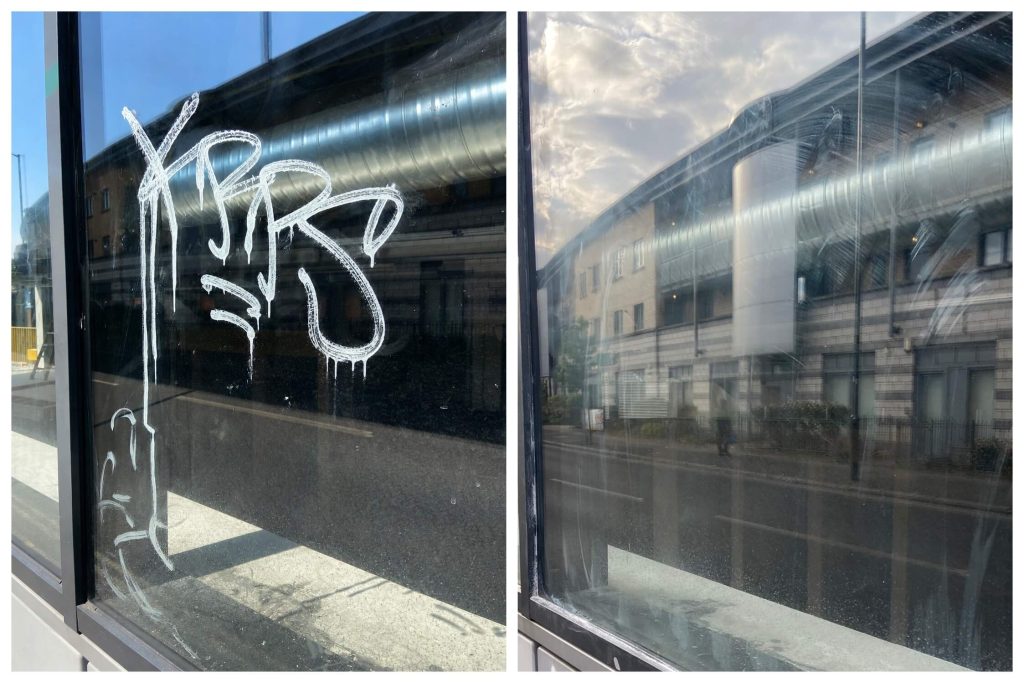
Recent London Graffiti Removal Projects
Before & After Photo of Graffiti Removal Project in Notting Hill
Two Elevations, One Of Them Private
The second local fact predates Carnival by a century and a half, and it decides who can help you.
How These Streets Were Built
The Ladbroke Estate was developed from 1821 into the 1870s, Thomas Allason its principal architect and surveyor among around six involved. Allason's 1823 plan, inspired by Nash at Regent's Park, set terraces and crescents of stuccoed brick houses around large private communal gardens, and about fifteen were eventually built, Arundel Gardens and Ladbroke Gardens among them. The original scheme for a great central circus was cut back after the 1825 financial crisis.
Your Back Wall Faces A Garden
So a great many buildings here have a rear elevation facing a private communal garden rather than a road. That elevation is not highway, not public realm and not visible from any street, so no council service reaches it, before or after Carnival, at ground-floor level or above.
And Access Runs Through A Committee
The gardens are gated and keyed, managed by a garden committee or residents' association rather than any single owner. So work on a rear elevation needs access arranged, and often notice that a contractor and equipment will be inside. Rarely difficult, never instant, which is why a rear elevation is booked rather than attended same day.
Why Rear Marking Lasts Longer
Together they produce the pattern we see constantly: front elevations cleaned within days, rear elevations carrying marking for months. Nobody walks past the back, no service covers it, access needs arranging, and it is nobody's individual responsibility. The fix is to look at both elevations whenever you look at either.
The Medium Matters As Much As Surface
Most advice concentrates on what the wall is made of, and on a terrace of near-identical stuccoed houses the more useful variable is what marked it. Aerosol is a binder holding pigment, sitting as a film on the paint below, and the most predictable thing we meet: a controlled gel at measured dwell releases it. Permanent marker is a dye in a solvent carrier, already travelled into the paint and sometimes through it, needing a product that lifts dye rather than softens binder, while water alone spreads it. Thrown emulsion arrives thick, dries slowly and bonds hard to a scheme it is chemically related to, the hardest of the three to separate from stucco. So the surface decides the method, and where every house is the same material the medium decides it just as much. Where marker has dyed through a scheme, or an earlier attempt opened the render, full recovery is not always possible and we will say so at the quotation.
Front Elevation Against Rear Elevation
| What faces the street | What faces the garden |
|---|---|
| Painted stucco, well maintained and periodically redecorated to a known scheme. | Brick, often unpainted or patchily painted, rarely touched since it was built. |
| Painted timber sashes, doors and joinery in sound condition. | Timber not redecorated in a decade, where grain lifts under heat immediately. |
| Painted railings and area ironwork with an intact film. | Ironwork, gates and fire escapes where the film has already gone in places. |
| Stone steps, cills and thresholds, kept clean and inspected. | Render patches, extensions and outbuildings nobody has surveyed. |
| Cleaned within days, because everybody sees it. | Marked for months, because nobody does. |
Detail: smooth render, rough render, painted brick, unpainted brick, mortar joints, painted timber, cast iron, limestone and powder coated metal.
The Setting Nobody Discusses
Conversations about superheated steam concentrate on temperature, and what decides whether a stuccoed elevation survives is how far the nozzle is held from the wall. Heat and water leave the lance at a fixed setting; what reaches the surface depends on distance, both temperature and energy falling away sharply across the gap. Held too close, a system rated gentle is not gentle at all, and on painted render it softens the scheme before the tag releases. At the right distance the same machine at the same setting softens only the graffiti's binder. That distance is not memorised; it is found on the concealed trial patch, written down and held for the job. Which is why the same operative finishes what they started, and why a contractor who cannot say how they establish working distance does it by eye.
What The Pellets Cost
Dry ice is usually our most expensive method per hour, and customers reasonably ask why. The pellets are a genuine consumable, manufactured, delivered and consumed during the work, unlike water or a gel. A real line in the figure rather than a margin. What it buys back is everything that then does not happen: no slurry, no water, no drying time, no grit to sweep out of a garden bed, no reason for the premises to stop. On a busy frontage or inside a private garden where nothing may be left on planting, that saving exceeds the hourly cost. On a plain rear wall in an empty yard it does not, and a wet method is the honest recommendation.
What A Second Application Buys
When a quotation names two poultice applications, people assume the second is insurance against the first failing. It is not. The first does most of the work and measures the job: how deep the pigment travelled, how fast the carrier dried on that render, and whether what remains is an even residue or a sharp ghost. The second is specified because porous surfaces surrender pigment in cycles rather than at once, so it buys the remainder that was never coming out first, plus the knowledge of exactly how to mix and dwell it. That is why the second is quicker, cheaper and more precise. It is also why a contractor quoting one application on aged stucco plans either to reach for something faster or to call it finished. Soda blasting is the alternative for coated metal only, soft enough to leave a sound coating and hard enough to lift paint. The reasoning is on chemical solutions for graffiti removal, and why the fast mechanical option loses on render is on pressure washing for graffiti removal.
Do you need graffiti removed from your property? Get a fast, hassle-free quote today! Click here to get a professional graffiti removal quote or call us today on: 020 8050 5997
What An Unattended Visit Requires
Six Obligations, Not A Convenience
Nobody needs to be there, which is a set of obligations on the contractor rather than a favour. It is what makes a garden elevation or an early start possible.
- Everything travels on the vehicle, water and power included, so we arrive self-contained and no door opens.
- The boundary is agreed from photographs beforehand, since nobody is there to point at anything.
- More than one removal system is carried, a second mobilisation to a gated garden being a far bigger problem than one to a street.
- Public liability cover goes out with the quotation, since a committee or agent wants it before granting access.
- Every stage is photographed and dated, which is what replaces supervision.
- We work seven days a week, which matters when a communal garden can only be opened on a day somebody is there.
What Goes Wrong Without Them
Skip one and the failure is predictable: a burnished patch on a railing nobody stopped, a spalled render face found a week later, a ghost left in brick because nobody could be asked about a second visit.
Booked, Urgent And Emergency
| Category | What it means and what it costs |
|---|---|
| Booked | A slot agreed for a date suiting access, licences and trade. The lowest figure, fitting an existing run rather than displacing one. |
| Urgent | Attendance within a day or two, absorbed into planned capacity. A modest premium, right for most frontage marking. |
| Emergency | Same day, a day rearranged around it. The highest figure, justified only by offensive content or something a customer is about to walk into. |
| Rear and garden elevations | Always booked, whatever the urgency, since access comes from whoever holds the gate. |
| Anything above ground floor | Always booked, a tower and licence running on the authority's timetable. |
Most people ask for emergency and need urgent. Telling us which changes what we offer rather than what the removal costs.
What You Pay For While Nothing Happens
There are stretches where an operative appears to stand beside a wall doing nothing, and customers watching from a window wonder what they are paying for. That is the dwell, and it is the work. A product has been applied and is separating the graffiti from what is underneath, the operative watching the edge of the patch for the moment the tag releases and before the scheme beneath moves. On painted stucco that window is narrow, both paints answering the same chemistry. Pull too early and the tag stays, so it is reapplied and total contact time doubles. Leave it too long and the scheme goes too. The standing about is the skilled part; the scrubbing is not. A contractor filling that time elsewhere is guessing at the release point. What drives the price on a stuccoed terrace is that judgement rather than the size of the mark. If you are setting a figure before you call, how much graffiti removal costs in London gives the bracket, factors that affect the cost of graffiti removal accounts for why two quotations differ, and the hidden costs of not removing graffiti promptly puts a number on delay.
Recovering The Cost From The Invoice
Most marking here is on a building somebody else owns, and whether you get the money back depends on what the invoice says. A bare total is not recoverable in practice, since whoever is asked to pay cannot tell what was done, to which part, or whether it was reasonable. An invoice naming the elevation, describing the method, stating whether one application or two, with the dated photographs attached, is a document a managing agent can put into a service charge, a freeholder can accept and a garden committee can apportion between houses on a square. Ask for it at quotation stage, since it is trivial in advance and awkward to reconstruct later. For a managing agent it is the difference between recovering and absorbing; for a sole trader who cleared somebody else's elevation because waiting was worse, between reimbursement and an argument. Whether the elevation is yours at all is worked through under who is responsible for graffiti removal, and whether to involve an insurer under whether insurance covers graffiti removal in London.
The Cheapest Three Changes, In Order
- Light the rear elevation. It costs less than one removal, and the garden side keeps marking longest precisely because it is dark and unobserved.
- Check the garden gate actually latches, since one that swings is an invitation and the committee will usually fix it if told.
- Move whatever stands against the wall: the bin store, the stacked chairs, the compost bay that turns a reachable wall into a high one.
Coatings come after those three, and on painted stucco are rarely right, the appearance change being permanent and the scheme redecorated periodically anyway. On a rear gate, outbuilding or service door they can genuinely pay. The difference between a coating that is consumed and one that stays is set out on how anti-graffiti coatings work, with the products themselves compared on the best coating products for London properties.
Who Else Needs To Know First
- The freeholder or managing agent, if the elevation is not inside your demise, which on a converted terrace it usually is not.
- The garden committee, where the marking is on a rear elevation, since access is theirs to grant and notice beats a surprise.
- Your neighbours either side, if the mark crosses a party boundary or the work needs space in front of their frontage.
- The council, before cleaning, if the content is offensive or you want it counted, since a report after removal has nothing attached.
- Your insurer, only if the figure exceeds the excess, which for a single incident it rarely does.
- Whoever holds the photographs, so the record sits with the person who will need it rather than on somebody's telephone.
Where the surface turns out not to be yours at all, the routes are under reporting vandalism in London, and the reason not to attempt it first is on DIY versus professional removal.
Why The Finished Wall Is Shot From One Point
The last photograph is taken from exactly where the first one was, deliberately rather than tidily. On painted stucco the question after a removal is never whether the tag has gone. It is whether anything else changed: whether the cleaned area reads lighter than the wall around it, whether the edge shows as a line, whether the texture altered. You cannot judge that from two photographs taken at different distances in different light, and it is exactly what a freeholder or garden committee asks weeks later. Matching the frame makes the comparison honest and lets somebody who was not there see that nothing was lost. It protects you too, a dated pair from a fixed point being the evidence that the elevation came back as it was found. How the work is kept controlled while the public passes is set out under safety precautions during graffiti removal.
Where We Attend Around Notting Hill
Portobello Road along its length. Westbourne Grove and Ledbury Road. Ladbroke Grove and Ladbroke Road. Kensington Park Road and Elgin Crescent. Lansdowne Road and Stanley Crescent. Talbot Road and All Saints Road. Plus communal garden elevations, rear returns, mews, bin stores and the service accesses behind the terraces, which take most of the marking the street never sees.
Work Completed Across W11
We have lifted aerosol from painted stucco with the scheme intact, drawn marker dye out of render an earlier attempt had spread, cleared thrown emulsion from a garden elevation without opening the brick, taken tagging off railings with the film undisturbed, worked inside gated communal gardens with access arranged through a committee, and left condition notes on rear elevations nobody had inspected in years. Fabric of this age is covered under graffiti on historic buildings in London, and glazing scored rather than sprayed on acid etched graffiti removal.
Who Instructs Us In Notting Hill
| Who calls | What they need from it |
|---|---|
| Independent shops, galleries and traders on Portobello | A frontage cleared before opening, priced first, nobody attending. |
| Managing agents holding converted terraces | An invoice naming the elevation and method, and a record that recovers through a service charge. |
| Garden committees and residents' associations | One visit covering several rear elevations, access arranged, equipment off the planting. |
| Restaurants, bars and hotels | A visit timed around service, upper-storey work booked early rather than after Carnival. |
| Freeholders of stuccoed terraces | A method protecting the scheme rather than requiring the elevation repainted. |
One Job, Decision By Decision
Worked through, the sequence explains itself. Take a throw-up across the rear elevation of a terrace facing a communal garden, reaching the first floor.
- The elevation is the garden side, so no council route applies at any height and the cost is private.
- Access is arranged with the garden committee, fixing this as a booked visit rather than same-day.
- The photographs show unpainted brick below and a painted band above: only one has a scheme to protect.
- The medium is thrown emulsion rather than aerosol, the hardest of the three to separate from paint.
- The brick takes heat at a working distance proven on a concealed patch and written down first.
- The painted band takes a gel at measured dwell, with the operative watching the edge for the release point.
- Equipment stays off the planting, and a dry method is preferred where anything would reach a bed.
What You Are Given Afterwards
Four dated photographs covering the sequence, first and last from the same position so they compare honestly. An invoice naming the elevation, describing the method and stating whether one application or two, which makes it recoverable from a freeholder or apportionable by a garden committee. Waste transfer documentation for anything taken off site. And a written note of what the work revealed: cracked render behind a scheme, a gate that no longer latches, rainwater goods discharging down the face, an earlier attempt made before you were involved.
Removing It Against Painting Over It
| Painting over | Removing |
|---|---|
| On a stucco terrace it means matching a bay against neighbours repainted at different times, so it becomes a whole elevation. | The decorative scheme survives, so no matching arises. |
| On a garden elevation it needs the same committee permission, and leaves a patch every house on the square can see. | Returns the rear wall to what the garden looked at before. |
| Traps moisture in a wall built to release it, and behind render that failure is expensive. | Leaves the fabric drying outward as intended. |
| Marker in particular comes back through a fresh coat within days, so the patch is painted repeatedly. | Takes the dye out rather than covering it, so there is nothing left to reappear. |
What Actually Reduces Repeat Marking
- Looking at both elevations whenever you look at either, since the garden side keeps marking for months unnoticed.
- Speed on whichever side it lands, since an elevation cleared within days is marked far less often than one left weeks.
- Light on the rear, which is the cheapest single intervention available and the one that changes most.
- Booking upper-storey work in the first week after Carnival, while access equipment is still available locally.
- Coatings last, on gates, outbuildings and service doors rather than stucco, where the change is permanent.
Nearby Areas We Also Attend
We cover the streets around W11, where a night's marking often crosses two.
Holland Park, Bayswater, West Kensington, Maida Vale, South Kensington, Knightsbridge, Shepherds Bush, Hammersmith, Paddington and St Johns Wood.
Notting Hill Graffiti Removal: Frequently Asked Questions
Will the post-Carnival sweep clear ours?
Only at ground-floor level. The council states plainly that anything above must be removed by the property owner, whatever else is happening that month.
We are a shop. Does the free frontage clean apply?
No. That scheme covers residential properties affected by Carnival, and excludes any where Carnival-related activity took place.
When should we book upper-storey work?
The first week rather than the third. Everybody discovers their upper marking at once, and access equipment and licences run short locally after that.
The marking is on our garden elevation.
Then no public service reaches it at any height, it being neither highway nor visible from a street. Private from the outset.
How do you get into the garden?
Through whoever holds the gate, usually a garden committee. Rarely difficult, never instant, so a rear elevation is booked rather than attended same day.
How soon can you attend W11?
Same day for most morning calls on a street frontage at ground level. Rear elevations and anything higher are booked, for the reasons above.
It is marker rather than spray paint.
Then it is a dye rather than a film, already travelled into the paint. It needs a product that lifts dye, and water alone spreads it.
Can you match our stucco colour if the paint lifts?
Matching one bay against neighbours repainted at different times is not realistic, which is why the method avoids the question entirely.
Why does the quotation say two applications?
Porous render gives up pigment in cycles. The first application does most of the work and measures the job; the second takes what was never coming out first.
Does anybody need to be there?
No, provided access is arranged. Everything travels on the vehicle, so nothing is drawn from the building and no door is opened.
Do you work weekends?
Every day of the week, which matters when a communal garden opens only on a day somebody is available.
Can you pressure wash the render?
No. Pressure strips the scheme with the tag and opens the render beneath, turning a removal into a repaint of the whole elevation.
Somebody had a go at it with a sponge.
Say so when you call, and what they used. A spread mark or opened surface changes the method and what is achievable.
Can you guarantee it all comes off?
Nearly always. Where marker has dyed through a scheme, or an earlier attempt opened the render, a faint ghost may remain and we say so first.
Several houses on our square were marked.
Instruct as one job through the committee or agent. A single visit covering several rear elevations costs each house materially less.
Do you need graffiti removed from your property? Get a fast, hassle-free quote today! Click here to get a professional graffiti removal quote or call us today on: 020 8050 5997