





Something has been sprayed on a Holborn frontage and you want it gone before the working day starts, with the stone, the joinery and the brickwork left as they were.
Almost all of it lifts. Holborn complicates two things that are simple elsewhere: who you are supposed to report it to, and what some of these buildings are actually made of. The surface decides the method, and on one or two frontages here the surface is older than anything else we work on.
We establish the material, prove the treatment somewhere concealed, then lift the mark and leave the fabric alone. Across WC1V and WC2A that is normally the same day, any day of the week.
Do you need graffiti removed from your property? Get a fast, hassle-free quote today! Click here to get a professional graffiti removal quote or call us today on: 020 8050 5997
One Question, Three Different Answers
Ask who deals with marking on the street outside and Holborn answers differently depending which side of a road you stand on. Not pedantry: it is the difference between a report that gets actioned and one that disappears.
The Boundary Moved In 1994
Holborn is where the London Borough of Camden meets the City of London, and the line has not always sat where it does now. Staple Inn, the timber-framed frontage on High Holborn, was transferred from Camden into the City on 1 April 1994 and now falls within Farringdon Without ward. Buildings a short walk apart are administered by different authorities, with different reporting routes and cleansing standards.
Gray's Inn And Lincoln's Inn Are Private Estates
Both sit in Camden near the City boundary, governed by their own benchers with a Treasurer holding office for a single year, each covering several acres of chambers, hall, chapel, library and gardens managed by the Inn itself. Neither has the status of a local authority, and neither behaves like an ordinary commercial landlord. Work there goes through the Inn's own arrangements rather than a managing agent, and turning up unannounced is not how anything gets done.
The Temple Is Genuinely Its Own Authority
Further east it is more unusual still. Inner Temple and Middle Temple are liberties of the City: within its boundaries, not subject to its jurisdiction, operating as their own local authorities. If your premises adjoin them, the body responsible for the public realm outside your door is neither Camden nor the City.
What To Settle Before You Report Anything
Which authority or estate the surface sits in. Whether it is your building or street furniture, which is never yours to clean. Whether your demise reaches above the entrance. And whether the premises sits on an Inn's estate, since that changes who instructs. A square-on photograph with the neighbouring doorways in shot settles most of it.
Recent London Graffiti Removal Projects
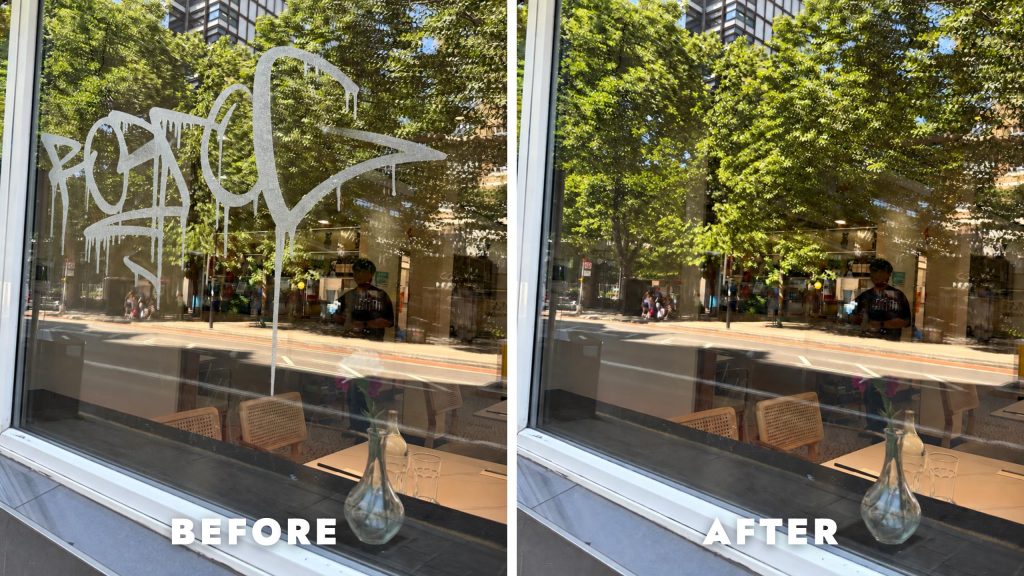
Before & After Photo of Graffiti Removal Project in Holborn
The One Substrate With No Margin At All
Holborn holds something nowhere else in London does: a commercial frontage of exposed, unpainted historic timber.
Staple Inn, Built In 1585
Listed Grade I in 1974, the last surviving Inn of Chancery, timber-framed with a cruck roof and an internal courtyard, bomb-damaged in 1944 and restored. It carries retail at street level under signage rules stricter than any normal parade. Whatever else is true of that frontage, nothing about it can be replaced.
Why Four Centuries Of Oak Behaves Differently
Almost every other surface has something between the mark and the material: a paint film, a fired skin, a glaze, a sealant, a polish. Exposed historic oak has none. It is open-grained, hygroscopic and unsealed, so it takes up whatever lands on it and holds it. Aerosol does not wait on the surface to be lifted, it goes in. And the silvered outer face, the result of centuries of weathering, is a fraction of a millimetre that cannot be regrown.
Everything The Instinct Suggests Makes It Worse
- Solvent soaks straight in, carrying pigment deeper and leaving a stain wider than the mark.
- Water at any pressure erodes the softer summer growth between the harder rings, leaving a ribbed, burnished surface.
- Heat opens the grain further, drives moisture out unevenly and risks scorching.
- Abrasives and sanding remove the weathered surface, and the bright wood beneath never matches again.
- Any alkaline product darkens oak on contact, which is a stain of its own on top of the one you started with.
What Can Honestly Be Achieved
On exposed historic timber this stops being cleaning and becomes conservation. The realistic approach is an inert absorbent poultice drawing pigment outward over hours, repeated, with improvement arriving gradually. Sometimes the result is a mark that fades to acceptable rather than disappears, and anybody promising otherwise on oak of that age has either misunderstood the material or is not telling you the truth. It is the clearest case in this district of something that genuinely needs more than cleaning, and we say so at the quotation.
The Question That Eliminates Most Options
Before anything else we want one thing: is there anything between the mark and the material beneath it? Everything follows from the answer.
If yes, and a paint film, glaze, lacquer or factory coating is in the way, the coating is what we are protecting, the pigment sits on it, and a controlled gel with a short dwell usually does the work. If no, and the mark is on bare stone, bare brick, unpainted render or exposed timber, the pigment has already moved into the material and nothing applied to the surface fetches it back quickly. That removes most of the product catalogue in a sentence. It also frames the honest boundary: where an earlier attempt has driven pigment inward, or a mark has bonded into an open surface, full recovery genuinely needs more than removal and it belongs in the quotation.
The Joints Are Where It Goes Wrong
Whatever a Holborn elevation is faced in, a poor removal does its damage first at the junction between one piece and the next, and that junction is always softer than either side.
Portland and limestone ashlar has fine joints that look decorative and are structural. Soft stock brick on returns spalls under pressure and is bedded in lime mortar an abrasive empties faster than it clears paint. Render and stucco go over that same jointed backing, so anything penetrating the render reaches the joint behind. Painted timber shopfronts meet masonry at a line that wicks whatever touches it. Metal panels are fixed back at a perimeter seal that behaves like a joint and fails like one. And on a timber-framed building the equivalent is the line between frame and infill panel, the most vulnerable thing on the elevation.
So the first assessment on arrival concerns those junctions rather than the paint. Substrate detail is on the relevant pages, including mortar joints, limestone, unpainted brick, painted brick, render and stucco, painted timber, architectural metalwork and powder coated metal, with the glazing itself on laminated glazing.
Where Superheated Steam Is The Only Thing We Will Use
On the protected masonry filling this district, low pressure superheated steam is often the only system we will put against a wall. A DOFF unit delivers heat rather than force, softening the binder until the film releases while the surface never absorbs an impact. It suits Portland ashlar where joints must stay full, soft stock where the fired face is all that stands between brick and weather, lime mortar an abrasive would empty, and moulded detail that loses its crispness under blasting. It is not the answer on exposed oak, where heat is itself the risk, nor on coated metal, which it burnishes.
When Water Is The Thing To Avoid
Dry ice earns its place wherever adding water creates the second problem. Inside entrance halls and covered passages, around lighting and live services, beside alarm and camera installations, and on interior finishes that mark when wetted, the pellets work and leave only dry flakes of paint. Nothing runs, nothing needs collecting off a floor, and the space is handed back at once. In a district of chambers and professional offices that is often what separates working in the day from waiting for a weekend.
Drawing Out Against Taking Off
The distinction governing porous material is direction. A poultice pulls: an active agent held against the surface for hours so pigment migrates outward into the carrier as it dries, removing nothing of the substrate. A blast pushes, taking a small amount of material with every pass, which is why it never reaches staining already below the surface and why it keeps going until it does. On limestone, soft brick, old render and above all historic timber, only the first is available. Soda blasting keeps its place on robust painted metal at the rear, well away from stone and joinery. The chemistry behind each is under chemical solutions for graffiti removal, and what the fast option costs a surface under pressure washing for graffiti removal.
A Certificate Against Cover That Answers
Every contractor can produce a public liability certificate. Fewer can produce one that would actually respond to the job you are asking for, and the difference only shows at the worst possible moment.
Read three things. The limit of indemnity, which should sit well above the value of what is being worked next to, and on a Grade I frontage or an Inn's estate that is a serious number. The description of business activity, since a policy written for general cleaning may not answer for damage from a specialist process on protected fabric. And the expiry date, which nobody checks. Ask before the visit, and treat a contractor who sends it unprompted as having answered several other questions at once.
The rest follows from working unattended: nobody needs to be on site, we arrive self-contained with our own water and power so nothing is drawn from the building, and trial, work and finished elevation are photographed and dated in place of supervision. We operate seven days a week, which in a district that empties at weekends is an advantage rather than a premium. How we handle products, run-off and the footway is set out under safety precautions during graffiti removal.
Who Finds It, And How Long Before Anyone Hears
The delay here is almost never ours. It is the gap between marking being seen and somebody with authority being told, and in Holborn that gap is unusually wide because of who occupies the buildings.
Marking is first seen by whoever arrives earliest, a cleaner, a porter or a security officer rather than anybody who can commission work. In chambers or a professional office there may be no facilities manager at all, only a practice manager with a hundred other things and a landlord somewhere else. On an Inn's estate the route runs through the estate department on its own timetable. So a Saturday night mark is often reported on Tuesday, by which point two warm days have cured it into a materially harder job.
The fix costs nothing. Tell whoever opens the building to report marking immediately, give them a number, and name one person who can approve a figure without a meeting. Buildings that do this clear marking in hours; buildings that do not take a fortnight and pay more for it.
Do you need graffiti removed from your property? Get a fast, hassle-free quote today! Click here to get a professional graffiti removal quote or call us today on: 020 8050 5997
The Five Minutes That Decide The Next Two Hours
- Photograph it first, three frames: the whole elevation, the mark in context, the surface close enough to identify the material.
- Write down the date and the time you found it, and if you can establish it, when the surface was last known clear.
- Establish whose surface it is, using the neighbouring doorways in the wide shot to show where your plot ends.
- Leave it alone. Do not test a cleaner on a corner, rub it with anything, or let a well-meaning contractor try something while you decide.
- Check whether anything on that elevation is meant to be there: signwriting, heritage lettering and commissioned work all exist here.
- Report it if it is not your surface, using the routes on our reporting vandalism in London page, and keep the reference.
- Send the photographs for a quotation the same morning, so the decision is taken while the mark is fresh.
Step four matters most. The most expensive jobs we quote here began with somebody sensible trying to help.
The Visit, From Your Side Of It
What you should see is undramatic, which is the point. A vehicle arrives and little appears to happen for a while, because protection takes longer than removal and the trial patch is run then read twice, wet and dry. You should be asked to confirm what is being removed and what stays, and that agreement photographed rather than remembered. You should not be asked for a tap, a socket, a key or a member of staff. Pedestrians should pass freely, with somebody managing that rather than the wall. Nothing should run across the pavement. At the end protection comes down in reverse with each surface checked, the area is left clean and the elevation photographed. If the first method failed you should be told what we are changing to and why, rather than see the same tool used harder.
Removing It Against Painting Over It
| Painting over | Removing |
|---|---|
| Not available at all on ashlar, exposed timber or architectural metalwork, which is much of this district. | Works on all of them, because it takes something away rather than adding something. |
| On a listed frontage it is an alteration, and the patch ghosts against the wall around it within a season. | Restores the existing appearance, so nothing is engaged. |
| Seals a jointed wall built to dry outward. | Leaves the fabric drying as it was designed to. |
| Commits every future occupier to maintaining a patch that was never meant to be there. | Leaves the building in the condition it would have been in had nothing happened. |
Where We Are Called Out Around Holborn
High Holborn frontages and the shopfronts along it. Chancery Lane and Cursitor Street. Gray's Inn Road and the approaches to Gray's Inn. Lincoln's Inn Fields and the professional frontages around it. Kingsway and Southampton Row. Red Lion Street, Lamb's Conduit Street and Theobald's Road. Leather Lane and the western edge of Hatton Garden. Fetter Lane, Bedford Row and John Street. Plus service courts, chambers entrances, bin stores and rear returns, which take most of the marking and least of the attention.
Work Completed Across WC1 And WC2
We have lifted aerosol from Portland ashlar without flushing a joint, drawn staining out of exposed historic timber with repeated poultices rather than solvent, cleared painted chambers doors with the scheme intact, worked entrance halls with dry ice so nothing got wet, and cleaned soft stock brickwork on rear returns with heat and water alone. Anyone responsible for a protected building will want graffiti on historic buildings in London, and anyone whose glazing has been attacked rather than painted wants acid etched graffiti removal. A first attempt with the wrong product is covered under DIY versus professional removal.
Who Instructs Us In Holborn
| Who they are | What they need from us |
|---|---|
| Practice and chambers managers | A frontage cleared without a meeting, priced before attendance, with nobody needed on site. |
| Estate departments of the Inns | Methods appropriate to protected fabric, evidenced in advance and worked to the estate's own arrangements. |
| Managing agents for office and mixed buildings | One instruction across frontage, returns and service areas, invoiced so a service charge can absorb it. |
| Facilities teams on Kingsway and High Holborn | Attendance timed around the working day, with a dated record attached to each invoice. |
| Independent retailers and sole traders on the side streets | A single frontage cleared quickly, with a written quotation they can pass to a landlord. |
The Quotation, Line By Line
What drives the price is easier to see line by line than to describe.
| Line | What sits behind it |
|---|---|
| Attendance | Getting a vehicle and operative to you at a set time. Shared across a round on booked work, carried alone on an emergency. |
| Assessment and trial | Identifying the material and proving the method out of sight. Short on a modern frontage, substantial on protected fabric. |
| Protection | Masking glazing, joinery, metalwork and adjacent stone. On a multi-material elevation it exceeds the removal. |
| Removal | The part everyone imagines is the whole job, priced by method and dwell rather than area. |
| Access | Nothing at ground level; the largest line once a tower, platform or licence is involved. |
| Return visit | Included where a poultice is specified, because a staged treatment was always going to need one. |
| Waste and documentation | Everything removed leaves under waste transfer documentation, with the record issued alongside the invoice. |
Comparing two quotations and wondering why they differ? Factors that affect the cost of graffiti removal works through each line, how much graffiti removal costs in London gives the wider range, and the hidden costs of not removing graffiti promptly covers what delay adds to all of them.
Who To Send The Quotation To, In Order
- Your managing agent, if there is one. They hold the service charge and can usually authorise it.
- Your landlord or freeholder, if there is no agent, since external repair commonly sits with them rather than you.
- The Inn's estate department, where the premises sits on an Inn's estate, because nothing proceeds there on any other route.
- Your own practice or finance manager, where the lease puts the elevation with you, as a full repairing lease of a whole building does.
- The relevant authority, where the marked surface was never yours, as street furniture never is.
- Your insurer last rather than first, and only after checking the excess, since a single frontage will usually fall inside it.
For an independent operator or sole trader the useful point is that a retail demise commonly stops at the shopfront and shutter, so the elevation above may not be your bill even though it is your view of it. If you are not sure which of the six applies, who is responsible for graffiti removal sets out how to tell, and whether insurance covers graffiti removal in London explains why the last is rarely the answer. A first attempt with the wrong product is covered under DIY versus professional removal.
What Actually Reduces Repeat Marking
- Speed of removal, by a wide margin. A surface cleared within a day stops being worth marking, since the point of a mark is that it stays visible.
- Lighting and sightlines at the position actually being hit, almost always a recess, service door or screened return rather than the frontage.
- Removing whatever creates cover at that exact spot: a parked vehicle, a bin, a hoarding, planting.
- A named approver and a working out of hours number, so nothing waits for a decision.
- A coating, but only on surfaces where marking repeats and appearance is irrelevant: service doors, shutters, bin stores and rear returns.
- Cameras, which help with evidence after the event and do very little to prevent it.
Note the order. Coatings come fifth because they change what the next removal costs rather than whether it happens, and belong nowhere near ashlar, exposed timber or original joinery. Deciding which surfaces in a portfolio are worth treating starts with how anti-graffiti coatings work and the options in the best coating products for London properties.
Nearby Areas We Also Attend
We cover the surrounding districts on the same terms, including Covent Garden, Bloomsbury, Farringdon, Clerkenwell, Aldwych, Temple, Kings Cross, Fitzrovia, Barbican and Islington.
Holborn Graffiti Removal: Frequently Asked Questions
Which council do we report street marking to?
It depends where you stand. Holborn straddles Camden and the City of London, and the boundary has moved, so check which side your address falls before reporting.
We are on an Inn's estate. Can you just attend?
Not without going through the estate department. The Inns manage their own estates through their benchers, and work is arranged on their terms rather than dispatched.
Is the Temple really outside the City's jurisdiction?
Yes. Inner and Middle Temple are liberties within the City's boundaries that act as their own local authorities, so neither Camden nor the City is the right route there.
There is a tag on exposed old timber. Will it come off?
It will improve, and it may not disappear. Unsealed historic oak absorbs pigment rather than holding it on the surface, so this becomes conservation work rather than cleaning.
Can you not just sand the timber back?
No. Sanding removes the weathered outer surface, and the bright wood underneath never matches the rest of the frontage again.
How soon can you attend WC1?
Same day for most morning calls at ground level. Add a day where a tower, a platform or a licence to occupy the footway has to be arranged first.
Can you work during the day without disrupting chambers?
Usually yes. The working area is contained, pedestrians pass freely, and where a method would be intrusive we say so when quoting rather than on arrival.
Does anybody need to be on site?
Nobody needs to be there. Water and power travel with us, and the dated photographs of trial, work and finished elevation do the job supervision would.
Why did the job get more expensive after the weekend?
Because aerosol keeps curing after it is applied. Two warm days harden the film and drive pigment into anything porous, which changes both the method and the dwell.
Our cleaner found it on Monday but nobody told me until Wednesday.
That is the most common delay we see here. Give whoever opens the building a number and name one person who can approve a figure without a meeting.
Can you pressure wash the brickwork at the back?
We would rather not. The lime joints give way before the paint does, and an emptied joint on a tall elevation is a repointing bill rather than a cleaning one.
Somebody tried a household cleaner on it first.
Then tell us, because it changes the method. A product that has driven pigment inward turns a surface job into a staged poultice across more than one visit.
Should we coat our frontage?
Not if it is stone, timber or original joinery. Coat the service doors, bin stores and rear returns, where marking repeats and the finish is not the point.
Our window has been scratched or etched.
That is damage within the glass rather than anything sitting on it, so cleaning will not reach it. It is dealt with on the acid etched graffiti removal page.
What do you need to give us a figure?
Three photographs: the full elevation with the neighbouring doorways in shot, the mark in context, and the surface close up. Tell us if the building is listed.
Do you need graffiti removed from your property? Get a fast, hassle-free quote today! Click here to get a professional graffiti removal quote or call us today on: 020 8050 5997