





Something has been sprayed on an Islington frontage and you want it cleared properly, leaving the brick, the stucco and the paintwork exactly as they were.
Nearly all of it lifts. Islington adds two complications. Much of the marking here is on canalside elevations, where what happens to the run-off is a legal question rather than a tidiness one, and the borough does have an enforcement route, but the evidence for it dies with the mark. The surface decides the method, and on the canal the surroundings decide almost as much.
We identify the material, prove the treatment out of sight, then take the mark off and leave everything else alone. Across N1 and N7 that is usually the same day, seven days a week.
Do you need graffiti removed from your property? Get a fast, hassle-free quote today! Click here to get a professional graffiti removal quote or call us today on: 020 8050 5997
The Canal Side Is A Different Country
The Regent's Canal runs through the middle of this borough, and the buildings that back onto it are worked on under a set of constraints that simply do not apply on Upper Street.
Nothing Goes In The Water
This is the one that catches contractors out. The Canal and River Trust requires consent for any discharge into its waterways and will not accept foul, polluted or contaminated water; clean surface water is considered only where flood risk does not increase and water quality does not deteriorate, and even that needs a licence. Pigment-laden run-off is contaminated water. There is no informal route and no small-quantities exemption. Containment on a canalside elevation is therefore total rather than good practice: the area is bunded, everything is collected at source, and all of it leaves with us.
Everything Is Carried In
The second constraint is access. A towpath is not a road. Nothing parks alongside the work, so water, power, product, masking and containment are carried in, sometimes several hundred metres, and carried out again with the waste. Light self-contained methods are favoured, heavy equipment is often ruled out, and a job taking two hours on a street takes most of a morning on the water. Which is why the quotation for a canalside elevation differs from one for the front of the same building.
Nobody Is Watching That Wall
Canalside elevations take a disproportionate share of the marking for an obvious reason: after dark the towpath is unlit for long stretches, there is no passing traffic, and anybody working there is invisible from the street. The same building gets marked repeatedly at the back and hardly at all at the front, which decides where a lighting or coating budget should go.
Who Owns What
Ownership splits in a way that surprises people. You own the wall; the Trust owns the water and generally the towpath. So a mark on your building is yours even though it was reached from land that is not, and a mark on towpath furniture or the canal wall is not yours at all. Settling which is which before instructing saves a wasted visit.
Recent London Graffiti Removal Projects
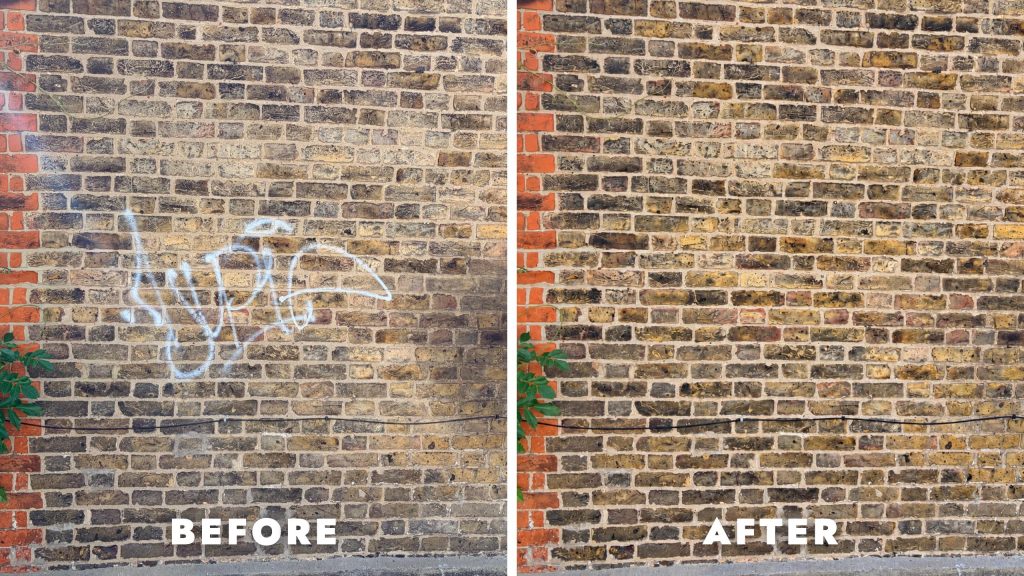
Before & After Photo of Graffiti Removal Project in Islington
Enforcement Is Possible, And The Evidence Dies With The Mark
Most owners assume nothing comes of reporting graffiti. In this borough that is not quite true, and the order you do things in decides whether that route stays open.
What The Council Actually Does
Islington removes offensive graffiti, including abusive and racist marking, within 24 hours of being notified, and other graffiti within 5 working days. Reports can be made through the Love Clean Streets app, through a My Islington account, or anonymously through the Love Clean Streets website.
A Fixed Penalty, And Worse Behind It
The borough issues fixed penalty notices of £500 for graffiti offences, and behind that sits the criminal law: graffiti is criminal damage, with a maximum sentence of ten years. Which is why a report with a reference number is worth the two minutes.
The Removal Destroys The Evidence
Here is the conflict nobody mentions. Everything supporting enforcement exists only until the wall is cleaned: the content, the scale, the position, and the tag itself, frequently the identifying feature. Clean first and there is nothing to act on. Wait for an outcome and the paint cures into a harder, costlier job on a wall you look at meanwhile.
The Order That Preserves Both
Photograph it before anything else, including a wide shot establishing the location. Report it and keep the reference. Ask whether footage exists nearby and ask for it to be preserved, since most systems overwrite within weeks. Then have it removed the same day. The sequence costs ten minutes and it is the difference between an incident and a case.
The Questions We Ask On Arrival
Each answer removes options, and by the fifth there is usually one sensible method left.
- Is this a street elevation or a canalside one? That decides containment, access and what equipment can physically reach the wall.
- What is the wall made of, established by looking closely rather than assuming from the age of the terrace, since Islington stucco and Islington brick frequently sit on the same elevation.
- Is there a paint scheme, a render or a coating that has to survive, and roughly how old is it?
- What was used, since aerosol, emulsion, marker and etching fluid fail in entirely different ways and only one of them is really a cleaning job.
- How long has it been there, because that changes dwell time and sometimes changes the method outright.
Those five produce a method and a realistic figure. Occasionally they produce a different conversation instead: on a wall that has already been pressure washed by somebody else, or where a mark has been left long enough to bond into open brick, full recovery genuinely needs more than cleaning, and we will say so before you commission anything rather than after.
The Surfaces People Guess Wrong About
Islington's stock is more mixed than one street suggests, and the confident guesses are usually wrong.
- Painted stucco at ground floor with bare brick above, on the same terrace house, wanting two different treatments either side of the string course.
- Stock brick that looks uniform and is not, where half a terrace was rebuilt after bomb damage in a harder brick.
- Render that appears solid and turns out to be modern and thin over insulation on a later block.
- Canalside brickwork permanently damp at low level, behaving nothing like the same brick at the front and drying nothing like it either.
- Painted timber shopfronts on Upper Street and Chapel Market, where anything strong enough for the tag lifts the top coats.
- Painted and galvanised metal shutters, where a factory finish and a site-applied one look identical and behave oppositely.
- Stone dressings, copings and thresholds, usually limestone, so ruled out for anything acidic.
Substrate detail is on the relevant pages, including stucco and render, unpainted brick, painted brick, mortar joints, limestone, painted timber, galvanised steel, painted metal and railings and cast iron.
What The Operator Is Actually Adjusting
A DOFF unit delivering low pressure superheated steam has no setting marked correct. The operator holds three things in balance throughout: how hot the water arrives, how far back the lance is held, and how long it stays on any one spot. Those interact, which is what makes it a skill rather than a procedure. Back off too far and nothing happens, which tempts an inexperienced operator to close in. Hold too long in one place on soft stock and the heat starts working on the brick rather than the film. Run the temperature low and the compensation is always more dwell or less distance, both of which do damage. On a damp canalside wall there is a fourth consideration, because a saturated substrate takes heat differently from a dry one and the same settings give a different result.
Where Dry Ice Is The Wrong Call
- Soft render and painted stucco, where the impact takes the coating and spalls the surface beneath it at the same time.
- Stone that is already eroded or friable, where the pellets take grains off the face instead of lifting the film.
- Any enclosed space without forced ventilation, including a canalside undercroft or a bridge arch, since the gas is heavier than air and pools at low level.
- Anywhere overnight with flats above or opposite, because it is loud enough to end the visit early.
- Against recently applied paint that must survive, since thermal shock does not distinguish between what should go and what should stay.
How Long A Poultice Stays On Here
Longer than elsewhere, and the canal is the reason. A poultice works by drying, drawing mobilised pigment outward into the carrier as it loses moisture, so anything slowing the drying slows the process. A canalside wall sits in a damper microclimate, is often shaded for much of the day, and may be wet at low level year round. A poultice that would finish in an afternoon on Upper Street needs considerably longer at the back, and sometimes a covering to control the drying rate. Which is why we quote canalside stonework with a return visit in it and street frontages sometimes without. The chemistry is set out under chemical solutions for graffiti removal, and why the quick alternative is wrong on this fabric under pressure washing for graffiti removal.
A Certificate, Or Cover That Would Actually Answer
Ask any contractor for their public liability certificate and you will get one. The question worth asking is whether it would respond to the work you are commissioning, and on a canalside job there is a specific reason that matters.
Work beside a waterway carries third-party exposure a street job does not. A discharge into the canal is not a mess, it is a pollution incident with a body that will take an interest. A policy written for general cleaning may not answer for that, and a modest limit of indemnity may not be adequate to it. So read the limit, the description of business activity and the expiry date, and ask specifically whether the cover extends to work adjacent to a watercourse.
The rest of the standard follows from being able to work without supervision. We attend self-contained with our own water and power, which on a towpath is not a convenience but the only way the job happens at all; nobody needs to be on site; and the trial patch, the work and the finished elevation are photographed and dated in place of anybody watching. We operate seven days a week. Product selection, containment and where run-off goes are covered under safety precautions during graffiti removal.
Why The First Forty-Eight Hours Matter More At The Back
Aerosol keeps curing after application, cross-linking over days while the remaining solvent carries pigment further into anything absorbent. True everywhere, worse on a canalside wall, because damp porous brick takes up solvent-borne pigment more readily and holds it longer than dry brick does.
So the gap between an easy job and a hard one is shorter at the back than the front. A tag on a street elevation attended within a week is usually one application. The same tag on a canal wall that never fully dries can be a staged poultice by then. Which argues for treating the towpath elevation as the priority rather than the afterthought, even though nobody sees it.
Do you need graffiti removed from your property? Get a fast, hassle-free quote today! Click here to get a professional graffiti removal quote or call us today on: 020 8050 5997
Abusive Or Targeted Content Is A Different Process
Everything above assumes ordinary tagging. Where the marking is racist, abusive or aimed at a particular person or household, the route changes and it changes first rather than last.
Report it to the police and get a crime reference, since that supports any later action and cannot be obtained once the wall is clean. Report it to the council too, as abusive and racist marking falls into the 24 hour category rather than the five working day one. Photograph it as evidence rather than a quotation aid: content legible, whole elevation, something establishing location. Screen it if it is in public view. Then have it removed ahead of everything else. We treat this category as same day without exception, weekends included, and do not wait to establish who is paying. Reporting routes are set out under reporting vandalism in London, and why an interim attempt with the wrong product makes things worse is on DIY versus professional removal.
How We Decide A Canalside Job Is Finished
The checks are stricter at the back, because more goes wrong unnoticed. The mark has to have reached the point the trial patch predicted, with no further gain available without risking the wall. The treated area has to read as part of the elevation once dry, which on a permanently damp wall means judging it wet and returning to look. Nothing may remain in the joints, on the coping or on the towpath. All containment comes up with the residues still in it, and every litre leaves with us under waste transfer documentation. The towpath is left as found, since it is not ours and is in constant use. And the elevation is photographed and dated, with anything we noticed that you did not know about written down.
Removing It Against Painting Over It
| Painting over | Removing |
|---|---|
| On a canalside wall that never fully dries, a film seals moisture in and the paint itself fails within a season or two. | Leaves the wall breathing and drying as it was built to. |
| Cannot be matched on stock brick or stone dressings, so the patch and its ghosting are permanent. | Returns the elevation to one continuous surface. |
| Destroys any evidence that might have supported enforcement, with nothing gained. | Can be done after the photographs and the report, preserving both. |
| Frequently becomes the fresh blank surface the next mark goes on. | Leaves no invitation behind. |
Where We Are Called Out Around Islington
Upper Street frontages, shutters and fascias. Essex Road and the parades along it. Chapel Market and White Lion Street. Camden Passage and the surrounding courts. The Regent's Canal towpath elevations between City Road Basin and Caledonian Road, including the approaches to the Islington Tunnel. Liverpool Road and Barnsbury Street. Cross Street and Islington Green. Holloway Road at the northern end. Canonbury Road and St Paul's Road. Plus bridge abutments, undercrofts, service yards, bin stores and rear returns, which take the great majority of the marking.
Work Completed Across N1
We have cleared canalside brickwork with full containment so that nothing reached the water, lifted aerosol from painted stucco at ground floor without bleaching the colour, removed marking from bare stock brick above it in the same visit using a different method, cleaned painted timber shopfronts with the scheme intact, taken tags off galvanised and painted shutters without altering the finish, and attended abusive content the same day at weekends. There is more on protected fabric under graffiti on historic buildings in London, while marking cut into glass rather than applied to it is handled by the process on acid etched graffiti removal.
Who Instructs Us In Islington
| Who they are | What they need from us |
|---|---|
| Independent shops, bars and restaurants on Upper Street and Essex Road | A frontage cleared before opening, priced before attendance, with no contract. |
| Managing agents for canalside and converted buildings | Containment that satisfies a waterway authority, and an invoice a service charge can absorb. |
| Residents associations and block managers | Clear pricing for a body making a collective decision without a property department. |
| Owners of listed and period houses | Methods appropriate to soft brick, lime mortar and historic stucco. |
| Facilities teams for offices and workspace buildings | One instruction covering frontage, towpath elevation and service areas. |
The Second Time Costs Less Than The First
What drives the price on a first visit is, to an unusual degree, the cost of not knowing. We have to identify the material, work out what is underneath it, prove a method somewhere concealed, discover what the access actually involves and find out how the wall responds, and all of that is priced with a contingency because any of it could turn out badly.
The second time on the same surface, all of that is known. The material is on file, the proven setting recorded, the masking worked out, the access understood, and no contingency to carry. On a canalside elevation the difference is larger, because the unknowns were: how long the poultice needed, how the damp base behaved, where the containment had to sit. Which is why a standing arrangement on a repeatedly marked building costs materially less per incident than calling each time, and why the first quotation is rarely the price it settles at. Wondering how any of that translates into the figure in front of you? Start with factors that affect the cost of graffiti removal, then how much graffiti removal costs in London for the wider range, and the hidden costs of not removing graffiti promptly before deciding to leave it.
Who To Send The Quotation To
Work down and stop at the first that applies. A managing agent, who holds the service charge and can usually authorise without going further. The landlord or freeholder if there is no agent, since external repair commonly sits with them. The Canal and River Trust, if the surface is towpath furniture or canal structure rather than your building. Your own finance manager, where a full repairing lease puts the building with you. The council, where the surface is theirs. And your insurer last, after checking the excess, since a single frontage usually falls inside it.
For an independent operator or sole trader the point that matters is that a retail demise commonly stops at the shopfront and shutter, which leaves the elevation above with the landlord, so the mark you are looking at may not be your bill even though it is entirely your problem. Who is responsible for graffiti removal sets out how to tell, and whether insurance covers graffiti removal in London explains why a claim rarely helps.
Sacrificial Against Permanent Coatings
- A sacrificial coating is consumed with the graffiti, so it protects once and must be reapplied, and somebody has to know when it has gone.
- A permanent system stays on the surface through repeated cleaning but degrades quietly over years, with no signal that it has stopped working.
- Sacrificial systems are generally breathable, which is the only reason either is worth discussing on damp canalside brickwork.
- Permanent systems are frequently impermeable, which rules them out on any wall that needs to dry outward, and canalside walls need that more than most.
- Initial cost favours sacrificial; running cost on a repeatedly hit surface favours permanent.
- Neither belongs on stucco, stone dressings or original joinery, where the appearance change is the problem you were trying to avoid.
Given how much of Islington's marking lands at the back, the towpath elevation is usually where a coating budget does most good, and the frontage is usually where it does least. The mechanism behind both types is in how anti-graffiti coatings work, with options in the best coating products for London properties.
Nearby Areas We Also Attend
We cover the surrounding districts on the same terms, including Angel, Canonbury, Highbury, Barnsbury, Holloway, Finsbury, Clerkenwell, Kings Cross, De Beauvoir Town and Tufnell Park.
Islington Graffiti Removal: Frequently Asked Questions
Our building backs onto the canal. Is that a problem?
Not a problem, a different job. Nothing may enter the water, so containment is total, and everything has to be carried in along the towpath rather than parked beside.
Why can the run-off not just go in the canal?
Because the waterway authority requires consent for any discharge and will not accept contaminated water. Pigment-laden run-off is contaminated water.
The towpath wall is marked as well. Will you do that too?
That is usually not yours. You own the building; the Trust owns the water and generally the towpath, so canal structures are reported rather than instructed.
Why is the back of our building marked far more than the front?
Because it is unlit, has no passing traffic and cannot be seen from the street. It is also where a coating or a light does the most good.
Will the council remove it for us?
They deal with offensive and racist marking within 24 hours and other graffiti within 5 working days on what they are responsible for. Your own building is yours.
Is there any point reporting it?
Yes. The borough issues fixed penalty notices of £500 for graffiti offences, and it is criminal damage, so a report with a reference is worth the two minutes.
Should we report before or after cleaning?
Before, every time. The evidence is the mark itself, and cleaning destroys it. Photograph, report, keep the reference, then have it removed the same day.
How soon can you attend N1?
Same day for most morning calls. A towpath elevation is booked rather than dispatched, because everything has to be carried and the containment set up first.
Does anybody need to be there?
No. We carry our own water and power, which on a towpath is the only way the job works at all, and the dated photographs replace supervision.
Our ground floor is painted stucco and above it is bare brick.
Then it is two operations in one visit, masked apart at the string course. A single method across both would protect one and damage the other.
Can you pressure wash the brickwork at the back?
No. Canalside stock brick is soft and already damp, and pressure opens the face, leaving a wetter, more absorbent surface that holds the next mark far deeper.
Why does the canal side need a second visit when the front did not?
Because a poultice works by drying, and a shaded wall beside water dries slowly. The same treatment that finishes in an afternoon at the front takes longer at the back.
Somebody has sprayed something racist on our wall.
Report it to the police for a reference and to the council, which treats that category as a 24 hour matter, then call us. We attend same day including weekends.
Our window has been scratched or etched.
Scratching and etching cut into the glass rather than sit on it, so no removal product reaches them. They are covered on the acid etched graffiti removal page.
What do you need to quote?
Photographs of the whole elevation, the mark in context and the surface close up. Say whether it is the street or the canal side, since the two price differently.
Do you need graffiti removed from your property? Get a fast, hassle-free quote today! Click here to get a professional graffiti removal quote or call us today on: 020 8050 5997