





Something has been sprayed on a Hackney frontage and you want it off properly, leaving the brick, stone and joinery exactly as they were.
Nearly all of it comes off. Two local facts decide the job. Hackney holds a listed building where the graffiti was deliberately kept: a wall decorated by squatters in the 1980s is preserved inside Sutton House, which is a genuine exception rather than a precedent for your wall. And the oldest building in the borough is coursed rubble masonry, wide soft joints between irregular stones, the worst thing you can point a pressure washer at.
We establish what the surface is and what is actually wanted from it, prove the treatment concealed, then lift the mark. Across E8 and E9 that is usually the same day, seven days a week.
Do you need graffiti removed from your property? Get a fast, hassle-free quote today! Click here to get a professional graffiti removal quote or call us today on: 020 8050 5997
The Wall Hackney Decided To Keep
Nowhere else has a Tudor house treating its own graffiti as part of the record, and it is worth knowing why before anybody argues from it.
What Sutton House Is
Sutton House on Homerton High Street was built in 1535 by Sir Ralph Sadler, Principal Secretary of State to Henry VIII. Red brick, listed Grade II* on 23 April 1951, owned by the National Trust, it is among the oldest domestic buildings in London.
What Happened To It In The 1980s
It was occupied by squatters in the mid-1980s and run as the Blue House, a music venue and social centre. When the building was renovated and reopened in 1993, a decorated wall from that period was preserved inside the museum rather than cleaned off.
Why That Was The Right Call There
Because the marking is part of the building's documented history, it is internal rather than on a public elevation, it sits under a national body with a curatorial view, and the decision was taken deliberately within a conservation programme. Four conditions, all met.
Why It Is Not A Precedent
On a shop shutter on Mare Street, a mark applied last Tuesday is not a historical record and nobody is curating it. The Sutton House wall gets cited as though it settles an argument about leaving marks alone. It does the opposite, showing how unusual circumstances must be before retaining one is defensible.
Recent London Graffiti Removal Projects
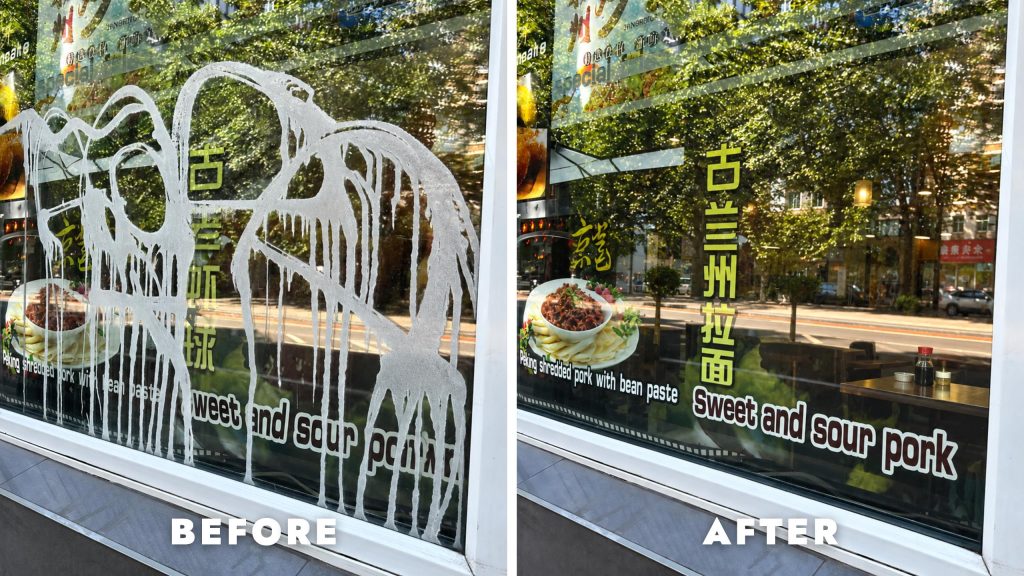
Before & After Photo of Graffiti Removal Project in Hackney
The Worst Substrate For A Pressure Washer
The second fact is physical and it applies far beyond the one building that illustrates it.
What The Tower Is
St Augustine's Tower, off Mare Street, dates from the end of the thirteenth century and is Grade I listed, in the top two per cent of listed buildings nationally. It is coursed rubble masonry, four floors linked by a spiral stone staircase, and the oldest building in Hackney. The council owned it from 1929, and the Hackney Historic Buildings Trust has held responsibility since 1990.
Its Repair History
The battlements were repaired and stone facings replaced in 1933, a renovation followed in 1983 under the Urban Programme Environment Project's Facelift scheme, and in 2005 the Heritage Lottery Fund awarded £231,000 towards preservation. Recent work has covered stonework repairs, lighting, glazing and access.
Why Rubble Masonry Is So Vulnerable
Because the joints are wide and the stones irregular. On ashlar or brick the joint is a thin line and the face takes the load. On coursed rubble the mortar is a substantial proportion of the wall surface and much softer than the stone beside it, so force removes mortar first, opens the bed and leaves stones loose rather than merely dirty.
And The Same Applies Around The Borough
Rubble walls, boundary walls, churchyard walls and nineteenth century returns in soft lime mortar are everywhere here, and they are exactly what gets jet washed because nobody thinks of them as delicate. The surface decides the method, and on these it is never pressure.
The Question Behind The Question
Before anything else we ask what the wall is meant to look like afterwards, because the answer is not always the obvious one.
Sometimes everything must go, the usual case on a shopfront. Sometimes one mark must go and something adjacent must stay, which happens more often here than anywhere else we work, because commissioned murals and authorised shutter paintings sit alongside unwanted marking on the same streets. And sometimes the wall should read as it did last month rather than when new, which on a weathered elevation is a smaller job.
Getting it wrong is expensive both ways: removing something commissioned is a serious mistake, leaving something that was not is a slow one. So we ask, and where it is unclear we ask you to check with whoever holds the building first. Occasionally the answer is that what you want cannot be delivered: where a mark has sat on open rubble or porous brick for a season, full recovery is not always possible, and we say so at the quotation rather than after the invoice.
What The Heat Does To The Paint Film
Low pressure superheated steam is the mainstay here, and what it actually does is worth understanding because it explains the limits.
Aerosol paint is pigment held in a binder, and the binder is what makes the film stick. It softens above a certain temperature, so steam raises the film past that point until it loses adhesion, at which stage very low pressure carries it away. The wall is never asked to resist anything, which is why DOFF is acceptable on rubble masonry, soft brick and lime mortar where nothing else is.
The limits follow. A modern two-pack or polyurethane coating does not soften usefully at those temperatures. Pigment that has migrated into a porous face is no longer a film, so there is nothing to release and a poultice answers instead. And a binder fully cured over a hot summer takes longer than a fresh one, which is why a mark reported in week one costs less than the same mark in week six.
Where Dry Ice Is The Wrong Call
Dry ice blasting is a genuinely good method and it is proposed here more often than it should be.
It is wrong on soft or friable render, where thermal shock detaches a coating that was holding the render together rather than merely decorating it. Wrong on friable stone and rubble masonry with perished mortar, where the pellets work on the weakest thing present, the joint. Wrong on a saturated wall in winter. And wrong wherever the mark is staining in the face rather than a film on top, because it needs a bond to break.
It is right on a coating over sound brick, metal or a modern substrate, on premises that cannot take water or cannot close. No run-off, a dry finish so the result is agreed on the visit, and nothing taken off the material underneath. The distinction is not how delicate the building is but whether there is a bond to break.
Do you need graffiti removed from your property? Get a fast, hassle-free quote today! Click here to get a professional graffiti removal quote or call us today on: 020 8050 5997
Soda As The Middle Ground
Soda blasting sits between steam and a true abrasive, and knowing where the line falls saves a lot of damage.
It is softer than grit, garnet or sand, so it will not cut stone the way those do. It is harder than water and harder than soft lime mortar, so it will still round an arris, open a joint and polish a face given time in one place. That combination is why it gets specified carelessly: it sounds safe, and the damage is gradual, so an operator is minutes past the point of harm before anything looks wrong.
Its honest use is a painted surface where the paint is coming off anyway, on robust masonry with no arrises and no finish worth keeping. On rubble masonry, Tudor brick or anything listed, a poultice does the same work untouched, the medium holding the solvent in contact long enough to draw staining out into itself.
Six Centuries On One Street
Hackney puts more construction periods within a few hundred metres than almost anywhere, and each needs a different answer.
Medieval And Tudor
- Coursed rubble masonry, where the wide soft joint is the weak point and goes first: mortar joints
- Early red brick, softer and more irregular than anything Victorian, and irreplaceable: red brick unpainted
- Dressed stone to openings and copings, which burnishes rather than chips: limestone
Georgian And Victorian
- Painted stucco to terraces and shopfront surrounds, where the scheme is what must survive: stucco smooth and synthetic
- Textured render on later work, where the mark hides in the profile: rough stucco
- Painted timber to shopfronts, pub frontages and doors, where mark and finish share a chemistry: painted wood
- Cast iron railings, gates and columns, whose old film is part of what is protected: cast iron
Twentieth Century And Later
- Brick painted at some point since, now a finish rather than a substrate: painted brick
- Powder coated shutters, gates and bin stores, which cloud under a masonry solvent: powder coated metal
- Glazing, where a scored mark is a separate discipline: acid etched graffiti removal
The Quote That Changes And The One That Does Not
A figure given before attendance either holds or it does not, and which is knowable beforehand.
It holds where the substrate was correctly identified from a close photograph, the access described accurately, nothing tried on the mark before, and the extent agreed rather than assumed. On those jobs the figure quoted is the figure invoiced, which covers most of what we do.
It changes where the trial contradicts the photograph, a previous attempt nobody mentioned turns up, or the access differs from the description. In each we stop, tell you, and give a revised position you can decline, paying for the trial alone. What does not happen is an adjusted invoice arriving afterwards with no conversation in between.
Which is why the close photograph matters more than anything else you send: it decides whether a figure is a price or a range.
Matching The Visit To How The Building Is Used
Same day is available seven days a week. The useful question is which part of the day suits the building.
A shop on Mare Street or Broadway Market wants clearing before trade, since a frontage cleaned at noon has cost the owner the morning. Licensed premises want the other end of the day, outside service. A converted terrace wants mid-morning, once the cars have gone. A school wants a slot outside arrivals, and a managed block one the agent can announce in advance.
Two things cannot be compressed whatever time suits: access equipment above the first floor takes days, and on a listed building the conversation with whoever holds it comes first. Raise both at enquiry rather than on the morning.
The Quotation, Line By Line
Owners ask what drives the price, so here is what is actually inside the figure.
| Line | What it covers |
|---|---|
| Survey and trial | Identifying the substrate, proving the method somewhere concealed, reading it dry |
| Protection and containment | Masking everything untreated, sized for where residue travels rather than where the mark is |
| Method and dwell | The treatment itself, including a second application where the substrate always needed one |
| Access and time on site | Where equipment stands, how far it is carried, and how long the working area must hold |
| Assessment and record | Returning to a dry wall, photographing from a fixed point, writing down what was used |
A materially cheaper quotation has removed lines rather than worked faster, usually the first, the second and the last. The wider picture sits under factors that affect the cost of graffiti removal and how much graffiti removal costs in London.
The Service Charge Route
On a managed block or estate the cost is usually recoverable, and whether it is turns on the paperwork rather than the work.
The invoice must identify elevation, method and date. A leaseholder may query a service charge item, and a line reading graffiti removal answers nothing, while one naming the rear elevation of a specific block, the method and the day answers everything. Where a block is marked repeatedly, a record showing the pattern turns an expense into a case for a preventative measure.
For an independent trader on a single site it is simpler: the address and date have to be right and nothing else, though naming the elevation still helps if a landlord should have paid. Which party actually carries this is set out under liability issues and who is responsible for graffiti removal, with the insurance position under does insurance cover graffiti removal in London.
Why A Cleaned Wall Gets Marked Again
The fortnight after a removal is when the second mark usually arrives, and knowing why interrupts the cycle.
A freshly cleaned wall is briefly the most attractive surface on the street: uniform, unweathered, obviously unmarked. It also signals somebody is paying attention, which cuts the other way, and which wins depends on how fast the second mark is dealt with. Cleared within days, the wall establishes that marking here does not last. Left a month, it establishes the opposite.
So the week after is when the cheap interventions are worth making rather than six months later: the light re-aimed at the wall instead of the pavement, the bin moved out of the alcove that gave cover, a planter denying the arm's length. Only then is a coating rational, and on lime-mortared walls the system must breathe or the wall fails instead. What the systems do is covered under anti graffiti coatings, what they are and how they work, with the comparison under best anti graffiti coating products for London properties.
Report First, Clean Second
The order matters in two situations and nowhere else.
It matters where you want enforcement, because removal ends the physical evidence and a later report describes something nobody can look at. Photograph it, note the date and the window it appeared in, report it, then clean it.
It matters where the surface might not be yours, since cleaning somebody else's wall is money you will not get back, and here the wall behind a shop can belong to a housing provider, a trust, a railway or a neighbouring freeholder. Otherwise clean it and move on, because every week it stays costs something. Reporting routes are set out under reporting vandalism in London, and the argument against trying a product yourself first under DIY versus hiring professionals.
What Gets Checked Before The Van Is Loaded
Most of what goes wrong on site was preventable the evening before, which is when the checking happens.
- The substrate from the photographs, so the right media and dilutions go on board rather than the ones that usually work.
- The access, so hose length, carrying distance and where the vehicle can legally stand are known rather than discovered.
- Whether the building is listed or in a conservation area, because that changes what may be used.
- Whether anything adjacent is meant to stay, which around here is a real question.
- Whether the premises trade, which sets the hour.
Then the equipment against that list: media, containment sized for the location, masking for what is not being treated, and the means to record it. A crew that arrives and improvises was never told enough, and the fix is the enquiry rather than the van. Product handling and control with the public alongside are covered under safety precautions during graffiti removal, and the case against force under high pressure washing for graffiti removal.
Where We Attend Around Hackney
Mare Street along its length. Homerton High Street and Morning Lane. Broadway Market and London Fields. Well Street and Lower Clapton Road. Amhurst Road and Dalston Lane. Graham Road and Richmond Road. Plus boundary walls, churchyard walls, rear returns, bin stores and estate elevations, which take most of the marking the main streets never show.
Work Completed Across E8 And E9
We have cleaned rubble masonry without opening a bed joint, lifted marks from early red brick with nothing abrasive near it, cleared shutters before trade on Mare Street, and removed one mark while leaving a commissioned piece beside it untouched. Fabric of this age has its own page at graffiti on historic buildings in London, and the products are compared under chemical solutions for graffiti removal.
Who Instructs Us In Hackney
| Who calls | What they need from it |
|---|---|
| Independent shops, cafes and bars on Mare Street and Broadway Market | A frontage cleared before trade, priced from photographs, nobody attending |
| Managing agents and housing providers | An invoice naming elevation, method and date, recoverable through a service charge |
| Trusts and institutions holding historic buildings | A method acceptable on protected fabric, evidenced before attendance |
| Freeholders of converted terraces | Removal that leaves lime pointing and old brick exactly as found |
| Landlords with runs of commercial units | Several addresses priced as one visit rather than separately |
One Job, Decision By Decision
A tag across a rubble boundary wall and onto the stock brick return beside it, with a commissioned mural on the adjoining panel.
The first question was scope rather than method, the mural being clearly deliberate and the tag clearly not. That was confirmed with the owner before anything was opened, and the working area set so no residue could reach the mural, which took longer than the removal.
The rubble ruled out pressure and abrasives outright: wide lime joints softer than the stone, and an opened bed joint does not merely look worse, it loosens stones. A poultice was chosen, drawing the staining out without touching the wall. The brick return took the same medium at a different dwell, trialled separately.
The poultice went on late so the dwell ran overnight, covered and secured because the wall fronts a public path. It came off in the morning and the wall dried before assessment rather than being judged wet. A faint shadow stayed in one deep joint, photographed and left, because reaching it meant working mortar already the weakest thing in the wall. The mural was untouched.
What You Are Given Afterwards
Photographs taken before and after from one position that does not move between them. A note of each surface with its method, dilution and dwell, which on protected fabric is evidence that maintenance was appropriate and anywhere else makes a repeat visit quicker. An honest description of what is still there and from how far away it reads. And an invoice worded so it recovers.
Removing It Against Painting Over It
On rubble masonry and early brick, painting is not a repair: it traps moisture in a wall built to breathe and the face fails later, which on irreplaceable fabric is the expensive outcome. On a shutter or a modern panel the ordinary argument applies, where paint over a mark repeats every time and thickens each round until detail beneath stops reading. Sutton House is the exception people cite and it proves the point: keeping a mark was defensible there because a national body decided it curatorially, indoors, as part of a documented history. What delay costs everywhere else is set out under hidden costs of not removing graffiti promptly.
Nearby Areas We Also Attend
We work across east and north London, including Dalston, Bethnal Green, Hackney Wick, Shoreditch, Whitechapel, Old Street, Islington, Highbury, Spitalfields and Brick Lane.
Hackney Graffiti Removal: Frequently Asked Questions
Can you remove one mark and leave the one beside it?
Yes, and here that is a routine request. The working area is set so no residue or overspray reaches what is staying, which usually takes longer than the removal itself.
Why is rubble masonry so difficult?
Because the joints are wide and much softer than the stone. Force removes mortar first, opens the bed and leaves stones loose rather than simply clean.
Can you work on a listed building?
Yes. Tell us at the enquiry, because the method is then chosen against what the listing protects and the record afterwards is evidence rather than paperwork.
Will steam shift everything?
No. It softens a binder so a film releases, so it will not touch a modern two-pack coating or pigment that has already gone into a porous face. Those need a different mechanism.
Is dry ice suitable on old walls?
Often not. It needs a bond to break, and on friable render or perished lime mortar it works on the weakest thing present, which is the joint.
Is soda blasting safe?
Safer than grit and not safe on soft or listed fabric. It rounds arrises and opens joints gradually, so nothing looks wrong until it is.
How quickly can somebody attend?
Usually the same day across E8 and E9, seven days a week. Access equipment above the first floor takes days whatever the urgency.
Does anybody need to be there?
No. We attend self-contained with our own water and power, so nobody needs to be there, and public liability cover is evidenced ahead of the visit rather than on request.
Will the price change on site?
Only if the trial contradicts the photograph, a previous attempt turns up, or the access differs from the description. We stop and tell you before anything else happens.
Does it cost more if I leave it a month?
Usually. The binder cures and pigment migrates, so a mark reported in week one is frequently a one-application job where the same mark in week six is two.
Should I report it before cleaning?
Only if you want enforcement, or if you are not sure the wall is yours. Otherwise clean it, because the delay costs more than the report gains.
Who pays on a managed block?
Usually the freeholder, recoverable through the service charge, provided the invoice names the elevation, the method and the date rather than reading graffiti removal.
Somebody scrubbed at it first. Does that matter?
Yes, more than the original mark. It drives pigment into a porous face and typically turns one visit into two.
Can several addresses be done together?
Yes, and it is the largest saving available. Landlords and agents with a run of units should ask for it priced as one attendance.
Is a coating worth having on an old wall?
Only if it is permeable. On lime-mortared and rubble walls a non-breathable system traps moisture and the wall fails instead of the coating.
Agents weighing recurring costs should read the cost pages together: how much graffiti removal costs in London is the one for budgeting a single job, and hidden costs of not removing graffiti promptly is the one for arguing the case upward.
Do you need graffiti removed from your property? Get a fast, hassle-free quote today! Click here to get a professional graffiti removal quote or call us today on: 020 8050 5997