


TL;DR
A free graffiti removal quotation should be more than just a price. Expect a structured process that includes an initial enquiry, a site assessment (or photo review), and a written document itemising costs, methods, safety documentation, and timelines. Understanding what belongs in a quotation helps you spot incomplete quotes, avoid hidden fees, and choose a provider who will protect your property rather than damage it.
Table of Contents
- TL;DR
- Why Your Graffiti Removal Quotation Matters More Than the Price
- The Quotation Process: What Actually Happens Step by Step
- Step 1: The Initial Enquiry
- Step 2: Site Assessment or Photo Review
- Step 3: The Written Quotation
- Step 4: The Work and Post-Removal Documentation
- Line Items You Should See in a Graffiti Removal Quotation
- Call-Out Fee
- Rate Per Square Metre
- Labour Costs
- Materials and Chemicals
- Access Equipment
- Emergency or Out-of-Hours Surcharge
- Anti-Graffiti Coating
- Waste Disposal
- VAT
- Technical Methods That Appear on Quotations
- Steam Cleaning / DOFF System
- Chemical Cleaning
- TORC System
- Acid-Etch Glass Restoration
- Test Patch / Trial Clean
- Documentation Terms You Should Recognise
- RAMS (Risk Assessment and Method Statement)
- COSHH Assessment
- Before-and-After Photography
- Post-Clean Report / Certificate of Completion
- Heritage and Listed Building Quotations: Extra Requirements
- Red Flags in a Graffiti Removal Quotation
- The Insurance Angle Most Quotations Miss
- Quick-Reference Checklist: 10 Things Your Quotation Should Include
- Frequently Asked Questions
Why Your Graffiti Removal Quotation Matters More Than the Price
A quotation is a window into how a contractor works. A thorough one tells you the company has assessed your specific situation, chosen an appropriate removal method, and considered the risks. A vague one, just a number scribbled in an email, tells you almost nothing.
The wrong removal method can cause ghosting (a permanent shadow of the original graffiti), pitting on brick, or discolouration on stone. Acting quickly matters too, since graffiti left in place becomes harder and more expensive to remove as it bonds with the surface. That means a quotation isn’t just about cost. It’s about whether the contractor understands what they’re dealing with.
If you’re weighing whether to hire a professional or attempt a DIY job, requesting a proper quotation is the best first step. A good provider will educate you during the process, not just sell to you.
The Quotation Process: What Actually Happens Step by Step
When you request a free graffiti removal quotation, professional companies follow a fairly standard sequence. Knowing these steps removes the guesswork.
Step 1: The Initial Enquiry
You make contact (phone, email, or online form) and provide basic details. The company needs to know:
- Location of the property and the graffiti
- Surface type (brick, glass, stone, metal, wood, painted render)
- Approximate size of the affected area
- Whether the graffiti is fresh or aged
- Photos, if possible
Many companies request photos upfront along with the size of the area and type of surface. This lets them triage the job and determine whether a remote estimate or an on-site visit is needed.
Step 2: Site Assessment or Photo Review
This is where a free quotation separates itself from a guess. There are two approaches:
Photo quotation: The contractor reviews images you’ve sent and provides a remote estimate. This is faster and works well for straightforward jobs, like spray paint on a smooth brick wall at ground level.
On-site survey: A technician visits the property in person. During the visit, they assess the surface condition, check for hazardous materials, identify the safest removal method, and evaluate access requirements. This is more reliable and essential for complex situations: acid-etched glass, heritage buildings, elevated surfaces, or graffiti that overlaps multiple substrates.
Practitioners on pressure washing forums note that apps and digital quoting tools now make it easier for contractors to measure jobs remotely. But for anything involving height, heritage surfaces, or acid-etching, an on-site survey remains the standard.
Step 3: The Written Quotation
After assessment, you receive a formal written quotation. A professional document outlines the work to be carried out, the products or methods to be used, the expected timeline, and the total cost. There should be no hidden fees, and the quoted price should be upheld unless the scope changes on site.
Step 4: The Work and Post-Removal Documentation
After the graffiti is removed, reputable companies provide a report detailing the steps taken, including before-and-after photographs. Some will also recommend or apply a protective anti-graffiti coating.
Line Items You Should See in a Graffiti Removal Quotation
A complete quotation breaks the cost down rather than presenting a single lump sum. Here are the components that should appear, or at least be explained.
Call-Out Fee
Some companies charge a base fee for attending the site, covering travel and the initial assessment. Forum members in the pressure washing community consistently advise that clients should expect a call-out fee covering the first few square metres, with decreasing rates per additional area. Not every company charges this, so ask upfront.
Rate Per Square Metre
This is the most common pricing unit. UK graffiti removal costs typically range from £10 to £60 per square metre, depending on surface type, method, and urgency. Checkatrade data puts the range at £42 to £135 per square metre when factoring in method-specific pricing.
For a detailed breakdown of what drives these numbers, see this graffiti removal costs guide.
Labour Costs
Labour typically accounts for around 60% of the total expense. Graffiti removal is hands-on work that requires trained technicians, and complex jobs (multiple layers of tags, filled-in bubble lettering, heritage surfaces) take significantly longer.
Practitioners note that your rate may need to double on filled-in bubble writing compared to simple line tags. Jobs on historic buildings can take five times longer than standard graffiti removal due to regulatory requirements and the care needed to protect original fabric.
Materials and Chemicals
Chemical solvents, gels, and poultices make up roughly 20% of total costs. The specific products depend on the surface and graffiti type. Your quotation should name the method or product category rather than just listing a generic “materials” charge.
Access Equipment
If the graffiti is above ground level, the quotation may include a line for MEWPs (mobile elevating work platforms), cherry pickers, or scaffolding. This is a legitimate additional cost. Hard-to-reach areas on tall buildings require specialised equipment that increases the price.
Emergency or Out-of-Hours Surcharge
Rapid response outside normal working hours commands a premium. If you need graffiti removed before your shop opens or over a weekend, expect this to appear as a separate line item.
Anti-Graffiti Coating
A good quotation should at least mention anti-graffiti coatings as an optional add-on, especially for properties that are repeat targets. Coating costs in the UK range from £15 to £40 per square metre at the lower end, up to £99 to £180 per square metre for premium permanent coatings. There are two main types:
- Sacrificial coatings dissolve along with the graffiti during the next clean and need reapplication
- Permanent coatings stay in place and allow graffiti to be wiped off repeatedly
For repeat-target properties, the cost of a coating often pays for itself after the second incident.
Waste Disposal
Graffiti removal can generate chemical effluent and debris. Professional companies handle this in compliance with environmental regulations. If it’s not mentioned in the quote, ask whether disposal is included.
VAT
Confirm whether the quoted price includes VAT. A quotation that looks significantly cheaper than others may simply be excluding it.
Technical Methods That Appear on Quotations
Your quotation will reference a specific removal method. Understanding what these terms mean helps you evaluate whether the approach suits your property.
Steam Cleaning / DOFF System
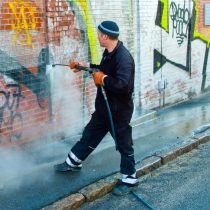
The DOFF system uses low-pressure superheated water (up to 150°C) to clean surfaces without mechanical abrasion. It is widely used on heritage buildings, stone, and brick because it minimises the risk of surface damage.
Chemical Cleaning
Solvent-based gels or poultices are applied to the graffiti, left to dwell, and then removed. This method works well on painted surfaces and smoother substrates. The chemicals used should be referenced in the quote’s safety documentation.
TORC System
The TORC system uses a gentle vortex of fine aggregate, low air pressure, and water to remove graffiti from delicate surfaces like limestone and sandstone. It is a go-to method for listed buildings and conservation areas.
Acid-Etch Glass Restoration
Acid-etched graffiti on glass cannot be cleaned in the conventional sense. It requires mechanical resurfacing and polishing to restore optical clarity. This is a fundamentally different process from paint removal, and the quotation should reflect that, both in method and price. If you’re facing etched glass, it’s worth understanding whether to restore or replace the pane.
Discussions on Reddit’s r/WindowCleaning and r/maintenance forums confirm that acid-etched glass often cannot be treated like painted graffiti, and DIY attempts are strongly discouraged by practitioners.
Test Patch / Trial Clean
For heritage surfaces or unusual substrates, a technician may perform a small test clean in an inconspicuous area before committing to a full method. This confirms that the approach won’t cause damage. If your property involves listed stone or aged brick, the quotation should mention this step.
Documentation Terms You Should Recognise
Beyond costs and methods, a professional quotation references safety and compliance documentation. These terms are not bureaucratic filler. They protect you legally and ensure the work is properly insured.
RAMS (Risk Assessment and Method Statement)
A reputable graffiti cleaning service should provide a clear RAMS before any work begins. This document identifies hazards linked to graffiti removal (chemical exposure, working at height, public safety) and outlines how the contractor will manage them.
Historic England specifically advises that contractors should confirm compliance with statutory requirements and provide a risk assessment and method statement for the proposed cleaning work. For listed building graffiti removal, this documentation is not optional.
COSHH Assessment
COSHH (Control of Substances Hazardous to Health) regulations govern the use of chemical solvents. Facilities managers are responsible for ensuring that contractors follow COSHH requirements, particularly when chemicals are used in public or high-traffic environments. A quotation that references COSHH compliance signals a contractor who takes safety seriously.
Before-and-After Photography
Professional providers photograph the graffiti before and after removal. This documentation serves two purposes: it proves the quality of the work, and it provides evidence for insurance claims. If your quotation doesn’t mention before-and-after photos, ask for them.
Post-Clean Report / Certificate of Completion
Some contractors provide a formal completion report detailing the methods used, products applied, and the final condition of the surface. This is particularly valuable for facilities managers who need to document maintenance activity or justify expenditure to building owners.
Heritage and Listed Building Quotations: Extra Requirements
Quotations for graffiti removal on heritage properties differ significantly from standard jobs. Expect to see:
- Listed building consent confirmation (if required for the cleaning method)
- Conservation officer liaison if the building falls under local authority oversight
- A test patch as a mandatory step, not an optional one
- DOFF or TORC method specification rather than aggressive blasting
- Extended timelines, since heritage-safe methods are inherently slower
Practitioners report that heritage jobs take roughly five times longer than standard graffiti removal. A quotation for a listed building that looks the same price as a standard brick clean should raise questions about whether the contractor understands the requirements.
Red Flags in a Graffiti Removal Quotation
Not all quotations are equal. Watch for these warning signs:
- No site visit offered. For anything beyond a small, simple tag, a photo-only quote carries real risk of inaccuracy.
- No method specified. A quote that says “graffiti removal” without naming the technique gives you no way to assess whether the approach is safe for your surface.
- No mention of surface type. The surface is the single biggest variable in method selection. If it’s not mentioned, the quote is generic.
- No RAMS or safety documentation. This should concern you both legally and practically.
- Price dramatically below market range. UK averages sit between £10 and £60 per square metre at minimum. A quote that undercuts this substantially may reflect an aggressive method that risks ghosting or discolouration.
- No discussion of ghosting risk. On porous surfaces like brick and stone, some shadowing may remain even after professional removal. A good contractor sets this expectation upfront.
- No timeline. You should know when the work will start and how long it will take.
- No mention of prevention. A professional company should at least raise the possibility of anti-graffiti coatings, especially if your property has been hit before. Read more about evidence-based prevention strategies for repeat-target properties.
The Insurance Angle Most Quotations Miss
Many commercial property insurance policies cover vandalism, including graffiti removal. However, for smaller jobs, the policy excess often exceeds the removal cost, meaning owners end up paying out of pocket regardless. Before filing a claim, compare the quotation amount against your deductible.
A well-documented quotation, complete with photographs, a method statement, and a completion report, gives your insurer everything they need if the claim does make financial sense. This is one more reason to choose a provider who includes documentation as standard rather than as an afterthought.
Quick-Reference Checklist: 10 Things Your Quotation Should Include
Use this checklist when reviewing any graffiti removal quotation:
- Surface type identified (brick, glass, stone, metal, render, etc.)
- Graffiti type noted (spray paint, marker, acid-etch, scratch)
- Removal method specified (DOFF, TORC, chemical, mechanical polishing)
- Rate per square metre or fixed price clearly stated
- Access equipment itemised separately, if needed
- RAMS and COSHH documentation referenced or attached
- Timeline for completion provided
- Anti-graffiti coating offered as an option
- Before-and-after photography included as standard
- VAT status confirmed (inclusive or exclusive)
If a quotation covers all ten points, you’re dealing with a thorough professional. If several are missing, request clarification before committing.
Frequently Asked Questions
Does “free quotation” really mean free with no obligation?
Yes. A free graffiti removal quotation means you receive a written estimate at no cost and with no obligation to proceed. The company absorbs the cost of the assessment. If a company tries to charge you for a standard quotation, treat it as a red flag.
What is the difference between a photo quote and an on-site survey?
A photo quote is a remote estimate based on images you send. It’s faster but less precise. An on-site survey involves a technician visiting your property to inspect the surface, graffiti type, access requirements, and any hazards. On-site surveys produce more accurate quotations and are essential for complex jobs like acid-etched glass or heritage surfaces.
How much does graffiti removal typically cost in the UK?
Costs range from £10 to £60 per square metre for straightforward jobs, with method-specific pricing reaching £42 to £135 per square metre. Most UK jobs fall between £80 and £1,000 depending on size, surface, and complexity. Labour accounts for roughly 60% of the total cost, with materials at around 20%.
Should an anti-graffiti coating be included in the quotation?
It should appear as an optional line item, not necessarily as a default inclusion. Coatings range from £15 to £180 per square metre depending on the type. For properties in high-vandalism areas, where annual graffiti costs can exceed £2,000 to £5,000, a coating often pays for itself quickly.
What is a RAMS document and why does it matter?
RAMS stands for Risk Assessment and Method Statement. It identifies hazards associated with the work (chemical exposure, working at height, public safety) and outlines the contractor’s plan for managing them. RAMS documentation protects you legally and confirms the contractor is operating professionally. Historic England recommends requiring RAMS for any cleaning work on heritage surfaces.
Can I use the quotation for an insurance claim?
Yes. A detailed quotation, combined with before-and-after photographs and a post-clean report, provides the evidence insurers need to process a vandalism claim. However, for smaller graffiti jobs, your policy excess may exceed the removal cost, making the claim uneconomical.
How quickly should I expect to receive a quotation?
Many companies provide same-day quotes for straightforward jobs, especially when photos are supplied. On-site surveys may take a day or two to schedule. Emergency or rapid-response providers can often assess and quote within hours.
What happens if the graffiti can’t be fully removed?
On porous surfaces like brick or natural stone, some ghosting (a faint shadow of the original graffiti) may persist even after professional treatment. A good contractor will flag this possibility in the quotation rather than guaranteeing a result they can’t deliver. Aged graffiti that has penetrated deeply into the substrate is more likely to ghost than fresh tags removed promptly.
Toby Doherty
Toby Doherty is a seasoned graffiti removal expert with over 20 years of experience in the industry. Throughout his career, Toby has helped countless businesses and property owners in London maintain clean, graffiti-free spaces. His extensive knowledge of graffiti removal techniques, from eco-friendly solutions to advanced technologies like laser cleaning, makes him a trusted authority in the field. Passionate about restoring urban environments, Toby combines his hands-on expertise with a commitment to staying up-to-date on the latest industry trends and innovations. When he’s not out in the field, Toby shares his insights through detailed articles, offering practical advice on everything from graffiti prevention to legal considerations.
Related Posts
Should I Replace or Restore Etched Graffiti Glass? 2026
Should I Replace Glass or Try Restoration for Etched Graffiti? See 60–80%…

How to Remove Stone Graffiti: No Ghosting or Discoloration
Learn how to remove graffiti from stone without ghosting or discoloration using…

Choosing Maintenance Contracts for Commercial Properties
Choosing maintenance contracts for commercial properties? Compare types, costs,…