


TLDR
Getting graffiti off concrete requires softening the paint with a concrete-safe remover before rinsing it away with controlled pressure. Blasting with a pressure washer alone is the most common mistake, often causing surface damage or leaving a faint shadow called ghosting. The correct sequence is: test a small patch, apply a gel or paste remover, let it dwell long enough to break the paint bond, scrub with a nylon brush, and rinse with hot water at moderate pressure. For old, deep, or large-scale graffiti on porous concrete, professional removal is usually the safer choice.
Table of Contents
- TLDR
- What Graffiti Removal From Concrete Actually Means
- Before You Start: Identify the Concrete and the Graffiti
- Tools and Materials You May Need
- For a small DIY job
- For a professional or commercial job
- Step by Step: How to Remove Graffiti From Concrete
- 1. Photograph the graffiti and protect the surrounding area
- 2. Test a hidden patch
- 3. Try detergent and water for light or fresh marks
- 4. Apply a concrete-safe graffiti remover
- 5. Let it dwell (and do not let it dry)
- 6. Agitate gently, then rinse with controlled pressure
- 7. Neutralise if the product requires it
- 8. Repeat or escalate for stubborn marks
- Can You Remove Graffiti From Concrete With Just a Pressure Washer?
- What if the Graffiti Leaves a Shadow?
- What You Should Avoid on Concrete
- Should You Paint Over Graffiti on Concrete?
- DIY vs Professional: When Should You Call Someone?
- How to Prevent Graffiti From Sticking to Concrete Again
- A Note for London Property Owners
- Frequently Asked Questions
To get graffiti off concrete, soften the paint first and rinse it away with controlled pressure. Use a concrete-safe graffiti remover (gel or paste types work best on porous or vertical surfaces), let it dwell until the paint loosens, scrub gently with a non-metal brush, and wash off with hot water where possible. Do not start by blasting at maximum pressure. Concrete is porous, and aggressive washing can scar the surface, push pigment deeper into the pores, or leave a bright clean rectangle that looks almost as bad as the tag itself.
The reason so many DIY attempts fail is simple: people treat concrete like glass or metal. It is not. Concrete absorbs paint. The Concrete Society notes that paints and markers vary in binders, pigments, and dyes, with some sitting on the surface while others absorb into porous material, making removal difficult without damaging the concrete. That absorption is the central problem, and every step below addresses it.
What Graffiti Removal From Concrete Actually Means
Graffiti removal from concrete is the controlled process of breaking the bond between paint (or marker, dye, or ink) and a porous mineral surface, then extracting the loosened pigment without damaging the substrate. It is not one technique. It is a sequence of decisions based on the concrete type, the graffiti medium, how long the paint has been there, and what “acceptable” looks like after cleaning.
A few terms worth knowing before going further:
- Dwell time is how long the remover stays wet on the graffiti. More dwell usually means less pressure needed.
- Ghosting (or shadowing) is the faint outline left behind when pigment has soaked into pores and resists chemical cleaning. The National Park Service confirms that ghosting is common on porous materials after graffiti removal.
- Substrate means the base material you are cleaning, in this case concrete.
- Poultice is an absorbent paste applied over the graffiti to hold cleaning chemistry in contact with the surface for an extended period, drawing pigment out of pores.
- Sacrificial coating is a protective layer that comes off with the graffiti during cleaning and must be reapplied afterwards.
- Permanent coating is designed to survive repeated graffiti cleanings without being stripped away.
Understanding these concepts saves time and prevents the kind of trial-and-error that damages concrete.
Before You Start: Identify the Concrete and the Graffiti
Not all concrete responds the same way. A polished garage floor and a rough blockwork boundary wall are both “concrete,” but they need completely different approaches. The GSA’s historic preservation procedure recommends identifying material types, surface conditions, previous treatments, and the graffiti medium before choosing any cleaning method.
Run through this checklist:
About the concrete:
- Is it sealed, painted, bare, decorative, stamped, polished, exposed aggregate, rough cast, blockwork, or historic?
- Has it been previously cleaned or coated?
About the graffiti:
- Is it fresh (hours old) or fully cured (days, weeks, months)?
- Is it spray paint, permanent marker, paint pen, brush paint, chalk, wax crayon, or acid/scratched damage?
About the setting:
- Is the surface private, commercial, heritage-listed, or on a public footpath?
- Are there nearby drains, plants, glass, metal trim, or painted surfaces that need protection?
- Is the graffiti offensive content that needs removing urgently?
If the concrete wall is also partially painted, the removal process changes significantly because you are trying to strip the graffiti without stripping the existing finish underneath. That situation is covered in more detail in this guide to removing graffiti from painted surfaces.
Tools and Materials You May Need
For a small DIY job
- Chemical-resistant gloves, safety goggles, and old clothing
- Concrete-safe graffiti remover (gel or paste preferred for vertical or porous surfaces)
- Stiff nylon or natural-bristle brush
- Bucket, clean water, and mild detergent
- Plastic sheeting or cling film (to extend dwell time in drying conditions)
- Garden sprayer or brush applicator
- Pressure washer with a fan tip (25 or 40 degree), if available
- Absorbent pads or drain covers to catch runoff
- pH strips if using an alkaline product that requires neutralisation
For product recommendations, see this roundup of the best products for DIY graffiti removal.
For a professional or commercial job
- Hot-water pressure washer with adjustable pressure and flow
- Gel, paste, or poultice removers matched to the graffiti type
- Containment and wastewater capture equipment
- Access equipment (scaffolding, cherry pickers) if working at height
- Risk assessments, COSHH documentation, and safety data sheets
- Before-and-after photography
- Anti-graffiti coating for post-clean protection
The HSE warns that solvents found in paint strippers and cleaning products can harm people through vapour inhalation, skin contact, and eye exposure, and that COSHH protections apply. Always read the safety data sheet for your chosen remover. For a fuller safety overview, refer to these safety tips for DIY graffiti clean-up.
Step by Step: How to Remove Graffiti From Concrete
This is the core method for getting graffiti off of concrete safely. Think of it as four levers working together: chemistry, dwell time, heat, and mechanical energy. The goal is to use enough of the first three that you need very little of the fourth.
1. Photograph the graffiti and protect the surrounding area
Before touching anything, take clear photos. The NPS advises documenting vandalism before starting removal and keeping photographic records. This matters for insurance claims, police reports, landlord-tenant records, and commercial documentation.
Next, protect what you do not want cleaned or contaminated. Mask off adjacent glass, painted trim, and metal. Cover plants. Block or protect nearby drains, because contaminated washwater containing dissolved paint and chemical remover should not enter surface water drains. UK government guidance states that businesses must ensure contaminated water does not discharge into surface drains, which go directly to the environment.
2. Test a hidden patch
Always test the remover on a small, inconspicuous area before committing to the full surface. The GSA recommends test patches no larger than 6 inches by 6 inches on sensitive surfaces, adjusting dwell time and method based on the result.
What to watch for during the test: colour change in the concrete, etching or pitting, softened sealer, exposed aggregate, and whether the graffiti actually lifts. If the concrete changes colour or texture, stop and reconsider the product, concentration, or approach.
3. Try detergent and water for light or fresh marks
For chalk, some water-based markers, and very fresh paint that has not cured, start with the least aggressive option. The Concrete Society says that because paints and markers are increasingly solvent-free, the first attempt can be water and liquid detergent with brushing. If this works, you have avoided chemicals entirely. If it does not, move on.
4. Apply a concrete-safe graffiti remover
For spray paint, permanent marker, and cured paint, you need a proper graffiti remover. Gel or paste formulations are strongly preferred on concrete. The Concrete Society recommends water-based gel or paste paint removers because they hold the active agent in contact with the graffiti for longer and resist absorption into the wall.
Apply a thick, even layer over the graffiti using a brush. On vertical concrete walls or rough blockwork, gel formulations cling where liquids would run off. For heritage or sensitive concrete, the GSA also warns against aerosol removers that can redistribute pigments to clean areas.
5. Let it dwell (and do not let it dry)
This is where most DIY jobs go wrong. Dwell time is the single biggest factor separating a clean removal from a frustrating half-result that leads to blasting with pressure.
PROSOCO, a masonry cleaning manufacturer, notes that some graffiti chemistries may need 30 minutes or more of dwell time, sometimes hours, with colder conditions requiring even longer. The Concrete Society adds that plastic sheeting can be placed over the treated area to extend action time, preventing the remover from drying out in sun or wind.
Practitioners on Reddit’s pressure washing community consistently flag insufficient dwell time as the top beginner mistake. One contractor explained that solvent blends can soften paint quickly, but if the solvent evaporates before rinsing, the softened paint re-adheres and becomes harder to remove on the second attempt. The message is clear: follow the product label, keep the remover wet, and be patient.
6. Agitate gently, then rinse with controlled pressure
Once the paint has visibly softened, scrub with a stiff nylon or natural-bristle brush. Avoid wire brushes on visible, decorative, historic, or light-coloured concrete. The GSA specifies natural bristle brushes and prohibits metal brushes for historic masonry work because they can scratch, leave metal residues, and change the surface texture.
Then rinse. Use a fan tip (25 or 40 degrees, never a zero-degree pencil jet), hold the wand at least 12 inches from the surface, and start at low pressure. Increase gradually only if the test showed no damage at that level.
Hot water makes a significant difference here. The Concrete Society confirms hot water is more effective than cold when washing off paint remover. Practitioners on Reddit report that hot water softens graffiti enough to allow lower pressure settings, which reduces surface damage and leaves less shadowing. Hot water is not a reason to blast harder. It is a reason to blast less.
For pressure ranges: the NPS recommends 100 to 400 psi for sensitive masonry, while trade publications like Cleaner Times describe professional contractors using 1,500 to 3,000 psi hot-water systems on hard commercial concrete. There is no universal number. Start low, test, and increase only as needed.
7. Neutralise if the product requires it
Some alkaline or caustic strippers require a neutralising rinse. The Concrete Society says a neutralising agent can be applied and rinsed until a neutral pH test is achieved. Check the product label and safety data sheet. If neutralisation is required, do it before the surface dries. The GSA recommends checking pH with litmus paper or phenolphthalein after the neutralising rinse.
8. Repeat or escalate for stubborn marks
If some graffiti remains, repeat the chemical step. Do not jump to higher pressure. Apply another round of remover, dwell, and rinse. For deep pigment in very porous concrete, a poultice (absorbent paste held against the surface for hours or overnight) can draw residual colour from the pores.
If you still see a faint shadow, you are likely dealing with ghosting, which is its own problem.
Can You Remove Graffiti From Concrete With Just a Pressure Washer?
Sometimes, yes. If the graffiti is very fresh, thin, and sitting on dense or sealed concrete, pressure washing alone might strip it. But on porous, rough, or unsealed concrete, pressure alone usually leaves a ghost, damages the surface, or both.
PROSOCO’s president frames the risk directly: high pressure can remove the concrete face rather than just the graffiti. The NPS warns that many hardware-store pressure washers operate at 1,600 to 3,200 psi, which is potentially damaging to concrete surfaces, especially weathered or decorative ones.
The pattern from practitioners is consistent. In Reddit threads on graffiti removal, contractors describe the same failure mode over and over: someone rents a pressure washer, blasts the wall, strips some paint but also some concrete, and ends up with a shadow they cannot remove and a roughened patch that will absorb future graffiti even faster.
Pressure washing is a valid rinse step after chemistry has done the heavy lifting. It is a poor primary method for graffiti removal from concrete. For a deeper comparison, see high-pressure washing for graffiti removal.
What if the Graffiti Leaves a Shadow?
Ghosting is the most common complaint after cleaning graffiti off concrete. The tag is gone, but a faint outline remains, visible in certain light. This happens because spray paint pigment penetrates the concrete pores deeper than any surface scrub can reach.
VicRoads’ technical guidance on anti-graffiti protection explains that permeable or porous surfaces can absorb inks and dyes deeply, leaving shadowing or ghosting if the surface was unprotected.
Here is how to handle it:
- Repeat the chemical process. A second or third pass with remover and proper dwell time often pulls more pigment.
- Try a poultice. An absorbent paste left on overnight can draw deep pigment from pores.
- Clean a wider area. A common Reddit complaint is that the cleaned spot looks cleaner than the surrounding dirty concrete. Feathering the edges or cleaning the whole panel reduces the “bright rectangle” effect.
- Consider specialist low-pressure abrasion. The Concrete Society says residual ghosting may be removed by air abrasion, but only where the resulting finish is acceptable. This changes the surface texture, so it is a finish-altering decision, not a routine step.
- Accept the limit or coat the surface. For severe pigment penetration on very porous concrete, complete invisible restoration may not be possible without resurfacing or applying a coating.
Set your expectations before starting. On unsealed concrete, “removal” often means reducing the graffiti to the point where it is no longer legible or noticeable from normal viewing distance, not erasing it to factory condition.
What You Should Avoid on Concrete
A clear list of things that cause damage or make things worse:
- Do not start with a zero-degree nozzle. It concentrates all pressure into a tiny point and will etch concrete.
- Do not use maximum pressure without a chemical dwell step first. Chemistry should do the dissolving; pressure should do the rinsing.
- Do not use acid-based cleaners unless specified by a specialist. VicRoads states that inorganic solvents such as acids are not preferred because they attack concrete.
- Do not let chemical remover dry on the surface. It can lock pigment back in or stain the concrete.
- Do not let contaminated washwater enter surface drains. This is a legal issue for commercial properties, not just an environmental nicety.
- Do not use metal brushes or grinders on decorative or historic concrete. They leave scratches, expose aggregate, and change the appearance permanently.
- Do not assume painting over graffiti will fix everything. On bare concrete, paint-over often creates a visible patch, and staining can bleed through.
- Do not mix different chemicals. Follow the safety data sheet for each product.
Should You Paint Over Graffiti on Concrete?
Only if the concrete is already painted or if a matching coating is part of a planned maintenance finish. On bare concrete, painting over a tag creates a patch that often looks worse than a faded ghost. VicRoads warns that painting out graffiti can be more expensive long term, provides no effective deterrent, and can harm aesthetics through colour mismatch. Staining may also bleed through the new paint layer, requiring full removal anyway.
If the concrete is already painted and you plan to repaint, prime over the graffiti with a stain-blocking primer before topcoating. But understand this is maintenance, not removal.
DIY vs Professional: When Should You Call Someone?
Small, fresh tags on dense or sealed concrete are reasonable DIY jobs. Most other situations benefit from professional assessment or handling.
| Situation | DIY feasible? | Professional recommended? |
|---|---|---|
| Small fresh tag on dense or sealed concrete | Yes | Optional |
| Old spray paint on bare porous concrete | Maybe | Yes |
| Large commercial frontage or car park | No | Yes |
| Offensive or obscene content needing fast removal | No (if speed matters) | Yes |
| Decorative, stamped, or coloured concrete | Risky | Yes |
| Historic, listed, or conservation-area concrete | No | Yes |
| Graffiti near drains or public footpaths | Risky | Yes |
| At height or near live traffic | No | Yes |
| Repeated tagging at a hotspot | Temporary fix only | Yes, with a coating plan |
Historic England warns that inappropriate cleaning of historic buildings can cause significant damage and visual disfigurement. For graffiti on listed or conservation-area concrete and masonry in London, read more about graffiti on historic buildings in London.
For a fuller breakdown of the DIY vs professional question, including cost and risk factors, see graffiti removal: DIY vs hiring professionals.
How to Prevent Graffiti From Sticking to Concrete Again
Once concrete has been cleaned, it makes sense to protect it, especially if the location is a repeat target. VicRoads explains that anti-graffiti coatings prevent deep penetration into pores and prevent firm attachment to the surface, and their predominant use is on concrete and masonry precisely because these materials are porous.
Two main coating types:
Permanent (long-life) coatings withstand repeated cleaning and typically last around 10 years. They are best for high-risk, hard-to-access, or disruption-sensitive locations. They cost more upfront and may slightly alter the concrete’s appearance.
Sacrificial coatings are cheaper and removed along with the graffiti during cleaning, then reapplied. Better formulations can last up to 5 years if not attacked. They are more breathable and usually lower sheen, but they do need recoating after every removal event.
For heritage concrete and masonry, Historic England says sacrificial aqueous wax coatings are generally more appropriate for historic structures, though even these can darken masonry temporarily.
Beyond coatings, speed matters for prevention. PROSOCO notes that rapid removal makes repeat tagging less likely because the vandal’s work does not stay visible. VicRoads provides a useful benchmark: sensitive graffiti within 24 hours, normal graffiti within 48 hours. Lighting, cameras, and visibility improvements also help at chronic hotspots.
For a detailed look at how coatings work and which type suits different situations, see anti-graffiti coatings: what they are and how they work.
A Note for London Property Owners
GOV.UK says local councils are usually responsible for removing graffiti from public buildings, monuments, benches, and bins. But private and commercial concrete surfaces, shopfronts, car parks, boundary walls, and residential driveways, are generally the property owner’s responsibility. Council response times and policies vary by borough, and many London boroughs do not clean private property at all.
If your concrete graffiti is old, offensive, on porous or decorative concrete, near a public entrance, or likely to leave ghosting, professional cleaning is usually safer than trying to force it off yourself. DUA London Graffiti Removal is a London-based specialist covering Greater London, with same-day rapid response targeting arrival within 3 hours. They handle concrete graffiti removal alongside other surfaces, offer heritage-safe methods including DOFF and TORC systems, and can apply anti-graffiti coatings for repeat-hit locations. If you need help, find out when to call a professional for graffiti removal.
Frequently Asked Questions
Can vinegar remove graffiti from concrete?
Not reliably. Vinegar is a weak acid, and it is not formulated to dissolve cured spray paint or marker. Worse, acids can damage cementitious materials. VicRoads notes that inorganic solvents such as acids are not preferred because they attack concrete. Use a concrete-safe graffiti remover and test it first.
Will bleach remove spray paint from concrete?
Bleach is not designed to dissolve paint. It is an oxidiser that can lighten organic staining, but it will not break the binder that holds spray paint to concrete. A purpose-made graffiti remover is the right tool.
Is acetone safe for removing graffiti from concrete?
Acetone can dissolve some fresh paint, but it evaporates quickly (often before the paint fully softens), it is flammable, it can spread pigment deeper into pores, and it may damage existing sealers or coatings on the concrete. The NPS notes that acetone may sometimes work on fresh permanent marker, but only in the context of careful testing on small areas.
Does pressure washing damage concrete?
It can. The risk increases with narrow nozzle tips, high pressure, close standoff distance, soft or weathered concrete, decorative finishes, and repeated passes over the same spot. The NPS warns that many consumer pressure washers operate at 1,600 to 3,200 psi, which is enough to etch or pit concrete, especially older or porous surfaces.
Why is there still a shadow after graffiti removal?
The paint pigment has penetrated below the surface into the concrete pores. This is called ghosting. The Concrete Society confirms that residual ghosting may remain after removal and may need air abrasion if the resulting finish is acceptable. Before resorting to abrasion, try a second chemical pass with longer dwell time or a poultice application.
Should I paint over concrete graffiti?
Only if the concrete is already painted or you are applying a planned maintenance finish. On bare concrete, paint-over creates a mismatched patch, may bleed through, and does not protect the substrate from future tagging. Proper removal followed by an anti-graffiti coating is a better long-term strategy.
How quickly should concrete graffiti be removed?
As soon as practical. Fresh graffiti is chemically easier to remove because the paint has not fully cured and bonded to the substrate. Speed also deters repeat tagging. VicRoads recommends removing sensitive graffiti within 24 hours and normal graffiti within 48 hours. Waiting days or weeks allows paint to cure, weather to drive pigment deeper, and vandals to see their work standing, which invites more. For more on why timing matters, read about the risks of not removing graffiti immediately.
What is the difference between sealed and unsealed concrete for graffiti removal?
Sealed concrete has a protective coating (epoxy, acrylic, polyurethane, or penetrating sealer) that reduces pore absorption. Graffiti sits more on the surface, making removal easier and ghosting less likely. Unsealed concrete is open-pored and absorbs paint quickly, which makes removal harder, ghosting more probable, and the need for proper chemistry and dwell time more critical. Most driveways, footpaths, and older walls are unsealed unless they have been specifically treated.
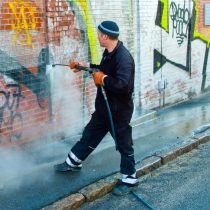
Toby Doherty
Toby Doherty is a seasoned graffiti removal expert with over 20 years of experience in the industry. Throughout his career, Toby has helped countless businesses and property owners in London maintain clean, graffiti-free spaces. His extensive knowledge of graffiti removal techniques, from eco-friendly solutions to advanced technologies like laser cleaning, makes him a trusted authority in the field. Passionate about restoring urban environments, Toby combines his hands-on expertise with a commitment to staying up-to-date on the latest industry trends and innovations. When he’s not out in the field, Toby shares his insights through detailed articles, offering practical advice on everything from graffiti prevention to legal considerations.
Related Posts

Should I Replace or Restore Etched Graffiti Glass? 2026
Should I Replace Glass or Try Restoration for Etched Graffiti? See 60–80%…

How to Remove Stone Graffiti: No Ghosting or Discoloration
Learn how to remove graffiti from stone without ghosting or discoloration using…

Choosing Maintenance Contracts for Commercial Properties
Choosing maintenance contracts for commercial properties? Compare types, costs,…